Ancient Galaxy Crash Solves Cosmic Mystery
Scientists finally figured out why a neighboring galaxy has been spinning strangely for decades. A catastrophic collision with its larger sister galaxy millions of years ago left it reeling in a cosmic twist.
Astronomers just solved a puzzle that's stumped them for decades: why the Small Magellanic Cloud, one of our nearest galactic neighbors, spins slower than it should.
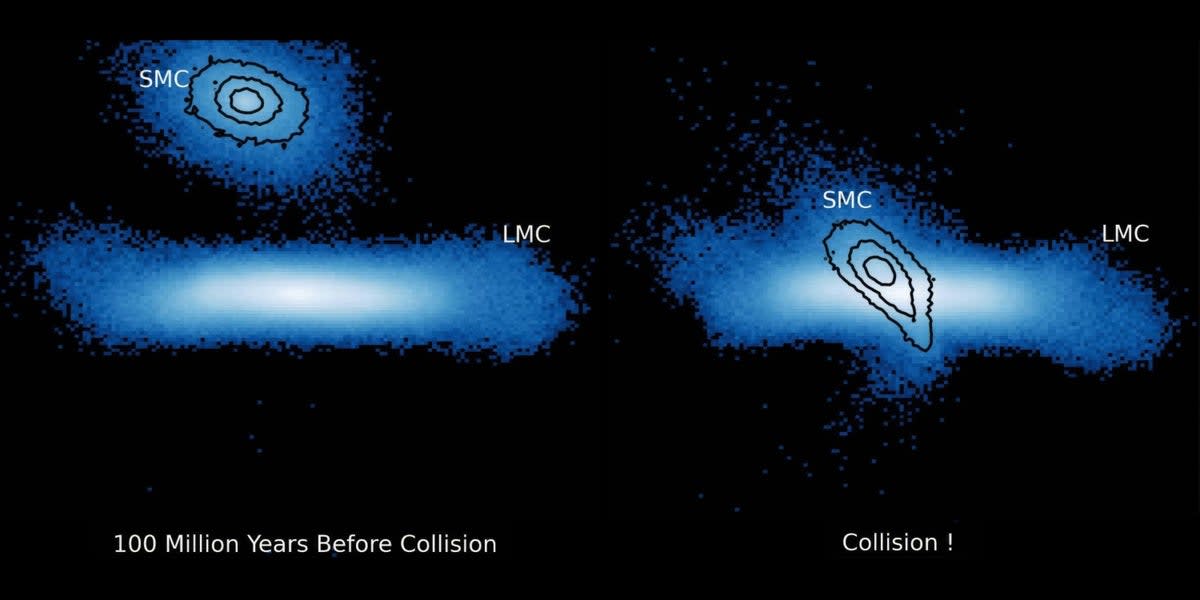
The answer? It's still recovering from a massive crash with its bigger sibling, the Large Magellanic Cloud, that happened hundreds of millions of years ago.
If you live in the Southern Hemisphere, you've probably seen the Small Magellanic Cloud glowing in the night sky. It's that elongated smudge sitting about twenty degrees from its larger companion. Both galaxies are named after explorer Ferdinand Magellan, though it was actually one of his crew who first reported them to Western science.
For years, scientists noticed something odd. The stars in the smaller galaxy weren't swirling around its center nearly as fast as they should be, especially compared to the rotation of its gas clouds. In a typical galaxy, these movements follow a predictable pattern based on size and brightness.
The Small Magellanic Cloud broke all the rules.
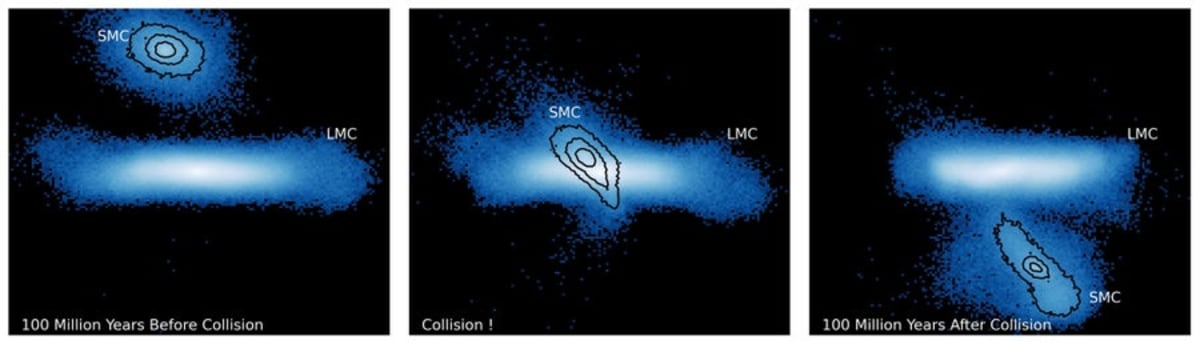
Researchers at the University of Arizona and Steward Observatory decided to test a bold theory. They built a computer simulation recreating a hypothetical collision between the two galaxies, tracking what would happen before, during, and after the crash across hundreds of millions of years.
The results, published Monday in the Astrophysical Journal, were striking. The violent encounter left the smaller galaxy in complete disarray, with its stars and gas rotating far slower than before—exactly what astronomers observe today.
"The SMC went through a catastrophic crash that injected a lot of energy into the system," says Gurtina Besla, an astronomer at Steward Observatory and the study's senior author. "It is not a 'normal' galaxy by any means."
Why This Inspires
This discovery does more than solve a cosmic mystery. The Small Magellanic Cloud serves as a comparison point for understanding galaxies in the early universe because it's poor in heavy metals, similar to younger galaxies. Now that scientists know about its dramatic history, they can revisit those comparisons with fresh eyes and better accuracy.
Michele De Leo, an astronomer at the University of Bologna not involved in the study, calls it "a step in the direction of solving the puzzle of complex interactions between galaxies."
The universe just got a little less mysterious, and our understanding of how galaxies interact and evolve took a giant leap forward.
More Images

Based on reporting by Scientific American
This story was written by BrightWire based on verified news reports.
Spread the positivity!
Share this good news with someone who needs it