Ancient Microbes Show How Complex Life May Have Begun
Scientists captured the first images of two microbes physically connected inside living fossils, offering clues to how simple cells first joined forces billions of years ago. The discovery could help solve one of biology's biggest mysteries: how complex life emerged on Earth.
Deep inside ancient rock formations in Australia, scientists have discovered a microscopic partnership that may reveal how all complex life on Earth began.
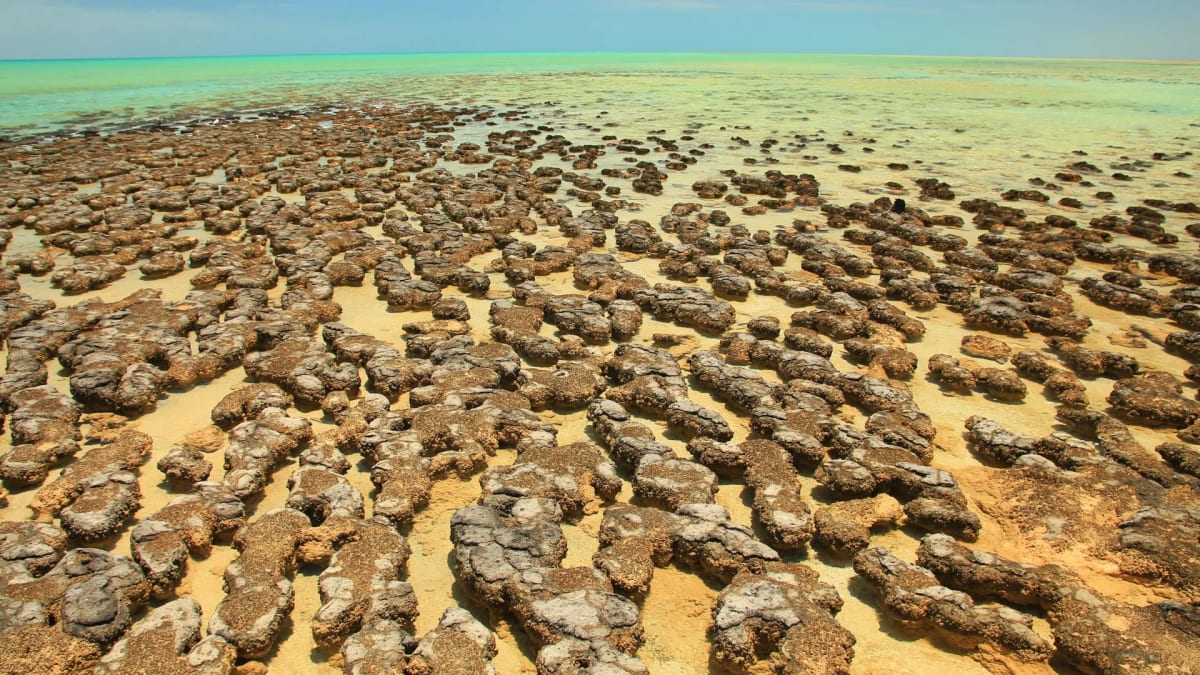
Researchers from three Australian universities found two tiny organisms living together inside stromatolites, layered structures built by microbes over billions of years. These "living fossils" still form today in Shark Bay, Western Australia, creating a rare window into ancient life.
The team captured something scientists have been searching for: direct images of an Asgard archaeon physically connected to a bacterium through ultra-thin tubes. These two microbes appear to exchange nutrients, vitamins, and other compounds, supporting each other's survival in harsh conditions.
Associate Professor Brendan Burns from UNSW Sydney spent four to five years trying to grow these elusive organisms in the lab. The fact that they refused to grow alone may be the key finding itself.
"The fact that we could never get these organisms into pure culture is probably because they always depend on other organisms to survive," Burns explains. This ancient dependency could mirror what happened billions of years ago when simple cells first cooperated to create something entirely new: complex life.
Scientists believe the first complex cell formed when an ancient archaeon and bacterium entered into an intimate partnership. One organism eventually engulfed the other, creating mitochondria, the energy factories inside every plant and animal cell today, including ours.
The team used electron cryotomography, a cutting edge 3D imaging method, to see structures at the scale of a millionth of a millimeter. They also employed deep learning to predict the structures of proteins in these microbes, revealing ancient versions of cellular machinery that later became essential to complex life.
Why This Inspires
This discovery brings us closer to understanding our own origins at the most fundamental level. Every human, every animal, every plant traces back to a moment when two simple organisms decided to cooperate rather than compete.
Associate Professor Iain Duggin from the University of Technology Sydney calls it remarkable that microbes have maintained these partnerships for millions of years in harsh environments. Life inside microbial mats is challenging, but close cooperation provides crucial advantages even at microscopic scales.
The stromatolites themselves played another pivotal role in Earth's history: they helped release some of the earliest oxygen into our atmosphere billions of years ago, making the planet habitable for future life. Now they're teaching us how that future life first became possible.
Burns describes archaea as companions, and that simple word captures something profound about life's journey on this planet.
These ancient partnerships, still thriving in Australian waters today, remind us that cooperation has been life's winning strategy from the very beginning.
Based on reporting by Google News - Scientists Discover
This story was written by BrightWire based on verified news reports.
Spread the positivity!
Share this good news with someone who needs it