Ancient Scrolls Buried 2,000 Years Ago Finally Readable
Scientists just digitally unrolled complete scrolls from Pompeii's sister city, revealing lost works by ancient philosophers for the first time in nearly 2,000 years. The breakthrough uses AI and particle accelerators to read books too fragile to open.
Imagine finding a book buried for 2,000 years but not being able to open it without turning it to dust. That problem just got solved.
University of Kentucky professor Brent Seales and a global team of volunteers announced Thursday they've fully digitally unrolled ancient Roman scrolls destroyed when Mount Vesuvius erupted in 79 AD. For the first time since the disaster that buried Herculaneum and Pompeii, scholars can read these fragile texts from end to end.
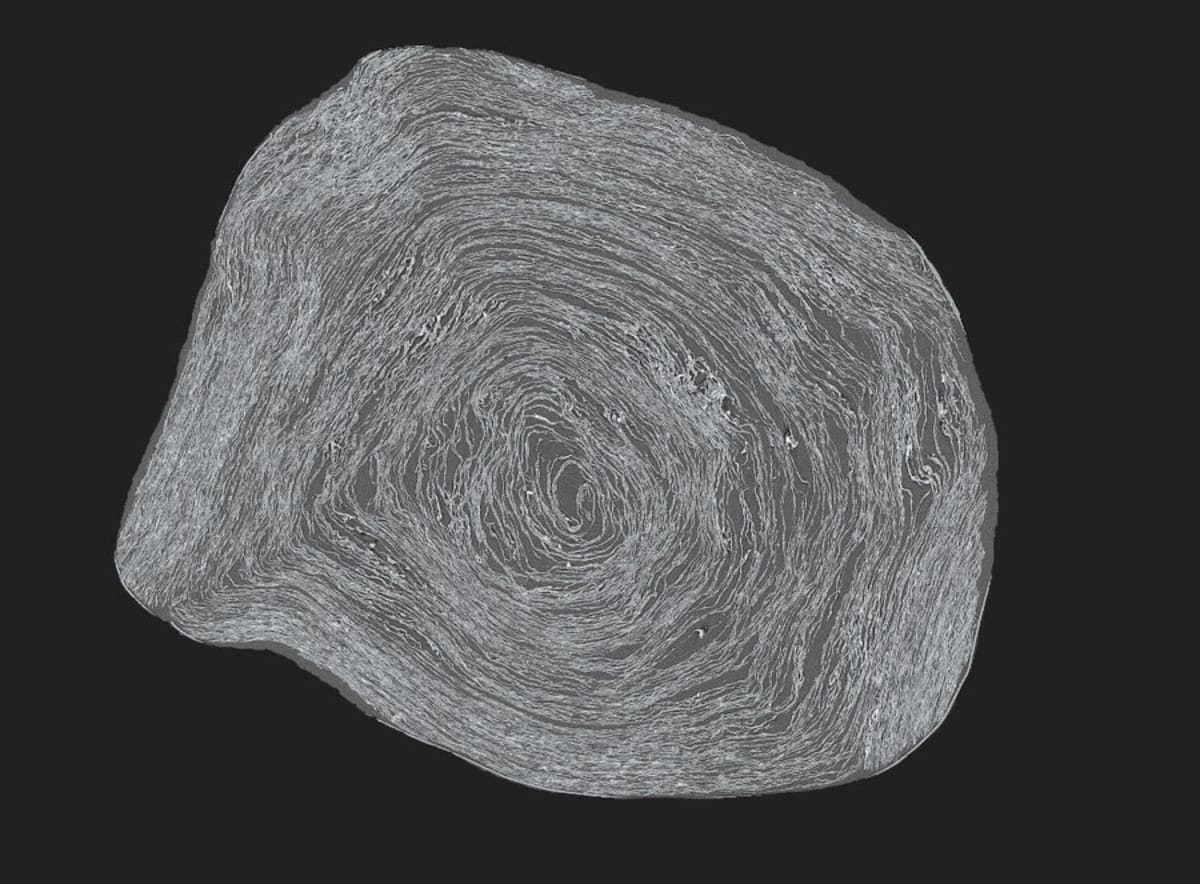
The scrolls look like charred pieces of delicate wood. They're so fragile that physically opening them would destroy the writing inside forever. But Seales spent 20 years developing technology that can see inside without touching them.
His technique uses massive particle accelerators called synchrotron scanners that beam high-power x-rays at the scrolls. These scans reveal the inner layers down to the atomic level. Then software called Volume Cartographer takes those 3D scans layer by layer and flattens them into readable 2D images.
The real game changer came when Silicon Valley investors Nat Friedman and Daniel Gross launched the Vesuvius Challenge two years ago. They used artificial intelligence to speed up the painstaking work that Seales had been doing manually. AI helped identify where ink appeared in the scans much faster than humans could do by hand.
One fully unrolled scroll called PHerc 1667 contains nearly 20 columns of continuous text. Even more exciting, it's a previously unknown work by Philodemus, a leading ancient philosopher. The text is called "On the Gods, Booke Eight," and scholars had no idea Philodemus had even written about gods at all, let alone eight volumes worth.
About 400 of these papyrus scrolls survived inside a villa called the Villa of the Papyrus. The same volcanic ash that killed at least 1,500 people also preserved these documents in a kind of time capsule.
The Ripple Effect
Seales and his team have now scanned 45 scrolls total. Scholars are already finding hints of other lost authors in the collection, including leaders of the Stoic philosophy school. It's like discovering the card catalog of an ancient library that the world forgot existed.
Papyrologist Federica Nicolardi said the passages they've uncovered discuss the nature of deities and providence, giving us direct access to how ancient Romans thought about fundamental questions. These aren't just dusty academic texts. They're actual voices from 2,000 years ago sharing their ideas about life's biggest mysteries.
For Seales, this feels like the moment where his decades of work pays off and others can take the lead. The technology is ready. The scrolls are scanned. Now historians and philosophers get to reconstruct an entire lost library, one digital page at a time.
Two thousand years of silence, finally broken by the same kind of innovation that would have amazed those ancient writers.
More Images
Based on reporting by Scientific American
This story was written by BrightWire based on verified news reports.
Spread the positivity!
Share this good news with someone who needs it