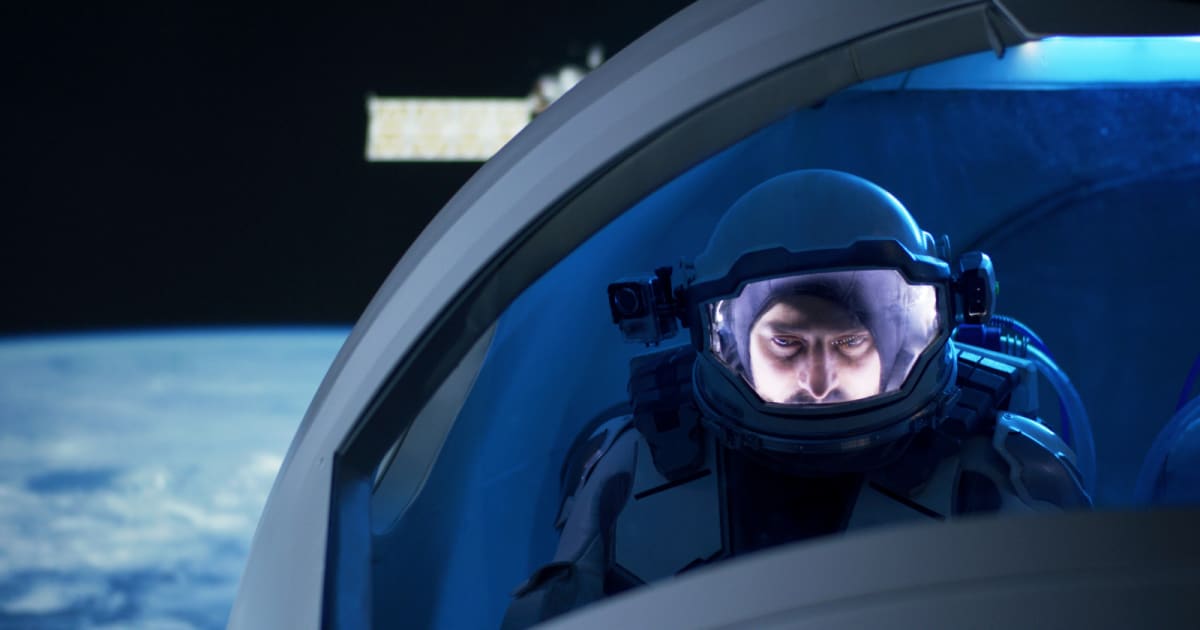
Apollo Astronauts Saw Cosmic Rays Flashing Through Their Eyes
Astronauts traveling to the Moon kept seeing mysterious flashes of light in the dark, until scientists discovered they were actually seeing cosmic radiation passing through their heads. The phenomenon revealed what deep space radiation looks like from the inside of a human skull.
Imagine trying to sleep in complete darkness and seeing fireworks that aren't really there. That's exactly what happened to every Apollo crew on their way to the Moon.
Starting with Apollo 11, astronauts reported seeing pinpoints, streaks, and small clouds of light when the cabin went dark. The flashes came about once or twice per minute, enough to keep them awake. These weren't hallucinations or equipment problems.
They were seeing cosmic rays from deep space passing straight through their eyeballs.
The discovery had actually been predicted. Back in 1952, scientist Cornelius Tobias suggested that space travelers might see exactly this kind of thing when exposed to cosmic radiation. Two decades later, his prediction came true 240,000 miles from Earth.
To prove what was happening, Apollo 16 and 17 crews wore a special detector that could track charged particles while astronauts reported flashes. The device matched the timing and location perfectly. When a heavy cosmic ray nucleus passed through an eye, the astronaut saw a flash.
Ground experiments confirmed it. When volunteers had particle beams aimed at their dark-adapted eyes, they saw the same thing Apollo crews described.
The mechanics are still being worked out. Scientists think the particles either stimulate light-sensing cells directly as they ionize tissue, or possibly generate a faint glow inside the eye itself. Some flashes might even come from particles hitting the visual centers of the brain, bypassing the eyes entirely.
The phenomenon isn't unique to Apollo. Astronauts on Skylab, Mir, and the International Space Station have all reported the same flashes, though less frequently because Earth's magnetic field still offers some protection in low orbit.
Why This Inspires
What makes this discovery remarkable is what it reveals about human exploration. These astronauts weren't just traveling to the Moon. They were the first humans to leave Earth's protective magnetic shield and experience the radiation environment of deep space directly.
The flashes were essentially cosmic rays making themselves visible inside a human head, a perceptible reminder of conditions we never encounter on Earth's surface. Our atmosphere and magnetic field shield us completely from this constant shower of high-energy particles from distant stars and galaxies.
Understanding this effect matters for future missions. As we plan longer journeys to Mars and beyond, these flashes serve as a natural dosimeter, a visible sign of radiation exposure that future astronauts will need to manage and understand.
The astronauts who first reported these mysterious lights helped scientists map the invisible dangers of deep space, one flash at a time. Their observations turned a strange sleep disturbance into valuable data about what it really means to leave Earth behind.
More Images




Based on reporting by Google News - Science
This story was written by BrightWire based on verified news reports.
Spread the positivity!
Share this good news with someone who needs it