Arctic Ice Edge Creates Clouds That Could Reshape Climate
Scientists discovered a natural process near melting Arctic sea ice that multiplies cloud-forming particles by 50 times in a single day. The finding could help us better understand how the rapidly warming Arctic affects global climate.
Scientists just found a powerful cloud-making machine hidden in one of Earth's most remote regions, and it could change how we understand Arctic climate change.
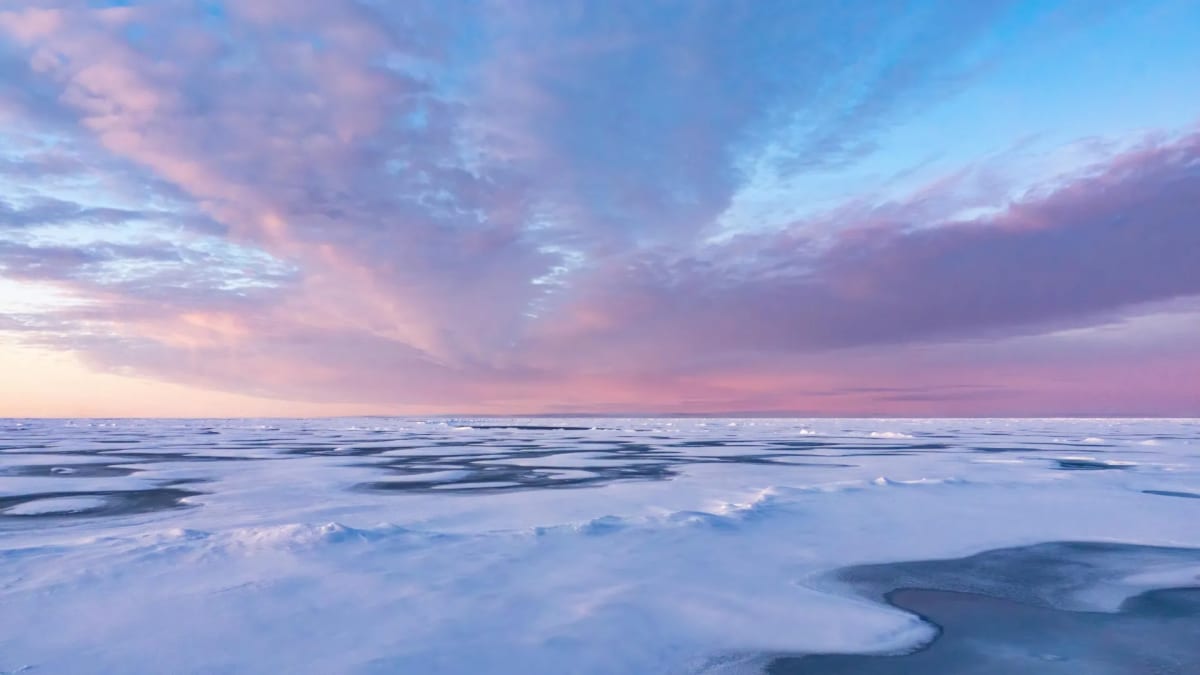
Researchers from the University of Birmingham discovered that where Arctic sea ice meets open ocean, nature creates a surge of cloud-forming particles. On more than 80% of sunny days during their 2022 expedition around Greenland, they watched particle counts jump from about 50 to 1,500 per cubic centimeter in just 24 hours.
The secret ingredient? A chemical cocktail of iodine from the ocean and sea ice, sulfur from marine algae, and natural organic compounds. When sunlight hits this mixture at the ice edge, it triggers a reaction that creates tiny particles capable of seeding clouds.
Dr. James Brean, Assistant Professor in Atmospheric Science at Birmingham, explained this was the first real-world proof of a process previously only seen in laboratory experiments at CERN. The team also identified a completely new class of molecules called iodine-containing oxygenated organic molecules that help these particles grow large enough to actually form clouds.
Why This Inspires
This discovery offers hope for better climate predictions at a critical time. The Arctic has warmed more than three times faster than the rest of the planet over the past 40 years, but current climate models are missing this important piece of the puzzle.
As sea ice continues melting, the biologically rich ice edge zone where this process happens is getting wider. That means more area for cloud formation, and clouds play a huge role in determining whether the Arctic absorbs or reflects the sun's energy back to space.
Professor Zongbo Shi, who led the study published in Nature Geoscience, noted that understanding these natural emissions is critical for predicting how climate change affects the Arctic and how the region influences global climate. More accurate models mean better preparation and smarter solutions.
The research team is now working to incorporate this newly discovered process into climate models. Once included, scientists will finally be able to see the full picture of how Arctic clouds form and what that means for the region's future.
This breakthrough reminds us that nature still holds surprises, and each discovery brings us closer to understanding and protecting our planet's most vulnerable places.
Based on reporting by Google News - Scientists Discover
This story was written by BrightWire based on verified news reports.
Spread the positivity!
Share this good news with someone who needs it