Army Captain Revives 14 Ancient Lakes in Bangalore
When retired Army Captain Santosh Kumar returned home to Bangalore, he noticed roads flooding while nearby lakes sat dry. Using 1923 British maps, he uncovered the city's buried water channels and brought them back to life.
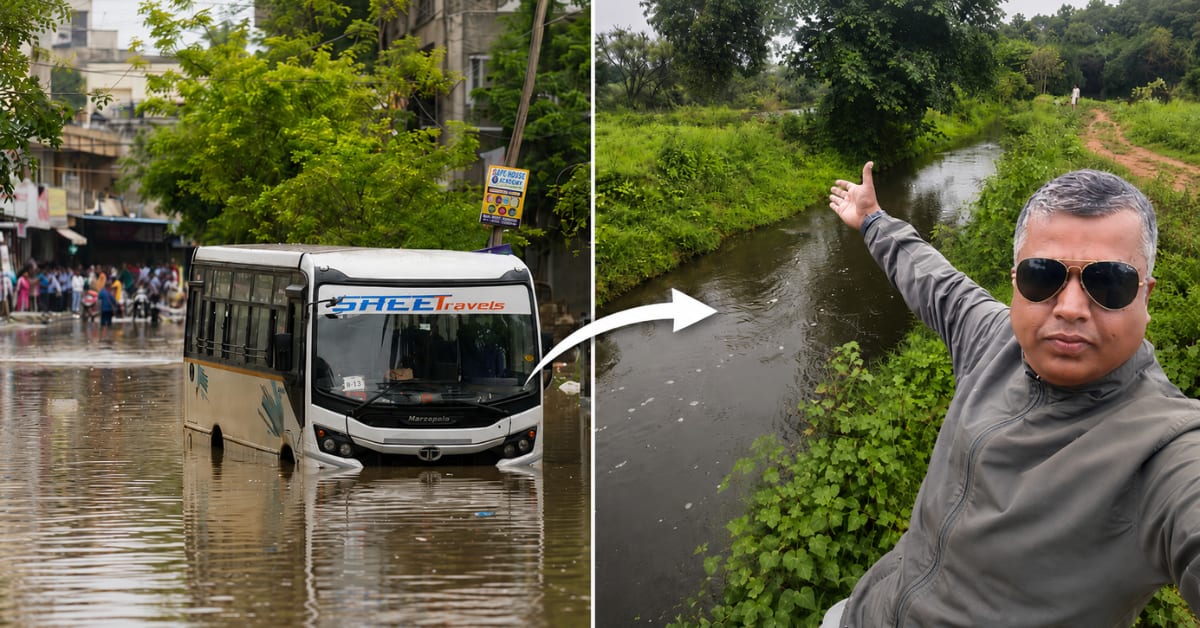
Bangalore's streets flooded every monsoon while its ancient lakes remained empty, and one retired Army officer wanted to know why.
Captain Santosh Kumar returned to his hometown of Muthanallur in 2008 after decades in the military. The pattern didn't make sense: neighborhoods underwater after a few hours of rain, yet nearby lakes bone dry.
The answer lay buried under roads and buildings. For over 500 years, Bangalore relied on Raja Kaluves, ancient channels that guided rainwater from one lake to another across the city's natural valleys. As Bangalore expanded, construction swallowed these waterways, leaving rain with nowhere to go but city streets.
Captain Santosh tracked down British maps from 1923 that showed where every channel once flowed. He walked through villages comparing old routes to today's landscape, documenting which stretches had vanished under concrete and encroachment.
Between 2017 and 2019, he worked with local residents to gather evidence and secure government approvals. They restored nearly four kilometers of forgotten channels, reconnecting Muthanallur Lake to Bidaraguppe Lake and Battalakere Lake.
The next monsoon brought the proof he needed. Neighboring areas flooded as usual, but Muthanallur stayed dry. The revived channels carried rainwater exactly where it belonged: into the interconnected lake system instead of onto roads and into homes.
The success inspired Captain Santosh to expand across Anekal Taluk. He helped restore 14 ancient lakes, some believed to be nearly 1,000 years old, dating back to the reign of Rajaraja Chola I.
The Ripple Effect
Bangalore has roughly 800 kilometers of stormwater drains, many disrupted by rapid growth. Captain Santosh's work proves the city doesn't need expensive new infrastructure to solve its flooding problem. It just needs to remember the pathways water naturally followed for centuries.
His approach offers other growing cities a blueprint: look backward to move forward. Natural drainage systems evolved over generations to handle local rainfall patterns. Restoring them can be more effective than building new solutions from scratch.
The work continues across Bangalore as more neighborhoods trace their own lost connections. Each restored channel means fewer flooded streets, healthier lakes, and recharged groundwater for a city struggling with water scarcity.
One retired officer armed with century-old maps showed an entire city how to work with nature instead of against it.
More Images
%2Fenglish-betterindia%2Fmedia%2Fmedia_files%2F2026%2F07%2F29%2Fblr-2026-07-29-18-44-10.png)
%2Ffilters%3Aformat(webp)%2Fenglish-betterindia%2Fmedia%2Fmedia_files%2F2026%2F07%2F29%2Fblr-1-2026-07-29-18-57-07.png)
%2Ffilters%3Aformat(webp)%2Fenglish-betterindia%2Fmedia%2Fmedia_files%2F2026%2F07%2F29%2Fblr-3-2026-07-29-19-00-15.png)
Based on reporting by The Better India
This story was written by BrightWire based on verified news reports.
Spread the positivity!
Share this good news with someone who needs it