Astronomer Finds Hidden Galaxy in Webb Telescope Data
A Costa Rican astrophysicist discovered a previously unknown ancient galaxy hiding in publicly available James Webb Space Telescope images, proving breakthrough discoveries are waiting in data anyone can access. His find shows the universe's earliest galaxies are still revealing themselves to careful observers.
A single researcher working with publicly available space telescope data just found what teams of astronomers had missed: a galaxy from when our universe was only a fraction of its current age.
Dr. Homer Dávila Gutierrez, founder of a Spanish-language astronomy news site and Costa Rica's first elected Fellow of the Royal Astronomical Society, made the discovery while carefully reviewing images captured by the James Webb Space Telescope. He searched through 54 different telescope fields and evaluated nearly 1,600 potential candidates before finding one that stood out.
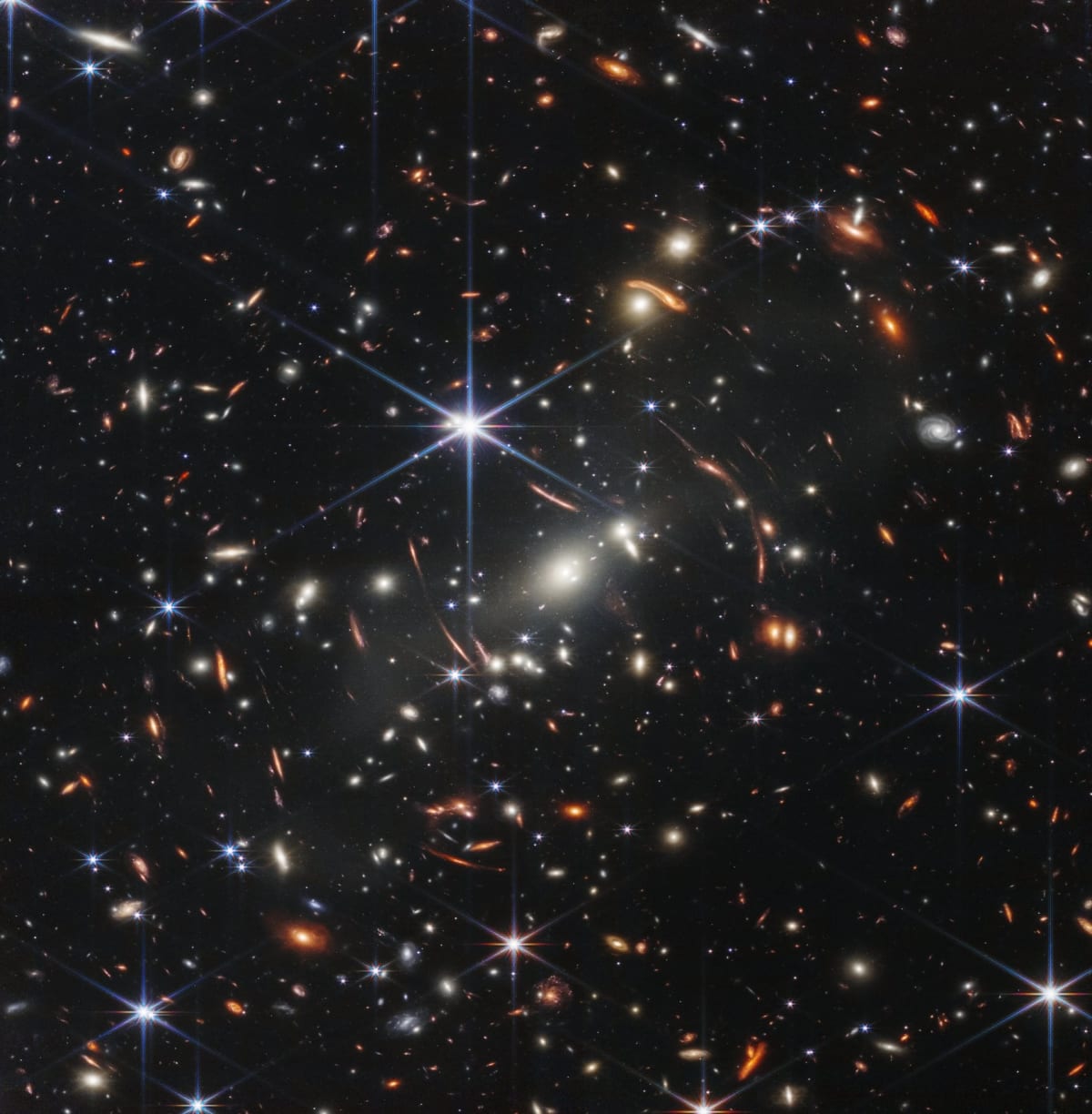
The galaxy, designated A1, appears as a stretched arc of light in the massive galaxy cluster MACS J0308.9+2645. This distortion happens because the cluster's immense gravity bends and amplifies light from objects behind it, like a cosmic magnifying glass. The effect, predicted by Einstein's Theory of General Relativity, lets astronomers see incredibly distant and faint galaxies that would otherwise remain invisible.
Three features made A1 special. First, its extremely elongated shape aligned perfectly with what gravitational lensing produces. Second, it shone brighter than other similarly stretched sources at that distance. Third, and most remarkably, it appeared in no existing astronomical catalog despite being visible in widely studied images.
Analysis revealed A1 dates back roughly 9 billion years, with the cluster's gravity magnifying its light by a factor of seven. Dr. Gutierrez also identified a second possible candidate, A2, which shares similar characteristics but requires further study to confirm.
The discovery happened entirely using data already available to the public. No special access or expensive telescope time was needed. Dr. Gutierrez simply applied careful analysis to images anyone could download.
Why This Inspires
This find proves that groundbreaking discoveries don't require massive research teams or exclusive resources. Webb's public archive grows daily, and hidden treasures wait for anyone willing to do meticulous work. A single dedicated researcher from Costa Rica just demonstrated that the next big discovery could come from anywhere.
The implications extend beyond one galaxy. If A1 was hiding in plain sight in well-studied images, countless other early universe objects likely await discovery in the same publicly accessible data. The universe's secrets are becoming more democratic.
As Dr. Gutierrez noted, the lesson goes beyond the technical achievement: genuine discoveries sit in already-released data, accessible to any researcher willing to do careful work.
The cosmos keeps surprising us, one careful observation at a time.
Based on reporting by Google: James Webb telescope
This story was written by BrightWire based on verified news reports.
Spread the positivity!
Share this good news with someone who needs it