Baby Beetles Team Up to Smell Like Flowers
Scientists discovered that parasitic beetle larvae work together to release floral scents, becoming the first known animals to mimic flower smells. The tiny tricksters use this perfume strategy to hitch rides with unsuspecting bees.
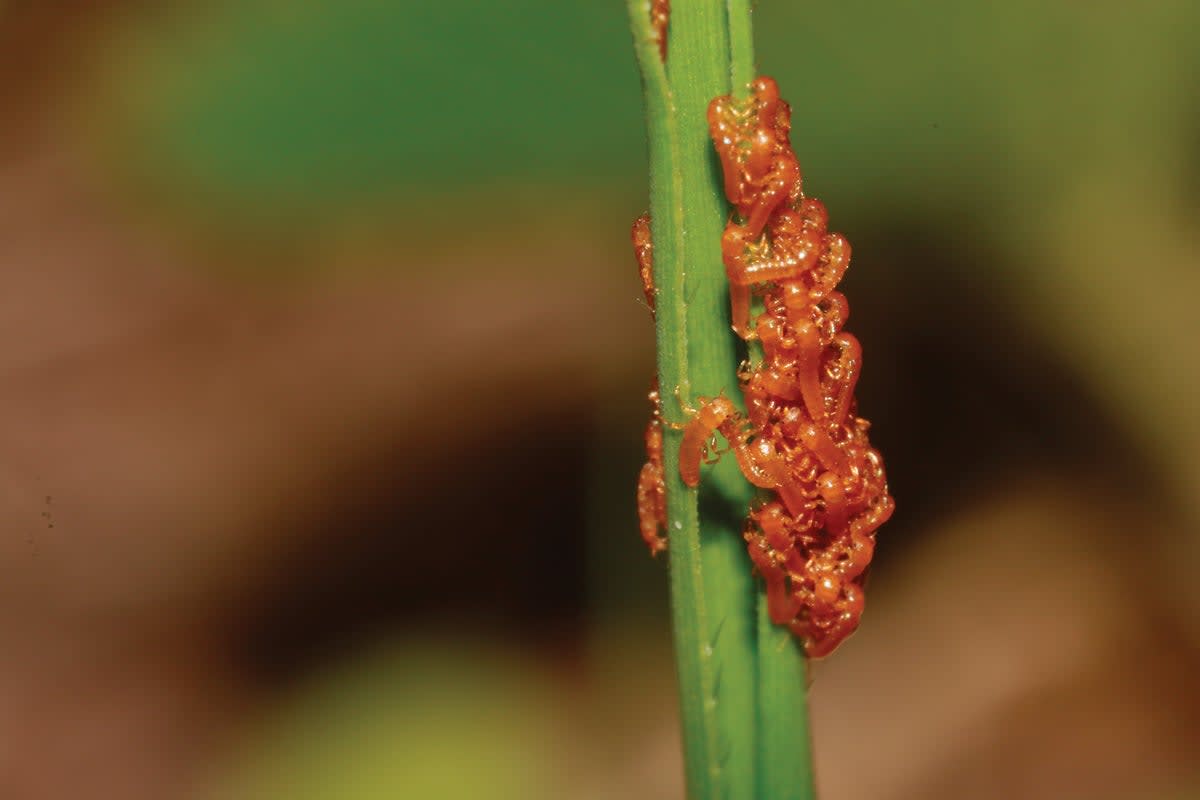
Imagine thousands of bright orange baby beetles huddling together on a flower stem, releasing a sweet floral perfume that would fool even the most discerning nose.
Scientists at the Max Planck Institute for Chemical Ecology in Germany just discovered that European blister beetle larvae are nature's first known scent impersonators. These tiny creatures emit 17 different scented compounds commonly found in flowers, including linalool oxide and lilac aldehyde, to attract solitary bees.
The strategy is clever survival at its finest. When a bee lands on what it thinks is a flower, the larvae latch on with tiny hook-like appendages and catch a ride to the bee's nest. Once there, they feast on eggs, pollen, and nectar until they're ready to emerge as adults and start the cycle again.
Chemist Ryan Alam and his team found that the larvae's perfume serves double duty. Not only does it attract bees, but it also draws other larvae to form those convincing flower-like clusters that complete the visual disguise.
The research, currently posted on bioRxiv, impressed independent scientists reviewing the work. "It presents a convincing case that the beetle larvae are mimicking flowers chemically, and perhaps visually, so as to deceive and attract bees," says Jim McLean, an evolutionary biologist at Macquarie University in Australia.
Why This Inspires
This discovery rewrites what we know about animal mimicry. While orchid mantises can look like flowers and corpse flowers smell like rotting meat, these beetles combine both visual and chemical deception in a completely new way.
The finding gets even more fascinating. Entomologist Dmitry Telnov from London's Natural History Museum notes that another blister beetle species in the U.S. can actually mimic bee sex pheromones. The beetles might be using smell mimicry as an evolutionary tool to target specific host species across different environments.
Nature continues to surprise us with strategies millions of years in the making, proving that even the smallest creatures can teach us something extraordinary about adaptation and survival.
More Images




Based on reporting by Scientific American
This story was written by BrightWire based on verified news reports.
Spread the positivity!
Share this good news with someone who needs it