Baby Planets Shed Light on Solar System Mystery
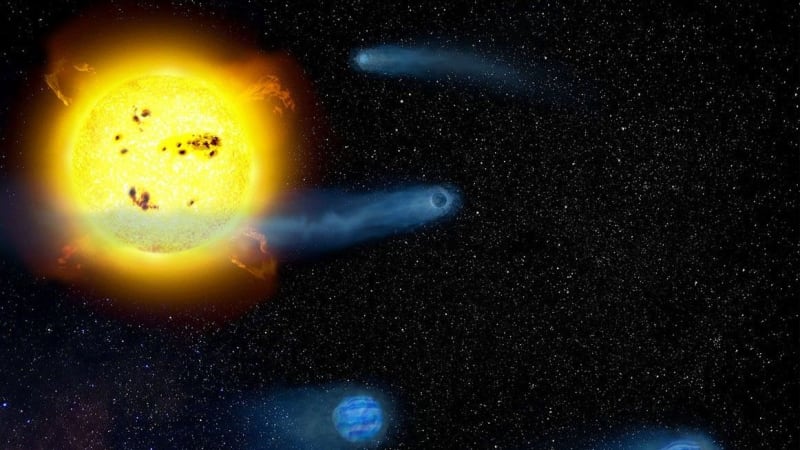
Astronomers have captured four young planets still forming around a distant star, revealing how they evolve from puffy gas giants into the common worlds found throughout our galaxy. The discovery fills a crucial gap in understanding how planetary systems like ours come to be.
Scientists just caught four baby planets in the act of growing up, and what they're seeing is rewriting the rules of how solar systems form.
The four worlds orbit a star called V1298 Tau, located about 350 light-years from Earth. At just 20 million years old, this stellar nursery is a toddler compared to our 4.5 billion year old sun.
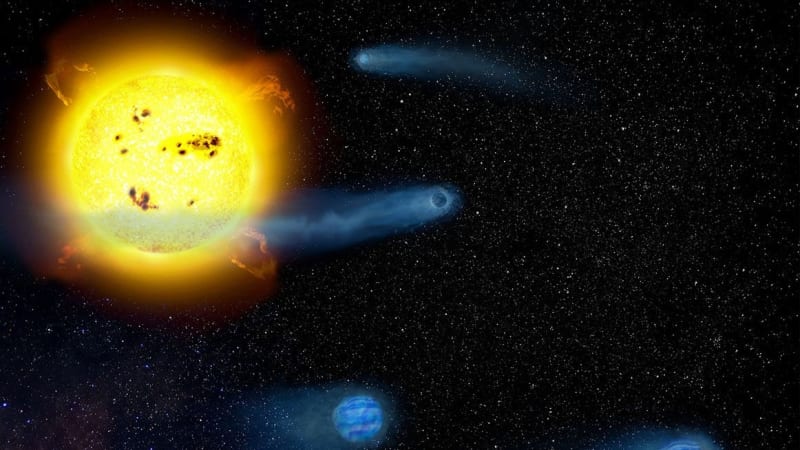
What makes these planets special is their fluffiness. Despite being five to 10 times wider than Earth, they weigh only five to 15 times more. Researchers compared them to Styrofoam, so lightweight and bloated that they rank among the least dense planets ever discovered.
John Livingston, who led the study at the National Astronomical Observatory of Japan, calls it a preview of what becomes a normal planetary system. His team spent nearly a decade tracking the planets using half a dozen telescopes, watching tiny dips in starlight as each world passed in front of its star.
The real breakthrough came when they measured how the planets tug on each other gravitationally. Those subtle interactions revealed their masses for the first time, confirming what scientists had long suspected but never proven: newborn planets start out puffy and gradually shrink.
A lucky observation sealed the discovery. The outermost planet had only been spotted twice in 6.5 years, leaving astronomers unsure of its orbit. When the Las Cumbres Observatory network caught a third transit at just the right moment, the pieces fell into place.
"I couldn't believe it!" said study co-author Erik Petigura from UCLA. "It was like getting a hole-in-one in golf."
Why This Inspires
This discovery bridges a mysterious gap in astronomy. Scientists routinely observe dusty disks around newborn stars and mature planetary systems around older ones, but catching planets in between has been nearly impossible.
The V1298 Tau system shows exactly what happens during those formative years. The bloated planets are already losing their thick atmospheres and cooling down. Over time, they'll shrink into super-Earths and sub-Neptunes, planet types absent from our solar system but common throughout the Milky Way.
The findings, published in the journal Nature, give astronomers their first clear picture of how the galaxy's most common planetary systems emerge from chaos. These tightly packed worlds on Mercury-like orbits have puzzled scientists for years because we have nothing like them orbiting our sun.
Now we know they start as puffed-up gas balls that gradually deflate into the compact systems we see everywhere across the galaxy.
Understanding how these common worlds form helps us understand our own cosmic neighborhood and why it looks the way it does.
More Images

Based on reporting by Live Science
This story was written by BrightWire based on verified news reports.
Spread the positivity!
Share this good news with someone who needs it