Bengaluru Turns Ancient 12-Km Sewage Drain Into Green Park
A polluted canal that carried 130 million liters of sewage daily is now a thriving public space where birds return and rainwater flows naturally. The project revives a 500-year-old water system that helped the city manage both droughts and floods.
Bengaluru once had a clever way to handle water problems that modern cities still struggle with today.
More than 500 years ago, the city built a network of canals called Rajakaluves that connected lakes across the landscape. During heavy rains, excess water flowed naturally from one lake to another instead of flooding streets. In dry months, the same system recharged groundwater and stored water for the future.
But as the city expanded, many of these ancient canals disappeared beneath roads and buildings. Others became sewage channels instead of stormwater drains.
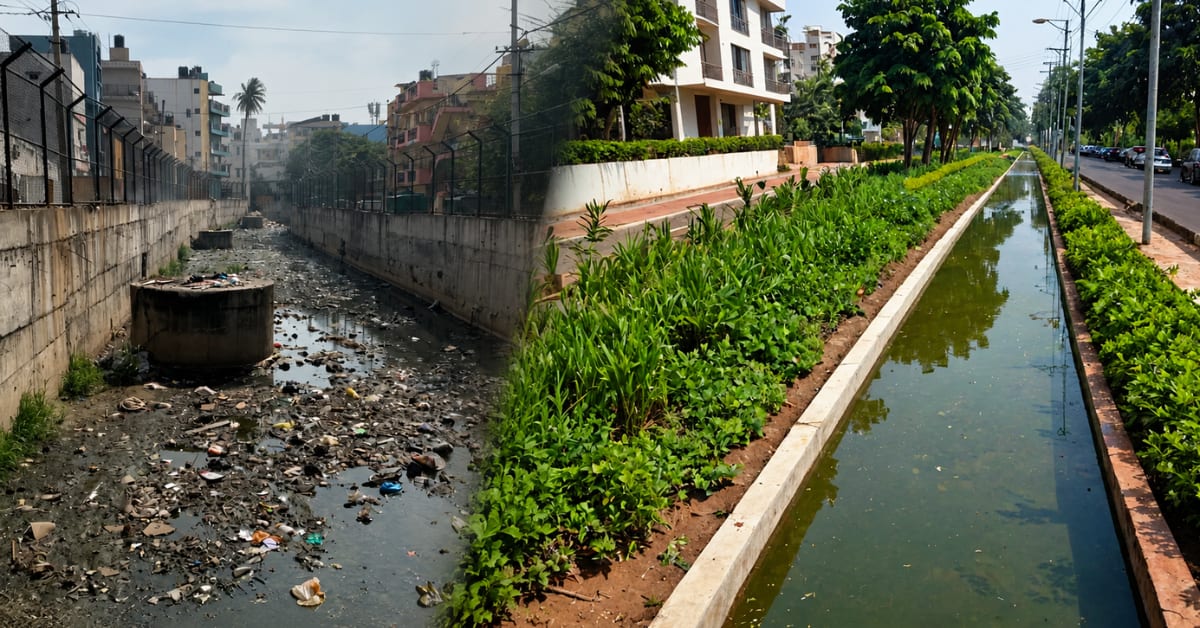
The K100 waterway followed that path. For years, it carried nearly 130 million liters of untreated sewage every day while solid waste piled up along its banks. Residents knew it more for its foul smell than its original purpose.
Then came an ambitious restoration project. The Karnataka government partnered with local agencies and the MOD Foundation to bring the waterway back to life.
The team started by stopping sewage from entering the canal. They built new sewer infrastructure to divert wastewater away and expanded treatment capacity to reduce untreated sewage from 130 million liters daily to just 5 million. Workers removed decades of accumulated waste and cleaned the canal bed.
Once the water quality improved, they focused on the surrounding space. Pedestrian walkways now line the canal's edge. New trees create shaded areas where people can walk and rest. The neglected waterway has become a nearly 12-kilometer green corridor where residents reconnect with nature.
The transformation goes beyond aesthetics. Urban designer Naresh Narasimhan, who conceived the project, points out that Bengaluru receives 900 to 1,000 millimeters of rainfall every year. The problem was never a lack of water but how the city managed it.
The Ripple Effect
The K100 revival shows other Indian cities facing similar challenges that solutions already exist in their own history. By treating wastewater as a resource instead of waste, Bengaluru is rediscovering wisdom from centuries ago.
The restored canal now serves its original purpose again. During monsoon season, it channels excess rainwater through the valley system. Birds have returned to the clean water. Families walk along paths where sewage once flowed.
This ancient engineering network once allowed Bengaluru to thrive without a major river, managing both water scarcity and flooding through the same interconnected system. Today's restoration proves those old solutions still work in a modern city of millions.
One restored canal is bringing back hope that Bengaluru can solve its water contradictions the way it did 500 years ago.
More Images
%2Fenglish-betterindia%2Fmedia%2Fmedia_files%2F2026%2F07%2F08%2Frajakaluve-2026-07-08-15-32-57.png)
%2Ffilters%3Aformat(webp)%2Fenglish-betterindia%2Fmedia%2Fmedia_files%2F2026%2F07%2F08%2Frajakaluve-1-2026-07-08-15-36-08.png)
%2Fenglish-betterindia%2Fmedia%2Fmedia_files%2F2026%2F07%2F08%2Fsuchita-and-vikas-tyagi-2026-07-08-11-11-59.png)
Based on reporting by The Better India
This story was written by BrightWire based on verified news reports.
Spread the positivity!
Share this good news with someone who needs it