Black Hole Awakens After 100 Million Years of Sleep
Astronomers captured stunning images of a supermassive black hole roaring back to life after nearly 100 million years of silence, shooting jets of energy almost 1 million light-years across space. The discovery reveals how galaxies transform over cosmic time, giving scientists a front-row seat to one of the universe's most dramatic processes.
A supermassive black hole has woken up from a 100-million-year nap, and astronomers just captured one of the most spectacular cosmic comebacks ever seen.
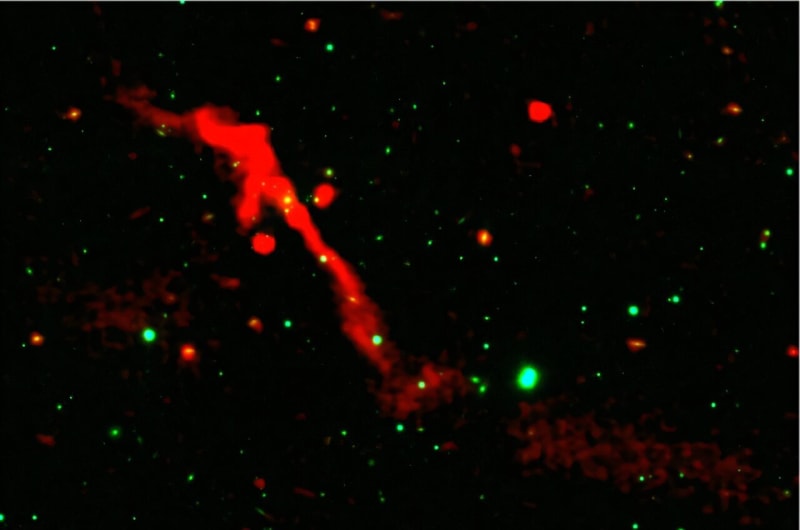
The black hole sits at the heart of galaxy J1007+3540, and recent observations show it restarted its powerful jets of energy after an incredibly long period of quiet. Using radio telescopes in the Netherlands and India, an international research team spotted the dramatic awakening playing out across nearly 1 million light-years of space.
Lead researcher Shobha Kumari from Midnapore City College in India described the scene as a cosmic volcano erupting after ages of calm. The images reveal bright new jets bursting from the black hole's center, surrounded by older, faded plasma clouds left over from previous eruptions millions of years ago.
What makes this discovery special is the clear evidence that black holes don't just turn on once and stay active forever. Instead, they cycle through long periods of activity and rest, fundamentally reshaping their galaxies each time they wake up.
The galaxy lives inside a massive cluster filled with extremely hot gas, creating enormous pressure that bends and squeezes the jets as they push outward. The northern jet appears compressed and curved, while a long, faint tail stretches to the southwest, showing magnetized plasma being dragged through space over millions of years.
Dr. Sabyasachi Pal, who worked on the research, called J1007+3540 one of the clearest examples of how surrounding environments can dramatically reshape a galaxy's structure. The interaction between the revived jets and the dense cluster gas creates a cosmic battle visible across radio wavelengths.
Why This Inspires
This discovery changes how scientists understand galaxy evolution. Rather than peaceful, gradual growth, galaxies experience dramatic cycles of explosive power and crushing environmental pressure that play out over millions of years.
The research team can now track exactly how often black holes switch between active and quiet phases, how old plasma interacts with hot gas, and how repeated eruptions transform a galaxy's surroundings. Each observation brings us closer to understanding the forces that shape the universe's largest structures.
The team plans to conduct even more detailed observations to zoom deeper into J1007+3540's core and watch how the restarted jets continue propagating through this turbulent environment.
Watching a black hole wake up after 100 million years reminds us that the universe operates on timescales we can barely imagine, yet we're developing the tools to witness these incredible transformations.
More Images


Based on reporting by Phys.org
This story was written by BrightWire based on verified news reports.
Spread the positivity! 🌟
Share this good news with someone who needs it