Dark Stars May Solve 3 Big Cosmic Mysteries
Scientists think mysterious "dark stars" could explain three puzzling discoveries from the James Webb Space Telescope that don't fit our current understanding of the early universe. These hypothetical objects, powered by dark matter instead of nuclear fusion, might be the missing piece that explains how the cosmos evolved.
The James Webb Space Telescope keeps spotting things in the early universe that shouldn't exist according to our best theories, and scientists may have finally figured out why.
A new study led by Colgate University physicist Cosmin Ilie suggests that hypothetical objects called "dark stars" could solve three major cosmic mysteries at once. These aren't the stars we're used to seeing in the night sky.
Dark stars would be powered by dark matter annihilations rather than the nuclear fusion that lights up regular stars. This different energy source would let them grow enormous and eventually collapse into the seeds of supermassive black holes.
The James Webb telescope has been sending back images that make astronomers scratch their heads. It's spotted unexpectedly bright galaxies nicknamed "blue monsters" that are way too compact and dust-free for their age.
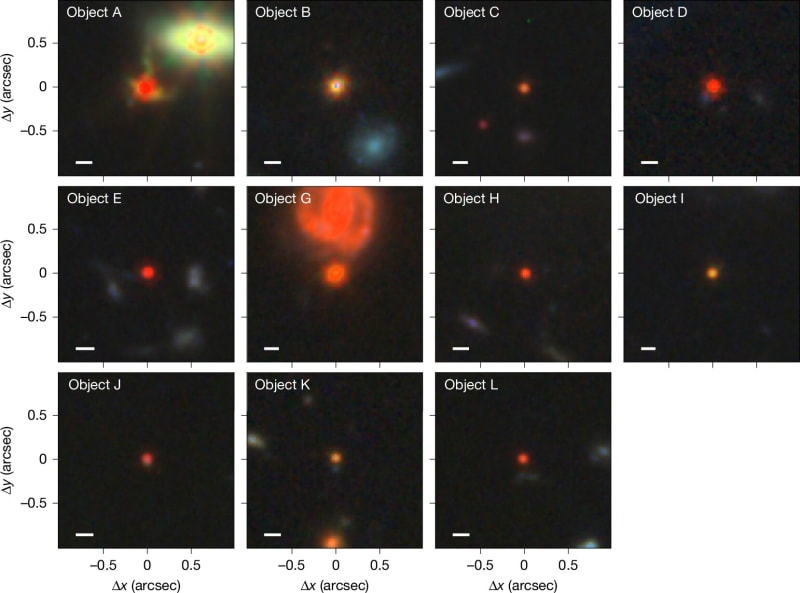
It's also found supermassive black holes that formed impossibly fast after the Big Bang. And it discovered strange "little red dots" that are compact cosmic objects emitting almost no X-rays, which doesn't match any known astronomical object.
Before Webb launched, computer models of the early universe didn't predict any of these things. The telescope pushed our view farther back in time than ever before, revealing a cosmic dawn that looks different from what we expected.
The Bright Side
Dark stars might sound like science fiction, but they're grounded in solid physics. If they existed, they would have formed in regions dominated by dark matter a few hundred million years after the Big Bang, when hydrogen and helium clouds first collapsed under gravity.
The research team found evidence for dark star signatures in spectroscopic data from two objects observed by Webb. They discovered absorption features from helium that match what dark stars would produce.
One galaxy called UHZ1 sits 13.2 billion light years away, meaning we're seeing it when the universe was only 3% of its current age. It contains a supermassive black hole that couldn't have formed from regular stars in the time available, but a collapsed dark star could explain it perfectly.
What makes this discovery especially exciting is that confirming dark stars would tell us about dark matter itself. Scientists have been trying to detect dark matter particles in Earth-based laboratories for decades without success.
Studying dark stars in space could reveal the physical properties of dark matter particles from astronomical observations instead. It's a completely different approach to one of physics' biggest questions.
The team published their findings in the journal Universe in December 2024, building on previous studies from 2023 and 2025 that identified possible dark star candidates. Each new piece of evidence makes the theory stronger.
Webb continues gathering data that will help confirm or rule out the dark star hypothesis, bringing us closer to understanding what really happened at cosmic dawn.
More Images


Based on reporting by Google: James Webb telescope
This story was written by BrightWire based on verified news reports.
Spread the positivity! 🌟
Share this good news with someone who needs it