Bonobo Kanzi Uses Imagination in Tea Party Experiments
A 43-year-old bonobo successfully tracked imaginary juice and grapes during pretend play experiments, proving imagination may not be uniquely human. The discovery could reshape our understanding of animal minds and evolution.
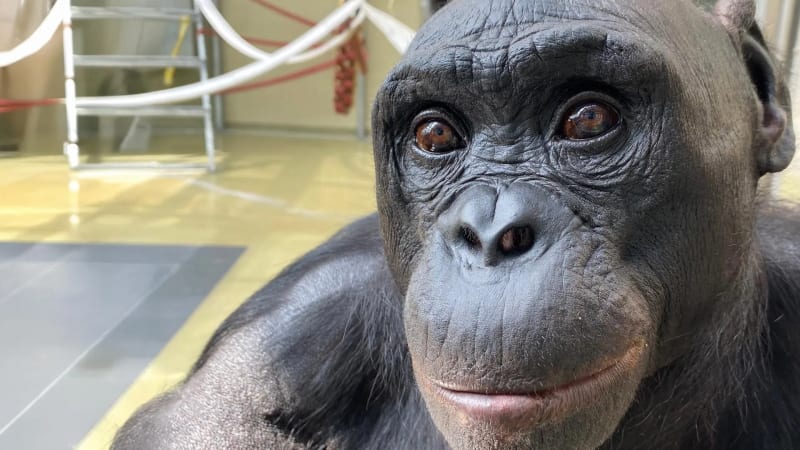
A bonobo named Kanzi just changed what scientists thought was possible about animal minds by playing pretend tea party and winning.
Researchers at Johns Hopkins University watched as the 43-year-old bonobo consistently pointed to the correct locations of imaginary juice and grapes during carefully designed experiments. He tracked pretend objects as they moved around a table, proving he could imagine things that weren't really there.
The experiments worked like a child's tea party. An experimenter sat across from Kanzi with empty cups and pitchers, pretending to pour invisible juice and asking where it went. Kanzi pointed to the right cup almost every time, even after the cups moved around.
To prove Kanzi wasn't just guessing, researchers added a twist. They offered him one cup with real juice and one with pretend juice. Kanzi chose the real juice nearly every time, showing he understood the difference between imagination and reality.
A third test used imaginary grapes with the same results. Kanzi could track pretend objects in his mind while knowing they weren't actually there.
"It really is game-changing that their mental lives go beyond the here and now," said Christopher Krupenye, a Johns Hopkins assistant professor who studies how animals think. The ability to imagine was long considered exclusively human, making this discovery transformative for understanding what makes us special.
The finding suggests imagination may have deep evolutionary roots, possibly stretching back 6 to 9 million years to a shared ancestor of humans and modern apes. Human children typically start pretend play around age two, and babies as young as 15 months show surprise at make-believe actions.
Why This Inspires
This discovery invites us to reconsider the rich mental lives happening all around us in the animal kingdom. If apes can imagine things that don't exist, what other complex thoughts might they have about the future or each other's feelings?
Krupenye compared the breakthrough to Jane Goodall's discovery that chimps make tools, which changed how we define being human. This research, published in Science, does the same thing for imagination and creativity.
The team plans to test whether other apes and animals can engage in pretend play. Each new discovery helps us see that the line between human and animal minds might be blurrier than we thought.
One bonobo's willingness to play along with invisible grapes just expanded our understanding of consciousness itself.
Based on reporting by Science Daily
This story was written by BrightWire based on verified news reports.
Spread the positivity!
Share this good news with someone who needs it