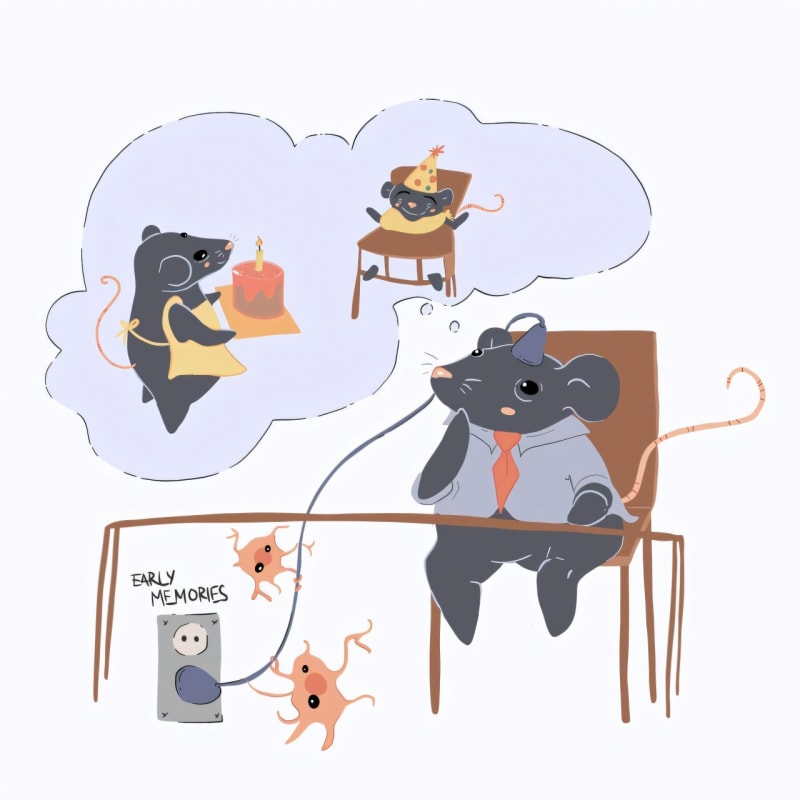
Brain Immune Cells Control What Babies Remember
Scientists discovered that blocking immune cells in infant mice brains prevented early memory loss, revealing those forgotten childhood memories might still exist in our brains. This breakthrough could reshape how we understand learning and forgetting in early life.
Your earliest memories might not be lost after all—they could just be filed away in your brain, waiting to be unlocked.
Scientists at Trinity College Dublin just made a stunning discovery about why we can't remember our first birthday parties or early childhood adventures. They found that specialized immune cells in the brain called microglia actively manage which memories infants keep and which ones fade away.
The research team tested their theory on infant mice, blocking the activity of these memory-managing cells. The results were remarkable: young mice with suppressed microglia activity remembered fearful experiences much better than those with normal microglial function.
Dr. Erika Stewart, the study's lead author, describes microglia as "memory managers" in the brain. These cells don't destroy memories but instead organize how they're stored and expressed throughout our lives. When the researchers used glowing tags to track memory neurons, they found that blocking microglia made these memory cells more active.
The implications go beyond infant forgetting. Professor Tomás Ryan points out that infantile amnesia affects virtually everyone, yet scientists have barely studied it because we accept it as normal. "But what if those memories are still present in the brain?" he asks.
The research suggests forgetting isn't a flaw but a feature. Our brains appear to deliberately file away early memories rather than erasing them completely. This challenges everything we thought we knew about memory loss.
One fascinating finding involves mice born to mothers with activated immune systems. These mice didn't experience normal infantile amnesia, but scientists could restore typical forgetting by adjusting microglial activity after birth. This shows how flexible the memory system really is.
The study, published in PLOS Biology, raises intriguing questions about human variation. Could some people exist who remember their infancy clearly? What would their early educational experiences look like?
Scientists noticed something interesting about which animals experience infantile amnesia. It only happens in species born helpless and dependent on caregivers, like humans and mice. Guinea pigs, born more independent and mature, don't forget their early days. Perhaps memories formed during our most vulnerable period get stored differently because they're less reliable.
Why This Inspires
This research transforms forgetting from a frustrating loss into an organized biological process we might eventually influence. Understanding how microglia manage memories could open new approaches to early childhood education and learning. It also offers hope for understanding memory loss in diseases—if the brain naturally knows how to file memories away, maybe we can learn to retrieve them.
The discovery suggests our earliest experiences aren't erased but carefully archived, potentially accessible if we find the right biological keys to unlock them.
More Images

Based on reporting by Medical Xpress
This story was written by BrightWire based on verified news reports.
Spread the positivity!
Share this good news with someone who needs it