Carnegie Mellon's New Robotics Hub Gets 92 Motion Cameras
Carnegie Mellon University just equipped its massive new Robotics Innovation Center with 92 high-tech cameras that can track hundreds of robots and drones at once. The system will help researchers develop smarter robots that could revolutionize everything from warehouse work to search-and-rescue missions.
Carnegie Mellon University just supercharged its robotics research with technology that can track the precise movements of drone swarms, robot teams, and human activity all at the same time.
The university partnered with OptiTrack to install 92 specialized cameras across its new 150,000-square-foot Robotics Innovation Center in Pittsburgh. The facility, which opened in February 2026, features a massive testing floor, an aquatic research lab, and even a 6,000-square-foot outdoor drone cage.
Inside the Motion Capture Studio, 28 ultra-precise cameras can track movements down to the width of a human hair across a 2,800-square-foot space. Four additional color cameras capture visual reference data that helps robots learn by watching and imitating human actions.
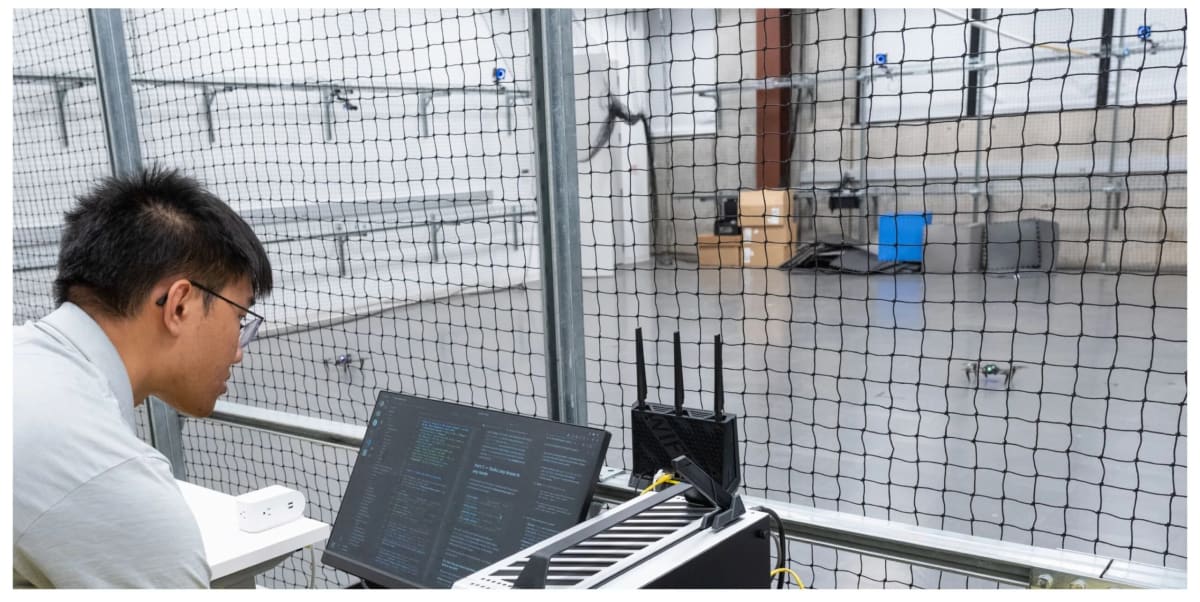
The outdoor drone cage uses 60 weather-resistant cameras that can handle Pittsburgh's rain and snow while tracking flying robots up to the facility's 38-foot ceiling. All the cameras work together using ActiveIO technology, which can identify and follow hundreds of objects simultaneously.
Researchers will use the system to tackle some of robotics' biggest challenges. Teams are working on autonomous drones that can navigate complex environments, groups of robots that coordinate with each other like a sports team, and AI systems that learn new tasks by watching humans demonstrate them once.
The Ripple Effect
This partnership connects to Carnegie Mellon's Physical AI Accelerator, a state-backed program focused on creating smarter robots and sensing systems. The technology being developed here could eventually help robots work safely alongside humans in factories, navigate disaster zones to find survivors, or assist elderly people living independently.
The motion capture systems will also benefit Carnegie Mellon's Extended Reality Technology Center, where researchers recreate real-world movement in virtual environments. OptiTrack recently joined as a sponsor, bringing industry expertise to student projects.
"The future of robotics, physical AI and extended reality will be forged at Carnegie Mellon's Robotics Innovation Center," said Martial Hebert, dean of the university's School of Computer Science. He emphasized that the precision tracking will enable discoveries that weren't possible before.
Research teams led by Associate Research Professor Kris Kitani and the university's AirLab will be among the first to use the new equipment. Their work spans multiple areas where robots need to understand and navigate the physical world with human-like awareness.
Pittsburgh continues to cement its reputation as a robotics innovation capital, with this new center representing one of the largest academic facilities dedicated to advanced robotics research.
Based on reporting by Google News - Innovation Technology
This story was written by BrightWire based on verified news reports.
Spread the positivity!
Share this good news with someone who needs it