CERN Detects Signals 100 Billion Times Smaller Than Atoms
Humanity just caught its first glimpse into the deepest layer of physical reality ever witnessed. Scientists at CERN have detected signals from the zeptoverse, an astonishing realm 100 billion times smaller than an atom that could unlock the secrets of dark matter.
Human curiosity just reached farther into the unseen fabric of our reality than ever before. By peering into a realm 100 billion times smaller than a single atom, scientists have officially crossed the threshold into the zeptoverse.
This breathtaking breakthrough offers humanity its clearest look yet into the hidden architecture of nature. It proves that even the deepest secrets of our cosmos are within reach when people unite to push the boundaries of knowledge.
An international team of researchers achieved this milestone using the Large Hadron Collider at CERN. Nestled deep beneath the border between France and Switzerland, this marvel of engineering propels atomic particles along a 17-mile underground ring at nearly the speed of light.
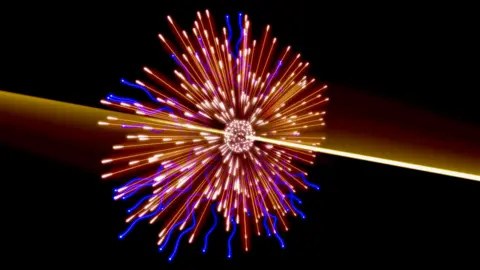
When these particles collide, they shatter into fundamental debris, briefly recreating the energetic conditions that shaped the cosmos right after the Big Bang. From this dazzling shower of subatomic shrapnel, scientists captured signals that had previously eluded detection for generations.
At the heart of the discovery sits an exotic particle known as a beauty quark. While normal atoms build everything from oceans to human bones, beauty quarks are rare wonders that survive for only 1.5 trillionths of a second.
Despite that fleeting existence, researchers recorded the quark interacting with surrounding particles at a scale of one billion-trillionth of a meter. Measuring activity across such an impossibly minute distance represents the smallest physical territory science has ever mapped.
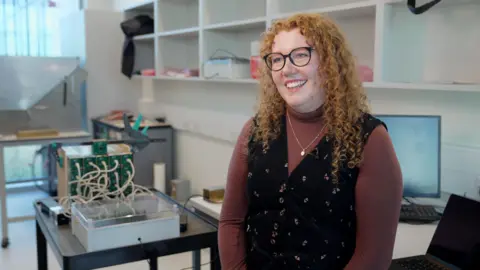
Dr. Harry Cliff, a Cambridge University physicist who led the data analysis, described the achievement as knocking directly on the door of an entirely new realm. He noted that watching this subatomic dance provides researchers with a ringside seat to physics never witnessed before.
For decades, our understanding of the universe has relied on the Standard Model of particle physics, a triumphant framework that explains ordinary matter with remarkable precision. Yet scientists have long recognized that this model only describes a tiny sliver of the actual cosmos.
Roughly 85 percent of all matter in the universe is dark matter, an invisible substance that emits no light, heat, or energy. We know dark matter exists because its immense gravity holds galaxies together, but it has stubbornly remained a ghost in our detectors.
That is what makes entering the zeptoverse so profoundly exciting for the scientific community. Theoretical physicists believe that particles operating at this ultra-miniature scale feel the influence of dark matter far more strongly than ordinary matter does.
By observing how beauty quarks decay inside this realm, researchers can spot telltale deviations caused by unseen cosmic forces. Each tiny collision acts like a flashbulb, illuminating corners of reality that were previously hidden in total darkness.
The Ripple Effect
Opening the zeptoverse demonstrates what becomes possible when hundreds of passionate thinkers across 28 nations unite behind a single dream. This global collaboration brings together mathematicians, computer engineers, and early-career researchers who dedicate their lives to solving nature's grandest puzzles.
Projects like this also serve as an invaluable training ground for the next generation of pioneers. Young scientists working on CERN detectors develop groundbreaking expertise in high-speed data processing, machine learning, and advanced sensor design.
Historically, fundamental science pursued purely for the joy of discovery transforms everyday human life in unexpected ways. Innovations born at CERN previously gave humanity the World Wide Web, revolutionized medical imaging, and inspired targeted cancer therapies.
Now, international teams are already preparing upgrades to make these detectors ten times more sensitive in the coming years. That enhanced vision will allow researchers to step fully through the doorway and map the new particles waiting inside.
Every small signal captured from this hidden frontier brings our global community closer to a unified story of where we came from and how everything works.
By daring to explore the smallest spaces imaginable, humanity continues to illuminate the limitless potential of human wonder.
More Images

Based on reporting by BBC
Building Something New? Try the BrightWire Tech Stack Advisor
Compare modern frameworks, cloud hosting, and AI tools tailored to your project budget and scale.
Spread the positivity!
Share this good news with someone who needs it