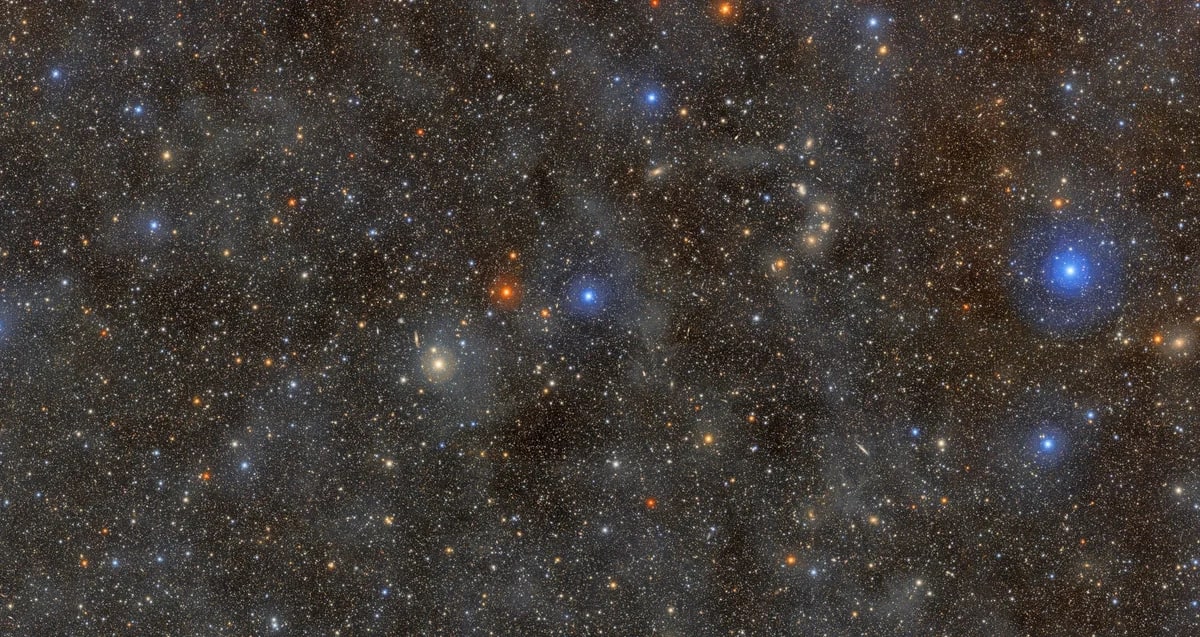
Chile Telescope Begins Largest Cosmic Time-Lapse Ever
The Vera C. Rubin Observatory in Chile just started a 10-year project to capture the universe like never before. Its revolutionary camera will scan the entire southern sky every few nights, creating humanity's most detailed cosmic movie.
A telescope in Chile just turned on the world's largest digital camera, and it's about to change how we see the universe.
The Vera C. Rubin Observatory officially began its 10-year Legacy Survey of Space and Time on June 30, marking the start of the most ambitious sky-watching project in history. For project leader Željko Ivezić, the moment felt as momentous as the birth of a child after working on it for over two decades.
The observatory's 3,200-megapixel camera captures images of the sky every 40 seconds. Its 8.4-meter mirror offers a view 100 times larger than similar telescopes, meaning it can scan the heavens 100 times faster too.
The data Rubin will collect in 10 years would take any other observatory more than a thousand years to gather. Every few nights, it will photograph the entire southern sky, creating a time-lapse that shows how the universe changes moment by moment.
Scientists will use this cosmic movie to hunt for undiscovered asteroids that might threaten Earth. They'll also study mysterious flashes of light from supernovae and gamma-ray bursts, some of the most powerful explosions in the universe.
But the biggest discovery could answer one of physics' most fundamental questions. Within five to seven years, Rubin should reveal whether dark energy is real or if scientists have misunderstood gravity itself at cosmic scales.
The Ripple Effect
This project will likely discover millions of new asteroids, including ones on potential collision courses with Earth. Early detection means more time to develop protection plans.
The observatory will also revolutionize the study of cosmic explosions and mysterious transient events. Scientists expect to find entirely new types of celestial phenomena they haven't even imagined yet.
The telescope's enormous field of view means amateur astronomers and students worldwide will get access to stunning, high-definition images of deep space. The data will be publicly available, democratizing space research for anyone with curiosity and an internet connection.
Funded by the U.S. National Science Foundation and Department of Energy, the project represents years of international collaboration. Hundreds of scientists from dozens of countries contributed to making this cosmic camera a reality.
After a year of testing and fine-tuning, the telescope is finally ready to unveil the universe's hidden stories, one 40-second snapshot at a time.
More Images


Based on reporting by Scientific American
This story was written by BrightWire based on verified news reports.
Spread the positivity!
Share this good news with someone who needs it

%2Fhttps%3A%2F%2Ftf-cmsv2-smithsonianmag-media.s3.amazonaws.com%2Ffiler_public%2F4e%2F9f%2F4e9f0fe8-aa48-438a-b88f-3a29cd71107e%2Fhttps___wwwfrontiersinorg_files_articles_1758862_xml-images_fmats-13-1758862-g001.jpeg)
%2Fhttps%3A%2F%2Ftf-cmsv2-smithsonianmag-media.s3.amazonaws.com%2Ffiler_public%2F8e%2F83%2F8e837bc6-e2b3-4bb6-bb1c-4f1287b45a6f%2Fcastillo-39-rincon_de_los_signos.jpg)