China and Europe Launch Joint Space Weather Satellite
A groundbreaking satellite built by China and Europe just launched to study how solar storms interact with Earth's protective shield. The SMILE mission marks the deepest space science partnership between the two powers yet.
Scientists from China and Europe are now watching space weather together from orbit, after successfully launching a satellite that will help protect our planet from solar storms.
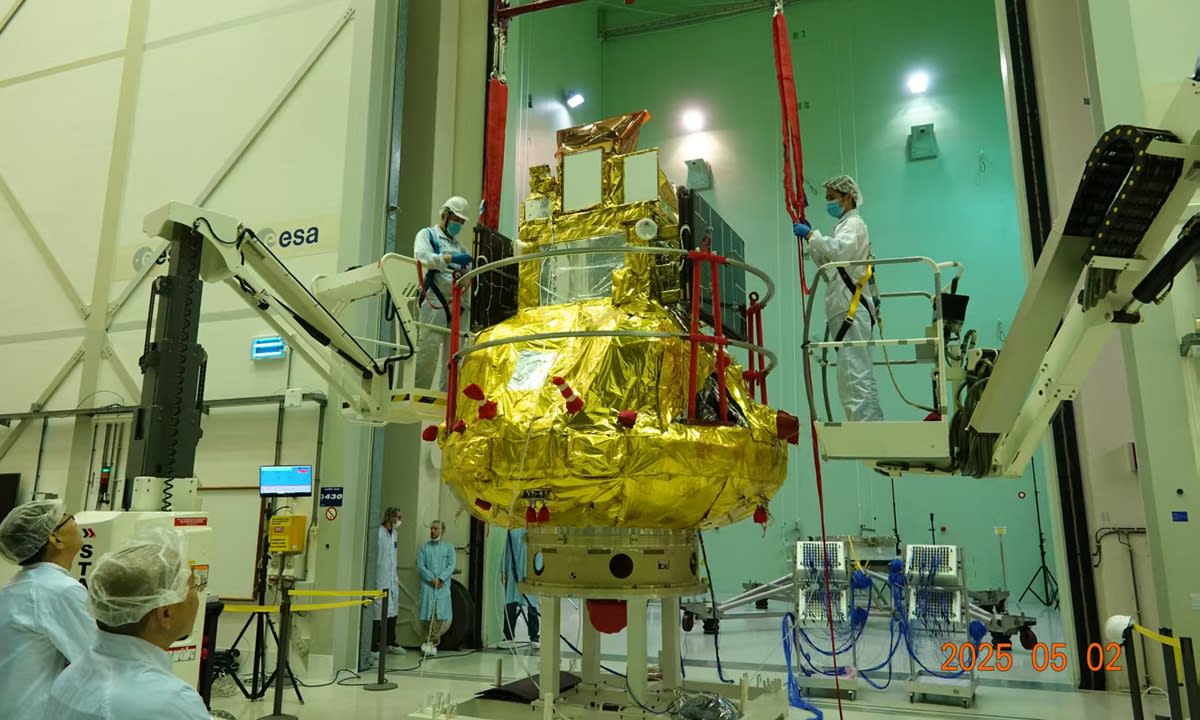
The SMILE satellite lifted off Tuesday from French Guiana aboard a European rocket. Built jointly by the Chinese Academy of Sciences and the European Space Agency, it represents the first full mission where both sides shared everything from design to construction.
SMILE will do something no spacecraft has done before. Using special X-ray cameras, it will capture panoramic views of invisible battles happening above our heads when solar wind slams into Earth's magnetic shield. These interactions can knock out power grids and damage satellites, so understanding them matters for everyone.
The partnership shows how far China's space program has come. Just years ago, China was learning from European satellite designs. Now Chinese engineers led the entire satellite platform development while European teams focused on scientific instruments.
When Canada had to drop out of building one of the key cameras, China stepped up. The National Space Science Center rallied domestic researchers to complete the ultraviolet imager, with Europe providing critical mirrors and image enhancers.
The Ripple Effect
The collaboration required extraordinary trust between ground control teams. SMILE needs more than 13 engine burns to reach its final orbit, each one requiring split-second coordination. Chinese and European controllers established direct data links so they could monitor the satellite through each other's tracking stations.
Teams ran end-to-end tests to make sure commands could flow seamlessly between Chinese stations and European outposts in South America and Antarctica. During critical maneuvers, Chinese propulsion systems and European tracking stations work as one team.
Zhang Yonghe, deputy director of China's Innovation Academy for Microsatellites, told reporters that China also helped solve unexpected technical challenges during development, demonstrating the partnership's strength.
The mission points toward even deeper cooperation ahead. Both agencies are already planning future projects, including a proposed microsatellite constellation that could extend this model of shared responsibility and shared success.
Above Earth right now, SMILE has unfurled its solar panels and begun its journey to its science orbit, a cosmic symbol of what nations can achieve when they look up together.
Based on reporting by Google News - Cooperation Success
This story was written by BrightWire based on verified news reports.
Spread the positivity!
Share this good news with someone who needs it