China Tests Underwater Energy Storage at 200-Foot Depth
China just completed a 10-day trial of an underwater energy storage system that could help solve one of renewable energy's biggest challenges. The technology stores excess power underwater, making clean energy more reliable.
China has successfully tested a groundbreaking underwater energy storage system that could make renewable energy far more dependable.
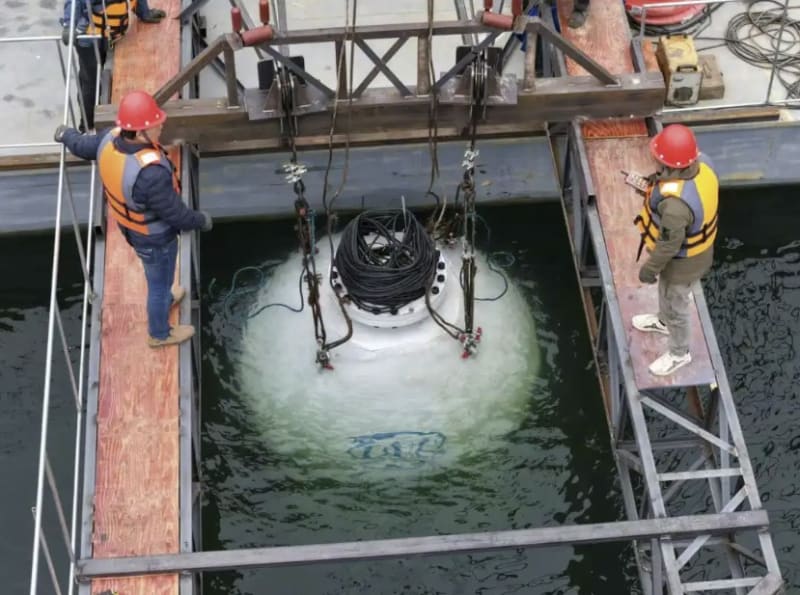
The system, called "Dongchu No. 1," spent 10 days submerged 65 meters (213 feet) deep in Minhu Lake in Fujian province. Engineers put it through more than 100 charge and discharge cycles to prove the technology works in real-world conditions.
Think of it as a giant underwater battery that stores excess energy when the sun is shining or wind is blowing, then releases it when demand spikes. The system uses water pressure at depth to help generate power, similar to pumped hydroelectric dams but without needing mountains or valleys.
The Dongfang Research Institute, part of China Dongfang Electric Corporation, ran the trial from January 2 to 11. Engineers tested everything from waterproof seals to pressure controls to make sure the system could handle continuous underwater operation.
This matters because renewable energy's biggest weakness is storage. Solar panels only work when the sun shines, and wind turbines only spin when air moves. Storing that energy for later use has been expensive and limited. Underwater systems could change that math entirely.
The Ripple Effect
Underwater energy storage opens possibilities that traditional batteries can't match. Deep lakes and coastal waters could become massive clean energy reserves without taking up valuable land. The technology could be especially useful for island nations and coastal cities trying to switch to renewable power.
China's successful test proves the concept works outside the laboratory. The system maintained its seals, controlled internal pressure, and converted energy reliably while completely submerged for over a week.
The trial used a kilowatt-scale system, meaning it's still relatively small. But proving the technology at this scale paves the way for much larger installations that could store enough energy to power entire neighborhoods.
Engineers didn't release specific efficiency numbers or costs yet, which will be crucial for determining if the technology can compete with other storage methods. But the successful 10-day trial shows the fundamental engineering challenges can be solved.
As the world races to build more solar and wind farms, finding affordable ways to store their energy becomes increasingly critical. China's underwater test brings that future one step closer to shore.
More Images

Based on reporting by PV Magazine
This story was written by BrightWire based on verified news reports.
Spread the positivity!
Share this good news with someone who needs it