South Africa Beat Blackouts With Solar, Now Faces New Test
After citizens installed 7,300 MW of rooftop solar to end a decade of rolling blackouts, South Africa now leads Africa in data centers. The question is whether the grid can handle both the businesses that saved it and the AI boom demanding massive power.
When your country suffers rolling blackouts for a decade, you stop waiting for help and start building your own power supply.
That's exactly what happened in South Africa. From 2007 onward, the state utility Eskom couldn't keep the lights on, forcing businesses and families to live with scheduled power cuts called load shedding. So they took matters into their own hands.
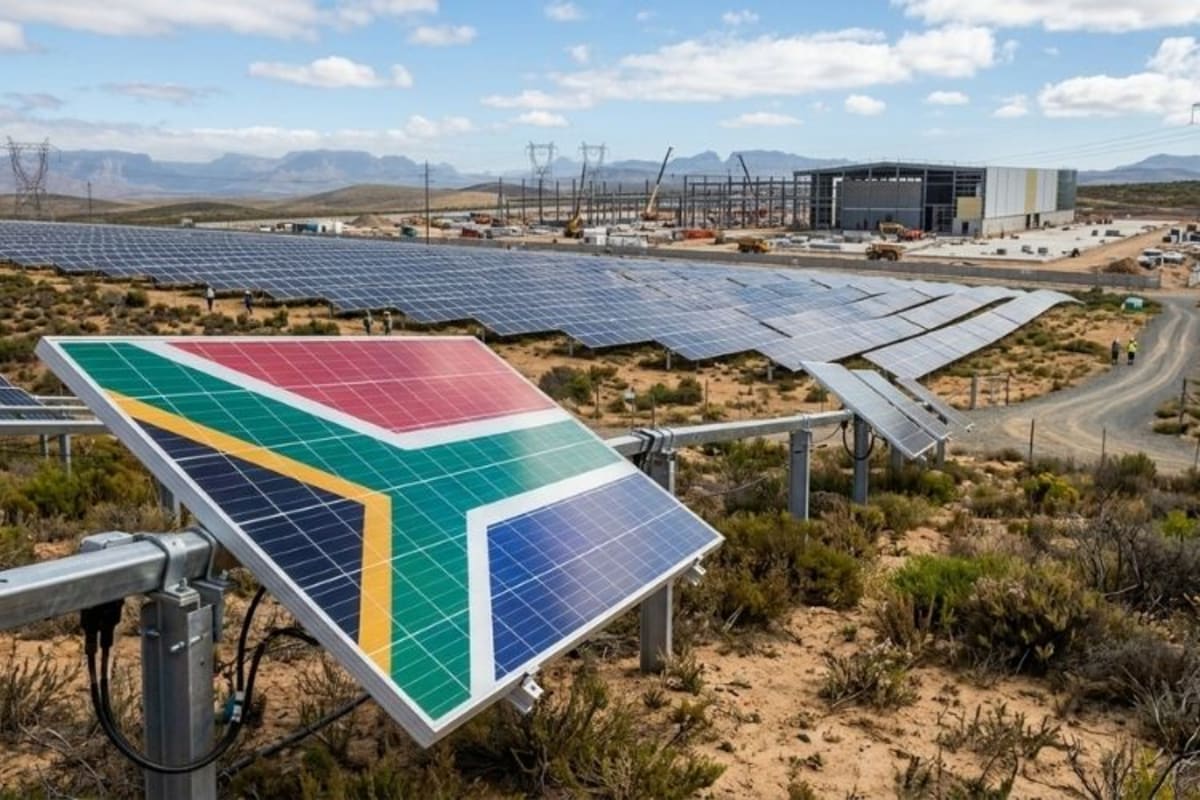
Between mid-2022 and late 2025, private rooftop solar capacity exploded from 2,260 megawatts to 7,300 megawatts. Homeowners, shops, and factories spent billions on solar panels not because of government incentives, but because they needed electricity to survive. It became one of the most market-driven clean energy transitions anywhere in the world.
The blackouts have largely ended. South Africa's citizens solved the crisis themselves, building resilience from the bottom up when the grid couldn't deliver from the top down.
Now comes the next chapter. South Africa has emerged as Africa's data center capital, hosting 56 facilities and roughly 1% of global AI data center capacity. The ten largest facilities alone use 278 megawatts of power, and another $1.5 billion in projects are underway or planned.
In Cape Town, four proposed data centers could consume more than a third of the city's current electricity demand. Durban is planning what could become the country's largest AI-focused facility, requiring hundreds of megawatts.
Data centers bring investment and jobs. They also need enormous, continuous power, the kind that places new stress on a grid that only recently stabilized. And here's where things get complicated.
The biggest data center operators are building their own renewable energy supplies. Teraco is constructing a 120 MW solar facility. Others are using wheeling arrangements, buying power from utility-scale solar plants and using the existing grid to deliver it.
That sounds positive, and in some ways it is. These companies are financing new clean energy instead of pulling from aging coal plants. But wheeling requires long contracts and strong balance sheets that smaller businesses can't match.
The Ripple Effect
The mom-and-pop shops, mid-size manufacturers, and local businesses that kept South Africa running during the blackout years are now facing a two-tier system. They invested in rooftop solar when no one else would help, but they can't access the same large-scale renewable infrastructure or grid capacity that hyperscalers can secure.
A recent report from the Public Affairs Research Institute found that Johannesburg, Ekurhuleni, and Tshwane account for over half of the country's rooftop solar installations. Most residential systems produce excess electricity that gets curtailed because it has nowhere to go, wasted capacity that could power someone else's needs.
The businesses that built the grid's resilience are now competing for scraps while data centers get preferential access to the clean energy future they helped create. It's not a shortage of electrons but a question of who gets to reach them first.
Other countries are just starting to face this tension between AI infrastructure and grid capacity. South Africa is showing them where that road leads when citizens solve an energy crisis only to watch new arrivals jump the line.
Based on reporting by Renewable Energy World
This story was written by BrightWire based on verified news reports.
Spread the positivity!
Share this good news with someone who needs it