
China Unveils Robot Guide Dog for Visually Impaired
A Chinese research institute has created the world's first wheeled and legged robot guide dog, offering new independence for people with visual impairments. The robot can climb stairs, detect overhead obstacles, and navigate with 99% accuracy indoors.
Navigating the world without sight just got easier thanks to a breakthrough robot that walks, rolls, and guides.
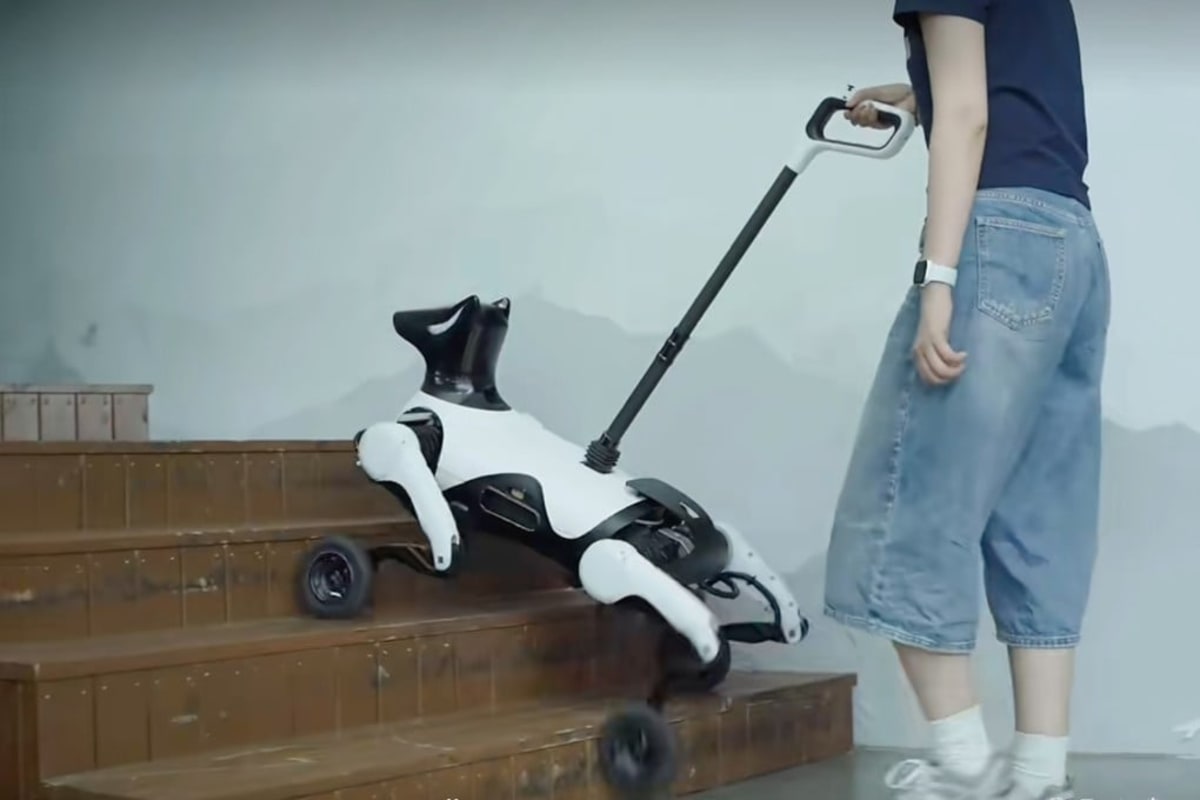
Hangzhou's Zhiyuan Research Institute launched Xiaoyuan, the world's first hybrid robot guide dog, at the China Care and Rehabilitation Expo in Beijing last Friday. The four-legged robot switches between wheels for smooth ground and legs for climbing stairs, giving visually impaired users the freedom to go places traditional mobility aids can't reach.
The timing couldn't be better. China faces a severe shortage of traditional guide dogs, with only about 400 serving a visually impaired population of over 17 million people. Training a single guide dog takes years and costs thousands of dollars, making them inaccessible for most who need them.
Xiaoyuan solves problems that even the best-trained dogs can't handle. Its sensors detect overhead obstacles like low-hanging branches, which canes and traditional guide dogs often miss. The robot moves silently on its wheels, a crucial feature for users who depend on hearing to understand their surroundings.
The technology behind Xiaoyuan is impressively precise. It navigates outdoor spaces with accuracy down to the centimeter, staying within a 30-centimeter margin of error. Its obstacle avoidance success rate hits 99% indoors and 96% outdoors, making it reliable in real-world conditions.
Beyond just navigation, the robot connects users to a wider support network. It links to disability services, accessibility maps, and a volunteer portal where users can request remote assistance whenever they need extra help.
The Ripple Effect
This robot represents something bigger than assistive technology. It shows how artificial intelligence and robotics can move beyond commercial applications into life-changing tools that promote independence and dignity. When defense technology pivots to civilian needs, innovation happens fast.
The robot's affordability potential could transform lives across China and eventually worldwide. While traditional guide dogs remain out of reach for most people, mass-produced robots could make independent navigation accessible to millions who currently struggle with mobility.
For the 17 million visually impaired people in China alone, Xiaoyuan signals that help is on the way, one precise step at a time.
More Images
Based on reporting by South China Morning Post
This story was written by BrightWire based on verified news reports.
Spread the positivity!
Share this good news with someone who needs it