Chinese Money Plant Hides Math Secret in Its Leaves
Scientists discovered that a popular houseplant uses the same elegant math that city planners use to design school districts. The Chinese money plant creates perfect geometric patterns without measuring anything at all.
Your favorite houseplant might be secretly solving complex math problems while sitting on your windowsill.
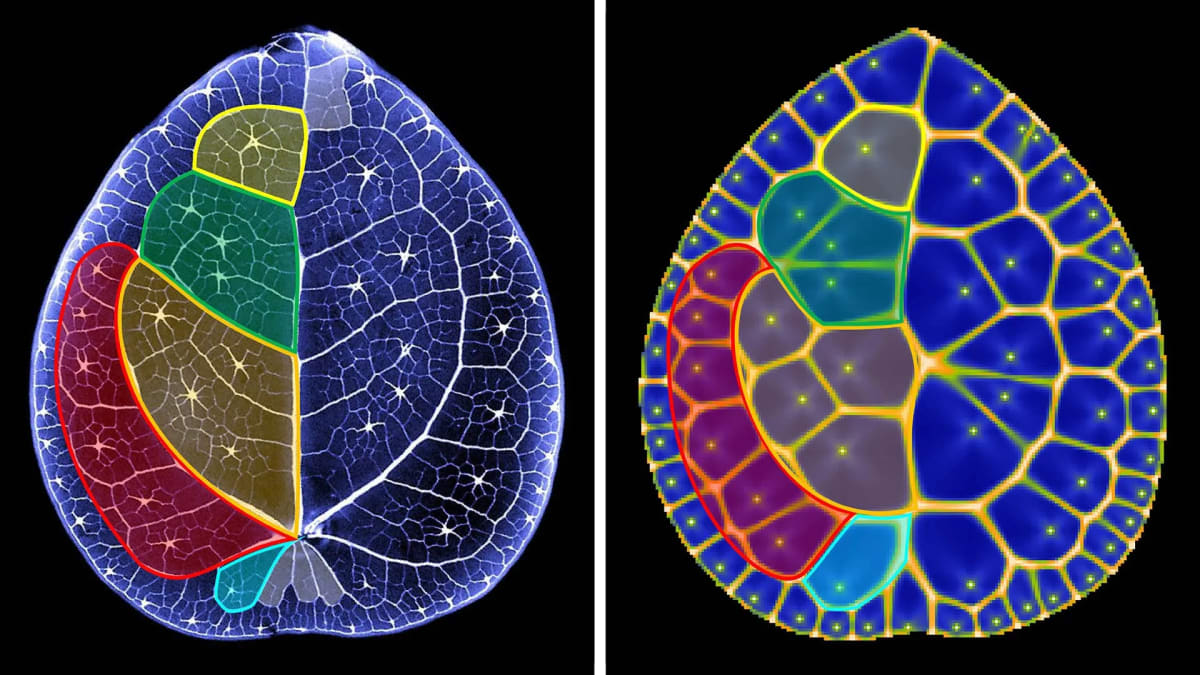
Scientists at Cold Spring Harbor Laboratory just discovered that the Chinese money plant uses a sophisticated geometric pattern called a Voronoi diagram to organize its leaves. This is the same mathematical system city planners use to arrange school districts so every student lives closest to their assigned school.
The finding solves a mystery that has puzzled botanists for decades. Researchers carefully mapped the tiny pores and looping veins inside the plant's round leaves and found something remarkable: a naturally perfect geometric system that looks exactly like the diagrams computer scientists draw to solve distance problems.
"Just as humans have to solve problems to survive, the same goes for other organisms," says CiCi Zheng, who worked on the study as a graduate student and is now at the Allen Institute. "But unlike humans, plants cannot explicitly measure distances."
Instead, the plant relies on local biological interactions between cells to achieve the same solution humans reach through careful calculation. Each visible pore in the leaf acts as a central point, surrounded by looping veins that form distinct regions. The result is a textbook example of Voronoi geometry, created without rulers, computers, or conscious thought.
The Chinese money plant, native to China's Yunnan and Sichuan provinces, is already popular as a gift. Its circular leaves make it instantly recognizable on Instagram. Now it turns out those pretty leaves also contain one of nature's clearest examples of hidden mathematical intelligence.
Przemysław Prusinkiewicz, an expert on plant vein formation, says the discovery finally answers long-standing questions about how certain leaf veins develop. "It's remarkable how mathematical yet another aspect of plant form and patterning turns out to be," he notes.
The discovery joins other examples of natural geometry, like the spiral patterns in sunflowers or the hexagons in honeycombs. But this case is special because the Voronoi pattern includes obvious central points, making it look almost identical to human-designed diagrams.
Why This Inspires
This discovery reminds us that nature has been solving complex problems for millions of years without classrooms or textbooks. The same principles that help us design cities, computer networks, and communication systems also help a simple plant move water efficiently through its leaves.
The research team hopes studying these patterns will reveal more about how living things solve biological challenges. Understanding nature's algorithms could eventually help scientists grasp the mathematical principles shaping evolution, development, and life itself. Every time you water your Chinese money plant, you're caring for a tiny mathematician.
Based on reporting by Science Daily
This story was written by BrightWire based on verified news reports.
Spread the positivity!
Share this good news with someone who needs it