Drones Lift 2X Their Weight in DARPA's $5.5M Challenge
Nearly 100 teams from 25 countries just proved that super-strong lightweight drones aren't science fiction anymore. The top drone carried almost four times its own weight, opening doors for emergency aid delivery and disaster response.
Imagine a drone that weighs as much as a suitcase but can carry the weight of a full-grown person through the sky for miles. That's exactly what teams from around the world just proved possible at a groundbreaking competition in Ohio.
DARPA, the US defense research agency known for creating GPS and the internet, challenged innovators to build drones weighing under 55 pounds that could lift at least 110 pounds. The prize pool? A total of $5.5 million for teams that could push the boundaries of what's possible.
Almost 100 teams from over 30 US states and 25 countries gathered at the National Museum of the US Air Force in early August. Each team had to fly their creation down a 100-foot-wide lane at 150 feet high for nearly five miles, drop their heavy load, then fly another mile before landing.
The AVIDrone team from Columbia, Maryland took first place with a helicopter-style drone that carried 3.84 times its own weight. MTech Operations from Massachusetts grabbed second with a hexacopter achieving a 3.64:1 ratio, while Xtreme Aerial Concepts from California landed third at 3.45:1.
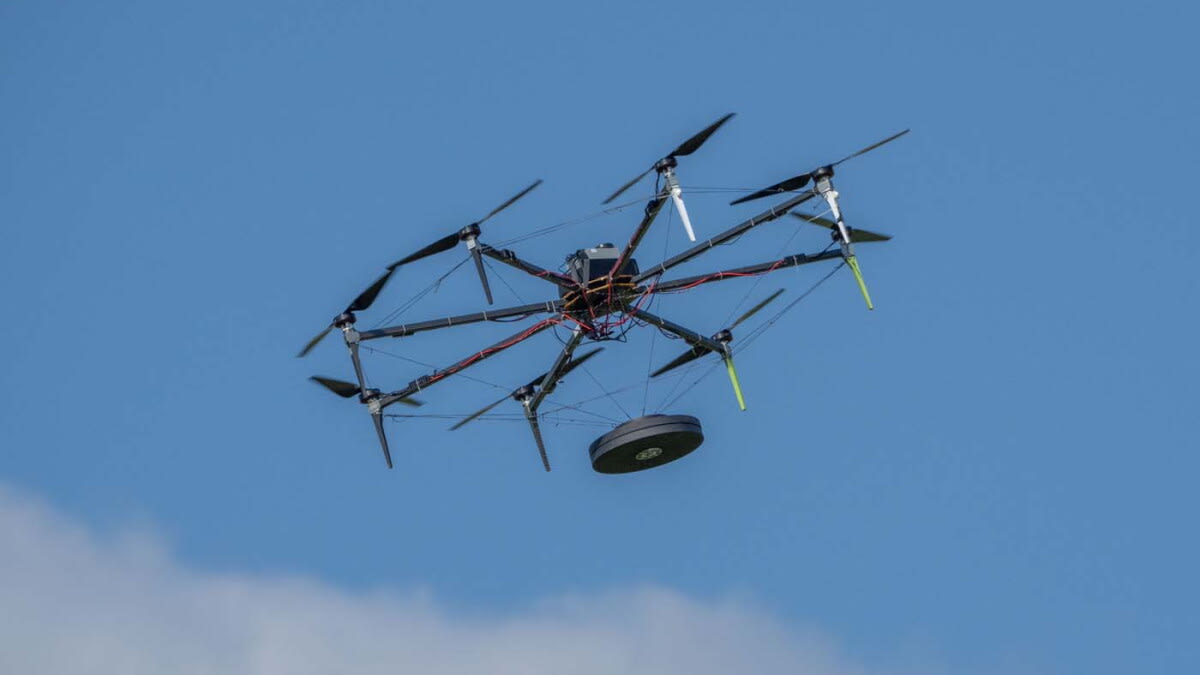
The real showstopper came from DefendTex in Utah. Their ethereal quadcopter, built with string supports instead of heavy metal frames, achieved an incredible 9.63:1 payload ratio. While it didn't complete the official course, it proved the ambitious 4:1 goal wasn't just possible but could be shattered.
The University of Maryland wowed judges with a tri-rotor design that takes off like a normal drone but transitions to forward flight using tiny propellers mounted on each rotor blade. Portal Aircraft Company from Texas innovated with turbine exhaust to drive rotors instead of mechanical parts, potentially making drones more reliable.
The Ripple Effect
These breakthrough designs could transform how we deliver medical supplies to remote villages, drop food and water in disaster zones, and respond to emergencies in hard-to-reach places. Traditional cargo helicopters typically carry only their own weight in cargo, making them expensive and inefficient for many missions.
The innovations go beyond military use. Farmers could deliver equipment across vast fields, construction crews could transport materials to rooftops, and search-and-rescue teams could bring supplies to stranded hikers without risking human pilots.
"We chose the target because we believed it might be possible, and what we proved this week... we saw the path," said Phillip Smith, the challenge's program manager. Even though no team officially hit the 4:1 ratio needed for the full prize, they came remarkably close and one exceeded expectations by more than double.
The future of cargo delivery just got a whole lot lighter.
More Images


Based on reporting by New Atlas
This story was written by BrightWire based on verified news reports.
Spread the positivity!
Share this good news with someone who needs it