Earth May Survive the Sun's Death, New Study Says
Scientists say our planet has a better shot at surviving the sun's fiery death than we thought. New calculations suggest Earth could drift to safety as the dying sun loses mass.
Humanity just got a cosmic reprieve that changes how we think about Earth's ultimate fate.
For decades, astronomers warned that Earth would be swallowed when the sun expands into a red giant in 5 billion years. New research from Belgium's KU Leuven Institute of Astronomy suggests our planet might escape that fiery end after all.
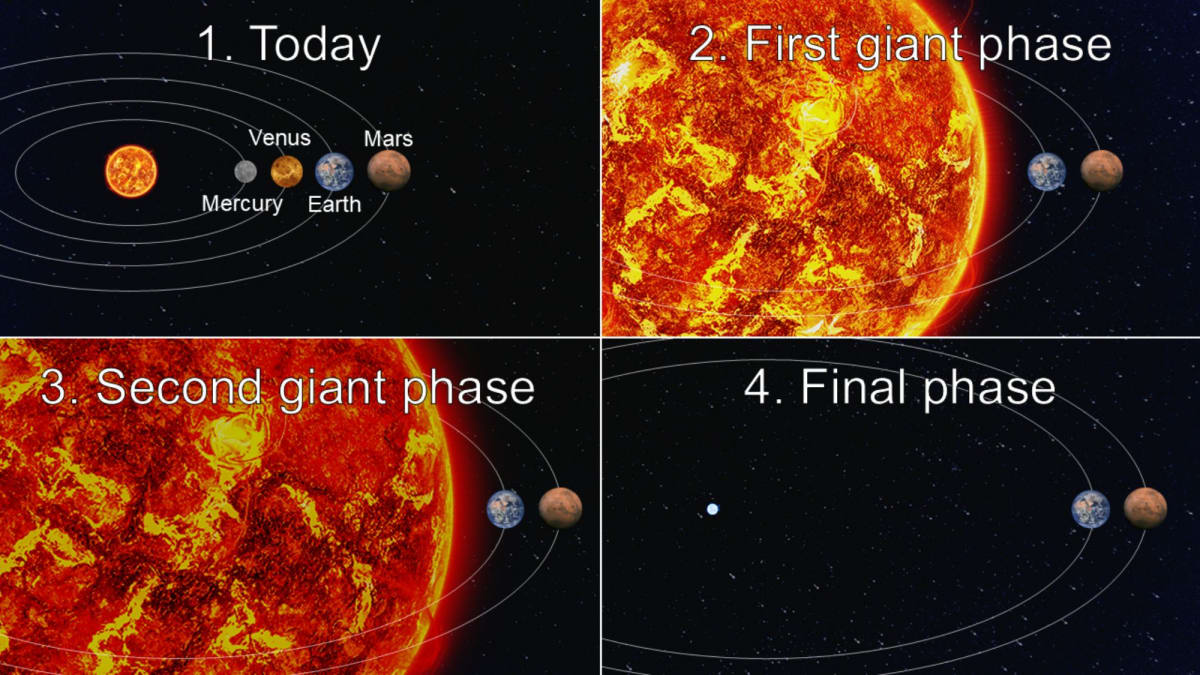
The key lies in understanding a delicate cosmic dance. When the sun exhausts its hydrogen fuel, it will balloon outward far enough to engulf Mercury and Venus. Meanwhile, two competing forces will decide Earth's fate: gravity pulling us inward and the sun's mass loss pushing us outward.
Lead researcher Mats Esseldeurs and his team discovered that older models overestimated how strongly the expanding sun would tug on Earth. Using updated calculations based on aging star behavior, they found the inward pull is weaker than previously thought.
As the dying sun sheds its outer layers through powerful stellar winds, it will lose about half its mass. That lighter gravitational grip could push Earth and Mars into wider orbits, potentially doubling our distance from what will become a white dwarf star.
"The fate of Earth depends on a delicate balance between these two effects," Esseldeurs explained. "If tidal interactions dominate, Earth is engulfed. If mass loss dominates, Earth escapes to a wider orbit."
The study tested various scenarios and found that even with updated numbers, Mercury and Venus cannot escape. But Earth and Mars should migrate safely through both giant phases, settling into broader orbits around the sun's remnant core.
Why This Inspires
This research reminds us that scientific understanding constantly evolves. What seemed like certain doom yesterday becomes possibility today through better observations and smarter calculations.
The findings also shift the scientific conversation. The biggest uncertainty is no longer about gravitational forces but about how much mass the sun will actually lose during its final stages.
Scientists still need better observations of sun-like giant stars to confirm Earth's survival chances. But knowing our planet might endure gives new perspective on humanity's distant future and the resilience of our cosmic home.
Of course, humans have 5 billion years to prepare, adapt, or find new worlds to call home. That's plenty of time for countless generations to write their own chapters in Earth's story.
More Images

Based on reporting by Space.com
This story was written by BrightWire based on verified news reports.
Spread the positivity!
Share this good news with someone who needs it