Edison May Have Made Graphene 145 Years Before Its Discovery
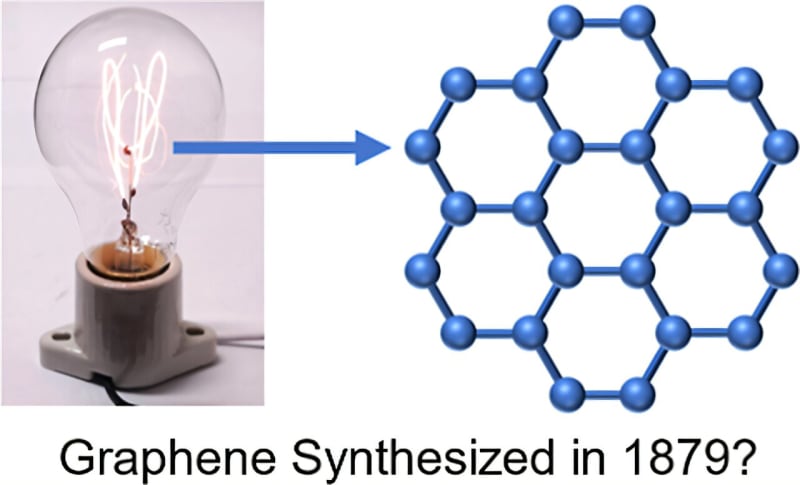
Thomas Edison's 1879 light bulb experiments likely produced graphene, a Nobel Prize-winning material that wouldn't be officially discovered for another 125 years. Rice University scientists recreated his work and found the inventor accidentally created one of the 21st century's most important materials.
Imagine accidentally inventing something so advanced that scientists wouldn't even prove it could exist for another 80 years. That's exactly what Thomas Edison may have done in 1879.
Rice University researcher Lucas Eddy was hunting for cheaper ways to produce graphene, a super-strong material as thin as a single atom that powers modern semiconductors. While brainstorming with colleagues, he realized Edison's early light bulbs used the exact process needed to create it.
Here's the wild part. Graphene requires heating carbon-based materials to 2,000 to 3,000 degrees Celsius with an electrical current. Edison's patented light bulbs did precisely that, using Japanese bamboo filaments instead of the tungsten we use today. When he flipped the switch, he wasn't just making light. He was likely creating a material that wouldn't win a Nobel Prize until 2010.
Eddy tracked down authentic Edison-style bulbs from a small art store in New York City after several failed attempts with fake "carbon" filaments. He connected one to a 110-volt DC power source, just like Edison would have, and switched it on for 20 seconds.
Under a microscope, the dark gray filament had transformed into a lustrous silver. Raman spectroscopy, a laser technique from the 1930s, confirmed it. Parts of the filament had become turbostratic graphene.
Why This Inspires
Edison died nearly 20 years before physicist P.R. Wallace even proposed graphene could exist in theory. He never knew his light bulb experiments were producing a substance that would revolutionize modern technology. His simple quest to bring light into homes may have accidentally paved the way for the semiconductors and advanced materials powering our digital age.
"To reproduce what Thomas Edison did, with the tools and knowledge we have now, is very exciting," said James Tour, the Rice University professor leading the research. The discovery raises an inspiring question: what other breakthroughs are hiding in plain sight, waiting in the notebooks of scientists who came before us?
Tour wonders what questions Edison would ask if he could step into a modern lab today, and what answers we might find by revisiting old experiments with new eyes.
The past and future of innovation just turned out to be more connected than anyone imagined.
More Images
Based on reporting by Google News - Science
This story was written by BrightWire based on verified news reports.
Spread the positivity!
Share this good news with someone who needs it