Elephant Trunk Whiskers Work Like a Touch Map for Tiny Objects
Scientists discovered that the 1,000 whiskers on an elephant's trunk have a unique stiffness gradient that acts like a natural GPS system, helping these gentle giants pick up peanuts without crushing them. The breakthrough is now inspiring smarter robot sensors.
Elephants can pluck a single peanut from the ground or grab a tortilla chip without breaking it, and scientists just figured out how.
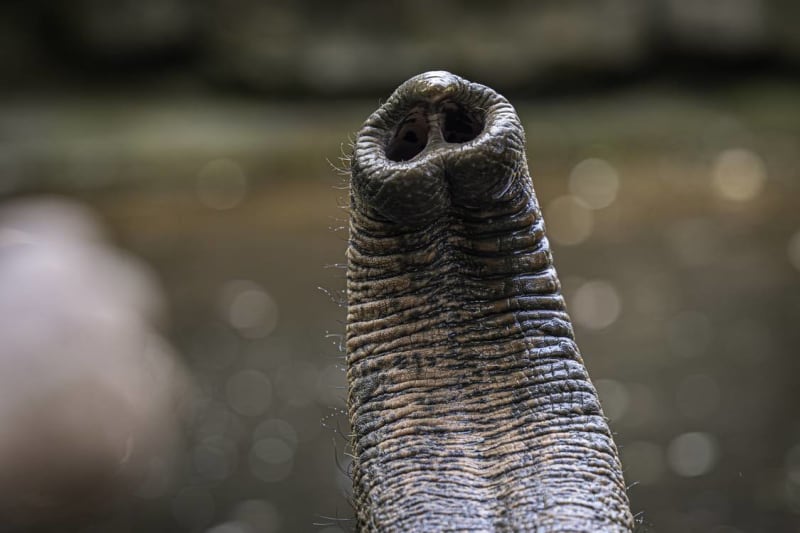
German researchers discovered that the 1,000 whiskers covering an elephant's trunk aren't ordinary hairs. Each one starts stiff at the base and gradually becomes soft and rubbery at the tip, creating what scientists call a "functional gradient."
This unusual design works like a built-in map. When a whisker touches something, the elephant instantly knows whether the contact happened near or far from its trunk, all without needing to look.
Dr. Andrew Schulz, who led the study, calls it "embodied intelligence." The whiskers themselves contain all the information an elephant needs, encoded in their shape, structure, and stiffness.
The research team used micro-CT scanning to examine whiskers in 3D. They found elephant whiskers are thick and blade-like with hollow bases and long internal channels, similar to sheep horns and horse hooves.
This porous design serves a practical purpose. It makes the whiskers lighter and more impact-resistant, protecting them as elephants eat hundreds of kilograms of food daily. The extra durability matters because elephant whiskers never grow back once damaged.
To understand how the stiffness gradient helps elephants feel, the team 3D-printed a scaled-up whisker model. Professor Katherine Kuchenbecker walked through her institute tapping the "whisker wand" on railings and columns.
"I didn't need to look to know where the contact was happening," she explained. "I could just feel it." Tapping with the soft tip felt gentle, while contact at the stiff base felt sharp and strong.
Computer simulations confirmed the insight. The gradual transition from stiff to soft makes it dramatically easier to sense exactly where touch occurs along each whisker, giving elephants precise control over delicate objects.
Why This Inspires
This discovery does more than explain elephant dexterity. Engineers are now designing robot sensors inspired by these natural whiskers that can provide precise touch information without complex computers, just through intelligent material design.
Nature solved a tricky engineering problem millions of years ago, and now that solution could help robots move more safely and interact more gently with their surroundings.
The research reminds us that some of the smartest designs already exist in the natural world, waiting to teach us something new.
More Images




Based on reporting by Good News Network
This story was written by BrightWire based on verified news reports.
Spread the positivity!
Share this good news with someone who needs it