Euclid Telescope Finds 2 Oldest Black Holes Ever Seen
Scientists just discovered 31 ancient quasars, including the two oldest ever found, shining from when the universe was barely 5% its current age. These cosmic beacons, each brighter than a trillion suns, could finally explain how supermassive black holes grew so large so quickly after the Big Bang.
The European Space Agency's Euclid telescope just spotted light from two black holes that have been traveling toward us for over 13 billion years.
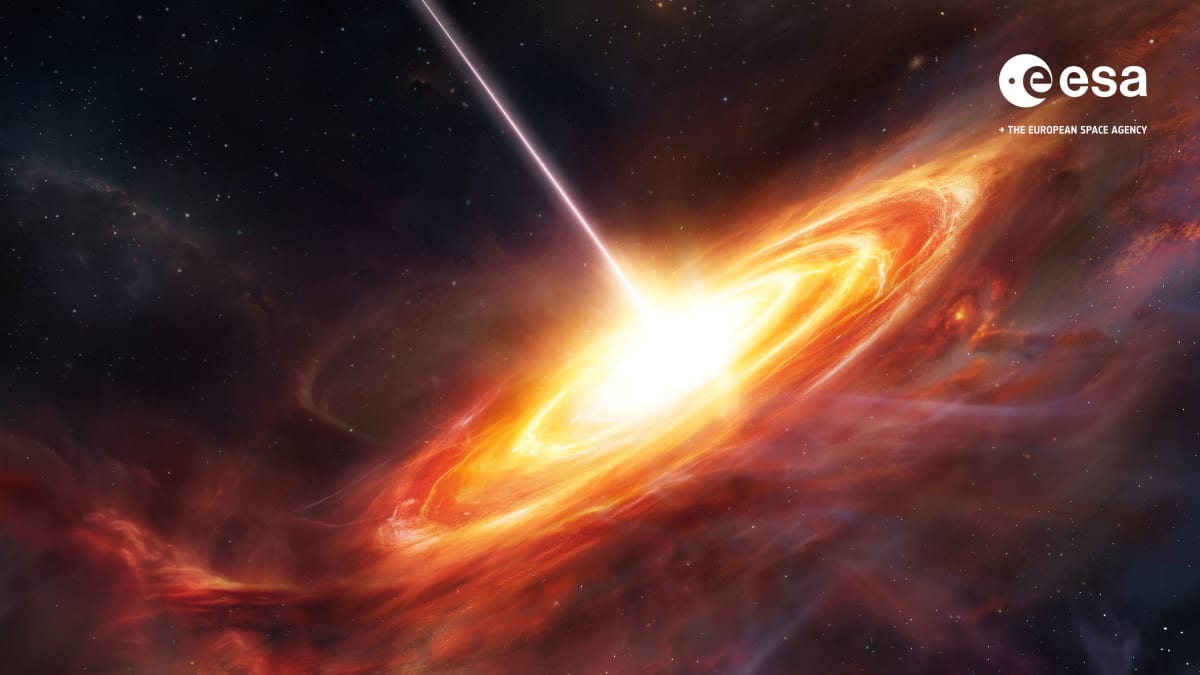
These aren't ordinary black holes. They're quasars, the brightest objects in the universe, formed when material spirals into supermassive black holes and releases energy that outshines entire galaxies. Each of the two record-breakers glowed with the power of a trillion suns when the universe was just 670 million years old.
The discovery includes 31 previously unknown quasars from the universe's earliest days, more than doubling the number we knew about from that era. Twelve of them date back to the first 770 million years after the Big Bang, a period when galaxies were just starting to take shape.
"By finding and studying them, we can better understand how these enormous systems formed and grew so quickly," said Daming Yang, an astronomer at Leiden University who led the study published in Astronomy & Astrophysics. It's one of the greatest mysteries in astrophysics: how did black holes get so massive so fast?
Until now, finding these ancient quasars was like searching for fireflies across an ocean. They're incredibly rare and distant, and astronomers could only spot the brightest ones. Euclid's wide-field survey changes everything by detecting fainter quasars across huge swaths of sky.
The Ripple Effect
This is just the beginning of what Euclid will reveal. The telescope's six-year mission will eventually cover more than one-third of the entire sky, creating the largest 3D map of the universe ever made. Scientists expect to find hundreds more ancient quasars, building an unprecedented picture of how early galaxies and black holes evolved together.
The discoveries give astronomers their first real chance to understand the full population of early quasars, not just the superstars. Each new find adds another piece to the puzzle of cosmic evolution, showing how the universe transformed from a hot, dense soup into the structured cosmos we see today.
Euclid isn't just looking backward in time. In late June, it also captured a stunning image revealing more than 60 million individual stars packed into the Milky Way's center, proving it can study both the ancient and nearby universe with equal clarity.
These distant beacons offer us a window into a time when the universe was young, wild, and forming the structures that would eventually lead to galaxies like our own.
More Images

Based on reporting by Live Science
This story was written by BrightWire based on verified news reports.
Spread the positivity!
Share this good news with someone who needs it