Europe's Skies 4.8% Brighter Over Past 30 Years
Europe's skies are literally getting brighter, with sunlight reaching the ground increasing by nearly 5% over three decades thanks to cleaner air and changing clouds. The shift is powering solar energy gains and reshaping everything from farming to tourism.
Europe is basking in more sunshine than it has in generations, and the reason reveals one of our biggest environmental wins in action.
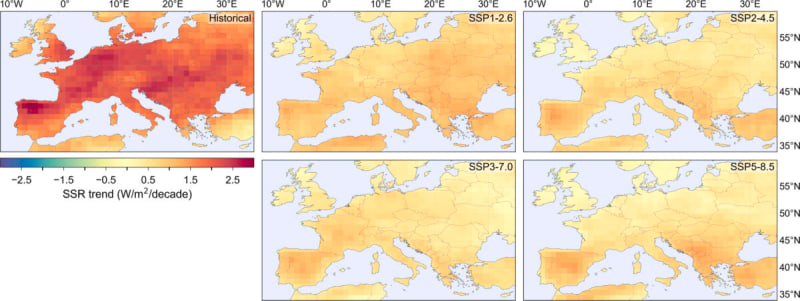
New research analyzing 30 years of data shows surface solar radiation across Europe increased by 4.8% between 1994 and 2023. That means the continent is receiving significantly more sunlight at ground level than it did a generation ago.
The study, led by researchers at the University of Malaga and University of Murcia in partnership with solar data company Solargis, analyzed three decades of historical data and projected trends through 2054. It represents one of the most comprehensive solar radiation studies ever conducted in Europe.
Central-western Europe saw the biggest gains. Northeastern France, the Benelux countries, and western Germany recorded nearly 11% more sunlight reaching the surface over the 30-year period, equivalent to 4.7 watts per square meter each decade.
The reason behind brighter skies tells an encouraging story about environmental progress. About 80% of the increase comes from changes in cloud patterns and opacity, while 20% results directly from reduced air pollution.
When researchers dug deeper into how aerosols interact with clouds, they found pollution reduction plays an even bigger role. Cleaner air affects how clouds form and how much light they block, making aerosol reduction responsible for up to three-fifths of the total brightening effect.
The Ripple Effect
The implications reach far beyond the solar energy industry. More sunlight means solar panels generate more electricity, making renewable energy projects more productive and financially viable than earlier projections suggested.
But the changes touch nearly every corner of European life. Farmers are adjusting to altered growing conditions, tourism patterns are shifting with changing weather, and education systems are adapting curriculum to address evolving environmental realities.
Lead researcher José Antonio Ruiz-Arias notes the brightening trend will likely slow over the next three decades based on climate model predictions. The complexity of atmospheric behavior and ongoing changes in pollution levels make long-term projections uncertain, he explains, underscoring the need for continued monitoring.
The research carries a powerful reminder that environmental action delivers measurable results, even if those results create new complexities to navigate.
A brighter Europe means rising temperatures and altered precipitation alongside the sunny skies, creating both opportunities and challenges that communities are already beginning to address with the same innovation that cleaned the air in the first place.
More Images

Based on reporting by PV Magazine
This story was written by BrightWire based on verified news reports.
Spread the positivity!
Share this good news with someone who needs it