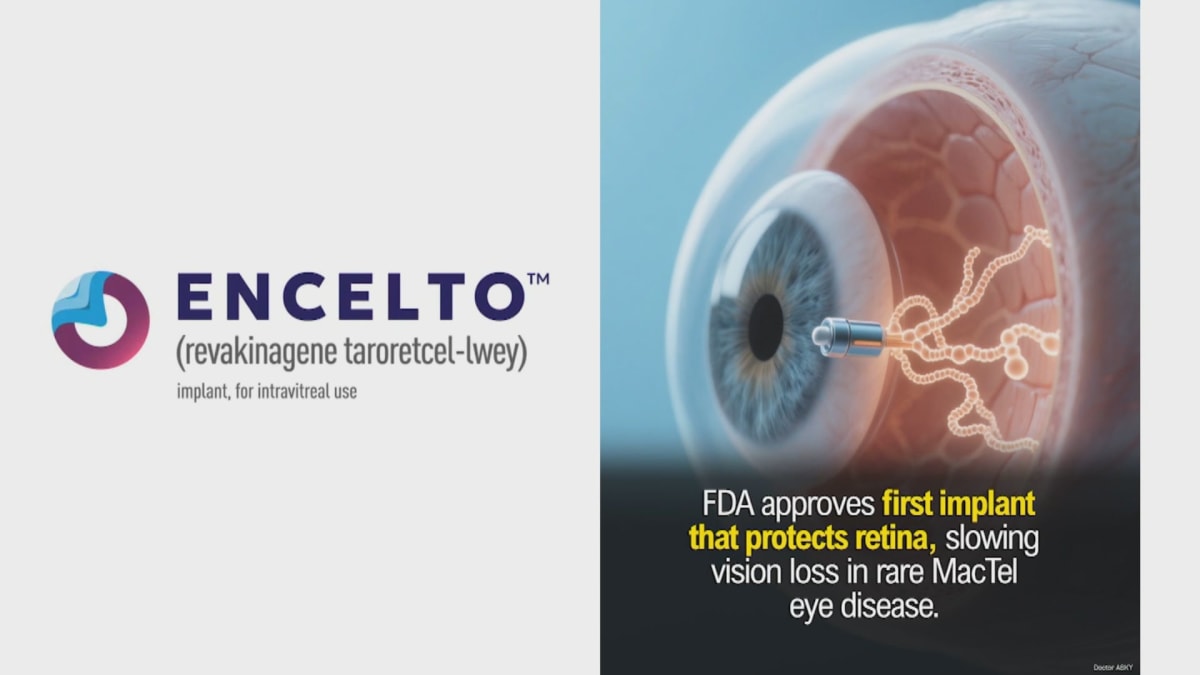
FDA Approves Vision-Saving Implant for Rare Eye Disease
A rice-sized implant with living cells is now FDA-approved to slow vision loss in MacTel patients, offering hope to thousands losing their sight. For the first time, people with this rare retinal disease have a real chance to preserve their independence.
For Yvette Crawley, planning her retirement adventures suddenly became harder when the world started losing its sharpness. Even new glasses couldn't fix what was happening to her central vision.
Crawley has MacTel, a rare progressive eye disease that creates a void right in the center of her sight. The condition damages photoreceptors at the back of the eye, making it impossible to read, drive, or even recognize the faces of loved ones.
But doctors at Duke Health are now offering something revolutionary. They're using a first-of-its-kind cell-based implant that's about the size of a grain of rice but packed with more than 200,000 living cells.
"It produces continuously a growth factor or protein that provides healthy function for the retinal cells," explains Dr. Lejla Vajzovic, a retina specialist at Duke University School of Medicine. The cells stay inside the tiny capsule and release proteins that reach the back of the eye, protecting remaining vision.
The implant can't restore sight that's already gone. But it can protect what patients still have, which for people like Yvette means holding onto their freedom and their dreams.
"I want to continue my fabulous retirement life," Yvette says with determination. "I have yet to go to Alaska! I want to see the Northern Lights, that's on my bucket list."
Why This Inspires
MacTel affects thousands of Americans who've watched their central vision slowly disappear with no treatment options. This breakthrough represents years of research finally paying off for a patient community that's been waiting for hope.
The procedure is straightforward: a one-day outpatient surgery. The FDA approval means access is expanding beyond clinical trials, and specialists say timing matters. The sooner patients receive the implant after diagnosis, the better their chances of preserving sight.
Unlike age-related macular degeneration, which affects millions, MacTel targets the tissue around the macula specifically. It's rarer but just as devastating for those who have it, robbing them of independence one blurry day at a time.
Now, for the first time, they can fight back. And for Yvette and her dog Riella Coconut, that means those Northern Lights are still within reach.
Based on reporting by Google News - Health Breakthrough
This story was written by BrightWire based on verified news reports.
Spread the positivity!
Share this good news with someone who needs it