First Adult T. Rex Footprints Found in North Dakota
Scientists discovered four fossilized footprints showing an adult T. rex's path across ancient mud 66.5 million years ago. It's the first known adult T. rex trackway ever found, capturing a rare moment of dinosaur behavior frozen in time.
Imagine following in the exact footsteps of a Tyrannosaurus rex as it walked across the landscape millions of years ago. That's now possible thanks to an extraordinary discovery in southwestern North Dakota.
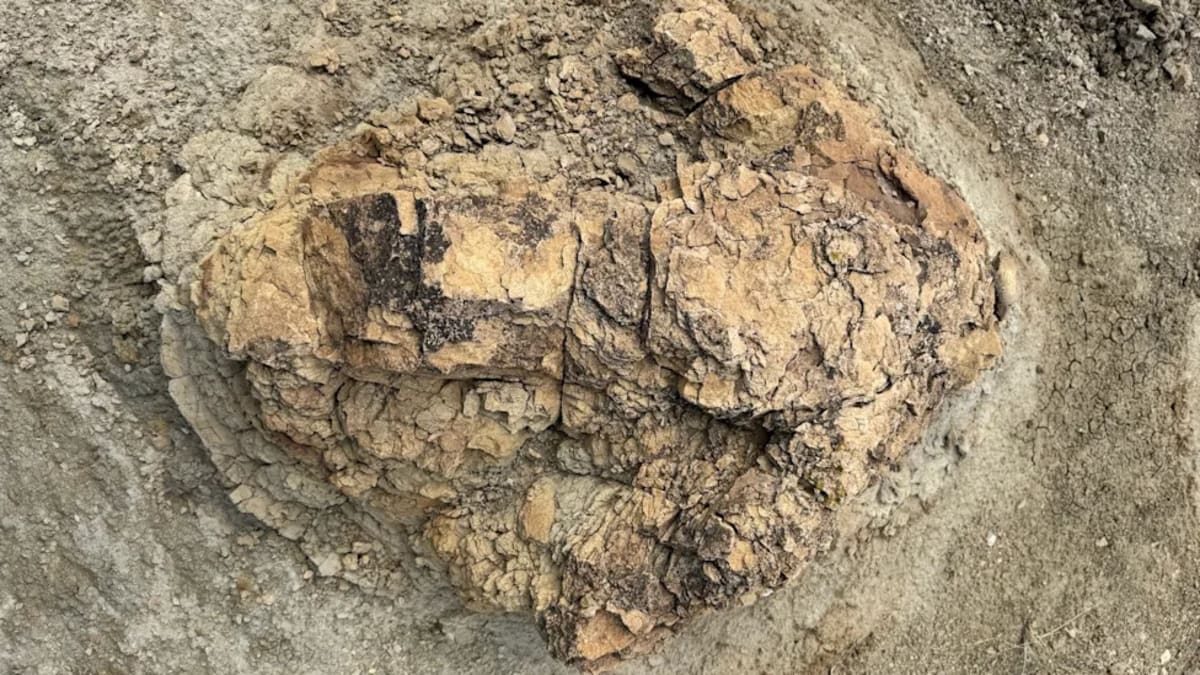
Paleontologists from the Denver Museum of Nature & Science and Liverpool John Moores University found four massive footprints preserved along a 23-foot path in the famous Hell Creek Formation. Each print measures about three feet long, stamped into ancient mud by a 17,500-pound apex predator roughly 66.5 million years ago.
Here's what makes this find so special: while T. rex fossils are relatively common, their footprints almost never survive long enough to fossilize. Even when made by creatures weighing nearly nine tons, these impressions in mud rarely last through millions of years of geological changes.
The discovery happened near the town of Marmath, North Dakota, close to the Montana border. After finding the prints on federal land last year, researchers carefully cleared the area and used high-resolution 3D scanners to capture every detail digitally and create physical reproductions.
The trackway tells a surprisingly peaceful story. Based on the 13-foot stride between prints, scientists estimate this particular T. rex was taking a leisurely stroll at about 3.5 to 4.5 miles per hour. That's roughly the same pace as a human power-walking, not the terrifying chase scene you'd see in movies.
Why This Inspires
This discovery opens a window into dinosaur life that bones simply can't provide. Fossils tell us about anatomy and size, but footprints capture something more intimate: a single moment in time when a living creature moved through its world.
"Bones tell us an enormous amount about these animals, but footprints capture a moment of behavior," explained Tyler Lyson, a paleontologist at the Denver Museum and study co-author. "With a trackway, we can actually follow an animal as it moved across the landscape. That is incredibly rare for T. rex."
Later this year, the team plans to excavate three of the four prints and transport them by helicopter to the Denver Museum of Nature & Science. There, visitors will be able to stand beside the same path a T. rex once walked, connecting across millions of years to one of Earth's most iconic creatures.
The findings were recently published in the Journal of Vertebrate Paleontology, ensuring this remarkable discovery will help scientists understand dinosaur behavior for generations to come. Sometimes the most amazing stories are literally written in stone, just waiting to be found.
More Images


Based on reporting by Google News - Science
This story was written by BrightWire based on verified news reports.
Spread the positivity!
Share this good news with someone who needs it