Food Grinders Cut Cities' Waste Costs 11%, Emissions 47%
Scientists discovered that grinding food waste and sending it through sewage systems saves money and dramatically reduces pollution in cities with wet food waste. Hong Kong could save $46 million annually while nearly halving greenhouse gas emissions.
What if your kitchen sink could help solve one of the world's biggest environmental problems while saving your city millions of dollars?
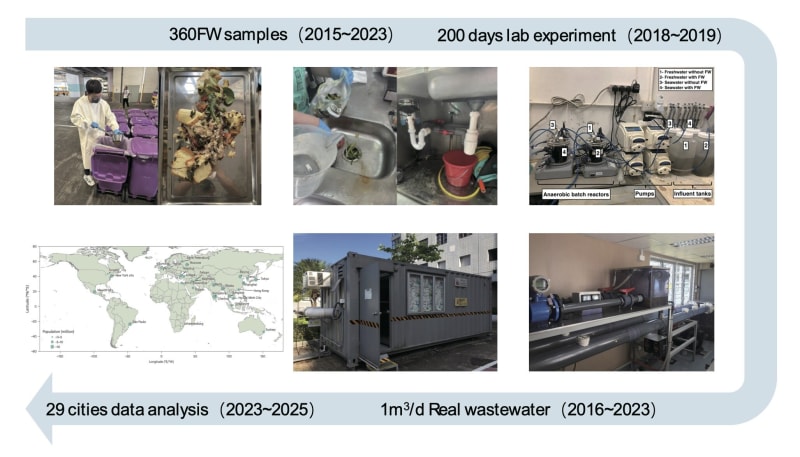
Researchers at Hong Kong University of Science and Technology just proved it can. After studying 29 major cities worldwide for ten years, they discovered that grinding wet food waste and sending it through sewage systems is far more effective than trucking it to landfills.
The breakthrough centers on a simple insight: moisture matters more than weight. Cities where people eat fresh ingredients and soup-based diets generate wetter food waste, which costs more to transport and releases more methane when buried in landfills.
Professor Chen Guanghao's team developed a framework called Urban Biowaste Flux that identifies which cities benefit most from integrated systems. They found that when food waste moisture exceeds about 47 kilograms per person per year, grinding and sewage treatment beats separate collection.
The numbers are striking. Hong Kong could reduce total waste management costs by 11% and cut greenhouse gas emissions by nearly half. The city would spend about $28 million more on wastewater treatment but save $74 million in landfill costs.
Twenty-seven of the 29 cities studied would see energy consumption drop by about 21% under this system. Twenty-six would reduce greenhouse gas emissions by roughly 23%.
The Ripple Effect
The implications reach far beyond Hong Kong. In the United States, food waste generates 58% of all methane emissions from landfills, making it a major climate problem. About half of American food waste already goes through sewage systems, but the practice remains rare in Asia.
Cities like Beijing and Seoul, where traditional diets include lots of soups and fresh vegetables, stand to gain the most. The integrated approach turns a disposal problem into an energy opportunity through anaerobic digestion, where bacteria break down waste and produce fuel.
The sewage treatment process captures methane that would otherwise escape into the atmosphere. Incinerated sludge generates electricity. What once cost money to bury now helps power cities.
Dr. Guo Hongxiao notes that food waste accounts for nearly 58% of the total chemical load entering Hong Kong's biowaste system. That massive volume has been treated as garbage when it could be treated as a resource.
The research, published in Nature Cities, gives urban planners a practical tool for evaluating their own food waste systems. Not every city will benefit equally, but those with high moisture loads and expensive landfill costs now have a tested alternative.
Turning dinner scraps into clean energy isn't just smart science—it's a recipe for cleaner air and healthier city budgets.
More Images

Based on reporting by Phys.org
This story was written by BrightWire based on verified news reports.
Spread the positivity!
Share this good news with someone who needs it