Fossil Wood Reveals 300 Million Years of Europe's History
Scientists discovered that fossilized wood from Germany contains a geological time capsule spanning 300 million years. The quartz crystals inside these ancient trees preserve the entire history of how Europe's landscape evolved.
A polished piece of fossilized wood might look like just another pretty stone, but scientists in Germany just proved it holds secrets stretching back 300 million years.
Dr. Steffen Trümper and his team at the University of Münster made a groundbreaking discovery: the quartz crystals inside petrified wood can preserve a complete geological record of how continents change over hundreds of millions of years. No one has ever documented such a long timeline of information locked inside fossilized trees.
The researchers studied ancient tree trunks from the Kyffhäuser Mountains in northern Germany, some reaching 20 meters long. These trees once grew in tropical forests on the supercontinent Pangaea when this part of Europe sat near the equator, supporting extinct relatives of modern conifers.
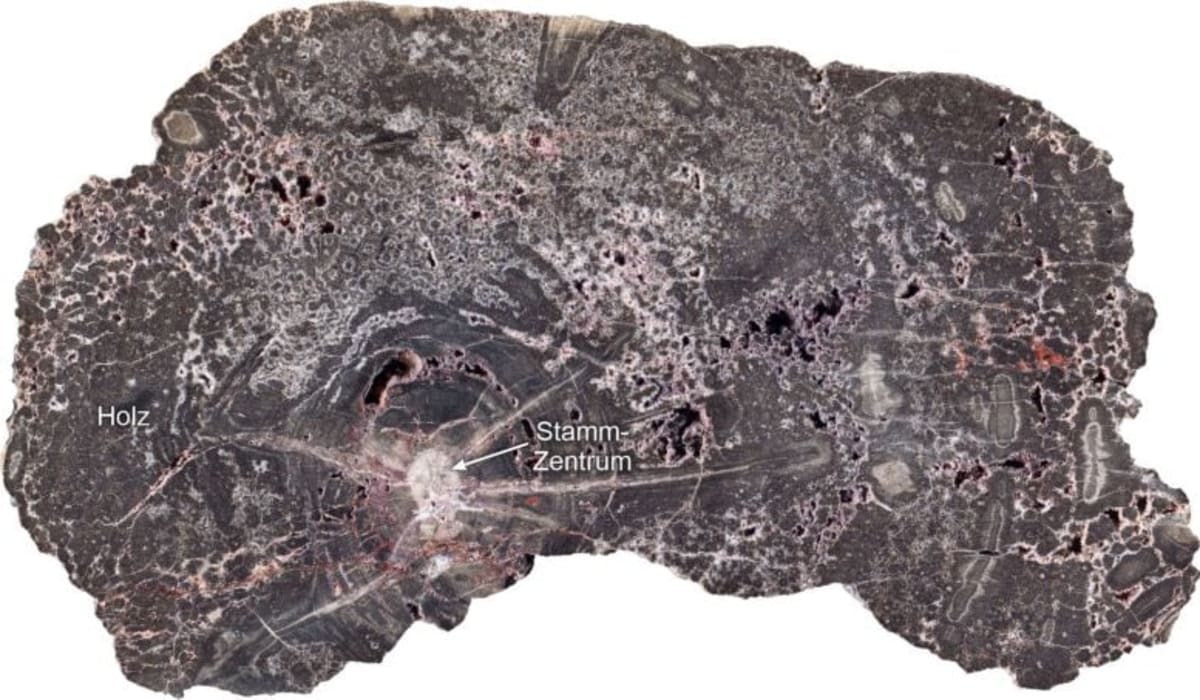
When rivers flooded and buried these trees 300 million years ago, something remarkable began. Dissolved silica slowly seeped into the dead wood, forming quartz crystals that replaced the original tissue cell by cell, preserving even microscopic details.
The team discovered five distinct generations of quartz, each capturing a snapshot of different geological conditions. Using advanced techniques including fluid analysis and isotope measurements, they traced how these fossils sank between three and five kilometers underground, experiencing temperatures up to 240 degrees Celsius.
The quartz crystals acted like tiny time capsules. Microscopic pockets of fluid trapped inside revealed exact temperatures and pressures the wood experienced at different depths over 200 million years of geological change.
Why This Inspires
This discovery gives scientists a completely new tool for understanding Earth's history. Fossilized wood exists in rock formations worldwide, meaning researchers now have access to geological archives they never knew existed.
"It is astonishing that a fossil, often no bigger than the palm of a hand, encapsulates the geological history of an entire region spanning hundreds of millions of years," Trümper explains. What once seemed like simple decorative stones now represent windows into continental evolution.
The research matters beyond academic curiosity. The Central European Basin system these fossils help map contains vital groundwater resources, raw materials, and potential geothermal energy sources that could benefit millions of people.
The findings prove that even objects we might overlook hold extraordinary stories waiting to be uncovered, opening doors to understanding our planet in ways previously impossible.
More Images
Based on reporting by Google News - Scientists Discover
This story was written by BrightWire based on verified news reports.
Spread the positivity!
Share this good news with someone who needs it