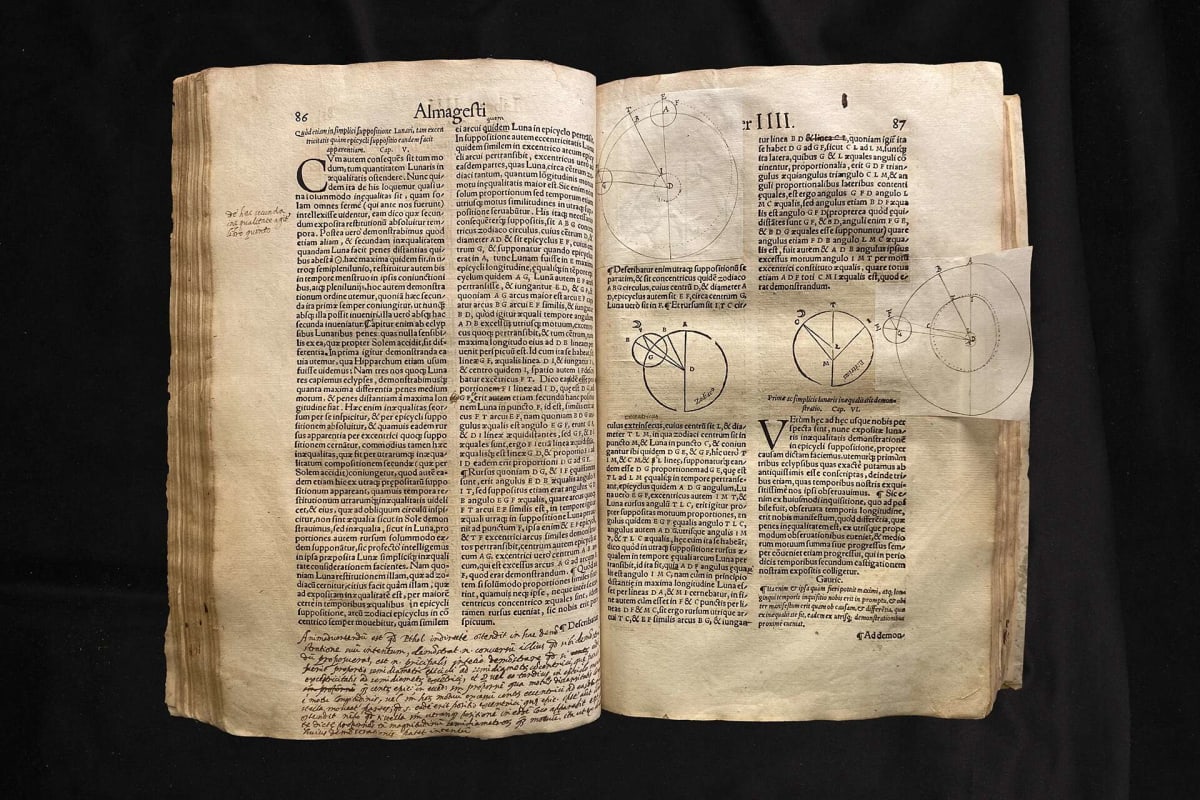
Galileo's Handwritten Notes Found in 1551 Astronomy Book
A historian in Florence discovered handwritten notes by Galileo Galilei hidden in a rare 16th-century astronomy textbook. The find reveals how the legendary scientist studied ancient theories before revolutionizing our understanding of the universe.
A centuries-old astronomy book sitting quietly in a Florence library just revealed one of its best-kept secrets: personal notes written by Galileo Galilei himself.
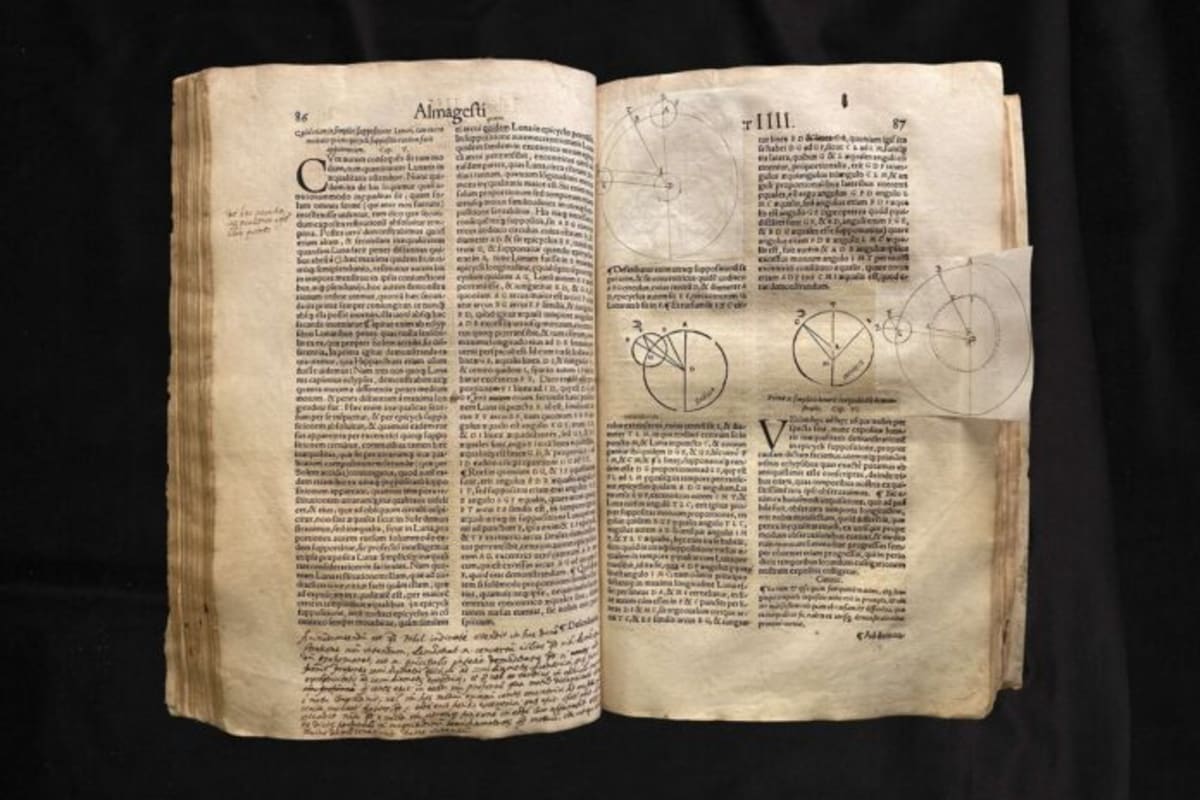
Historian Ivan Malara made the discovery in January while examining a 1551 Latin edition of The Almagest at the National Central Library of Florence. The influential text, written by Greek-Egyptian astronomer Claudius Ptolemy in the second century, shaped Western understanding of the cosmos for over 1,400 years with its Earth-centered model of the universe.
Malara's attention was caught by an unusual detail on a blank page: a handwritten copy of Psalm 145. The writing style looked remarkably similar to Galileo's known handwriting, prompting him to examine the book more carefully.
That closer look paid off. Malara found numerous detailed notes written in tight script along the margins of several pages, all appearing consistent with Galileo's documented writing style and study methods.
To verify the discovery, Malara consulted experts including Michele Camerota, a historian at the University of Cagliari who specializes in Galileo's work. After examining the handwriting patterns, abbreviations, and annotation techniques, Camerota and other scholars connected with the Galileo Museum concluded the notes appear authentic.
The timing makes the discovery even more fascinating. Malara believes Galileo wrote these notes around 1590, when he was still a young scholar years before his groundbreaking telescope observations of the Moon and Jupiter's moons.
Why This Inspires
This discovery shows us something beautifully human about scientific progress: even the greatest minds had to start somewhere. Galileo didn't wake up one day ready to challenge 1,400 years of accepted astronomy. He studied, questioned, and carefully examined the work that came before him.
The biblical passage Galileo copied into the book adds another layer of meaning. Records show that another 16th-century copy of The Almagest includes a note stating that Galileo prayed before studying the text, and an 1673 letter by mathematician Alessandro Marchetti mentioned the same practice.
These marginal notes reveal how Galileo deeply examined Ptolemy's geocentric theories before eventually supporting Nicolaus Copernicus's revolutionary idea that Earth and other planets orbit the sun. That support would later bring him into conflict with the Catholic Church and lead to his house arrest in 1633.
Some of Galileo's marginal comments even resemble arguments he later used in his own published scientific works from the same period. The annotations show his thought process evolving in real time, challenging ideas that had dominated scientific thinking for centuries.
Malara plans to publish a detailed academic study of the notes in the Journal for the History of Astronomy, giving researchers worldwide the chance to analyze how these early annotations shaped one of history's most important scientific minds.
This discovery reminds us that breakthroughs don't happen in isolation—they're built on careful study, deep thinking, and the courage to question even the most established ideas.
More Images
Based on reporting by Google: scientific discovery
This story was written by BrightWire based on verified news reports.
Spread the positivity!
Share this good news with someone who needs it