Golf Ball-Sized Blue Octopus Found in Galapagos
Scientists discovered a tiny blue octopus the size of a golf ball near the Galapagos Islands, marking the first new octopus species described by researcher Janet Voight in her 40-year career. The creature was found nearly 6,000 feet below the surface in waters that remain largely unexplored.
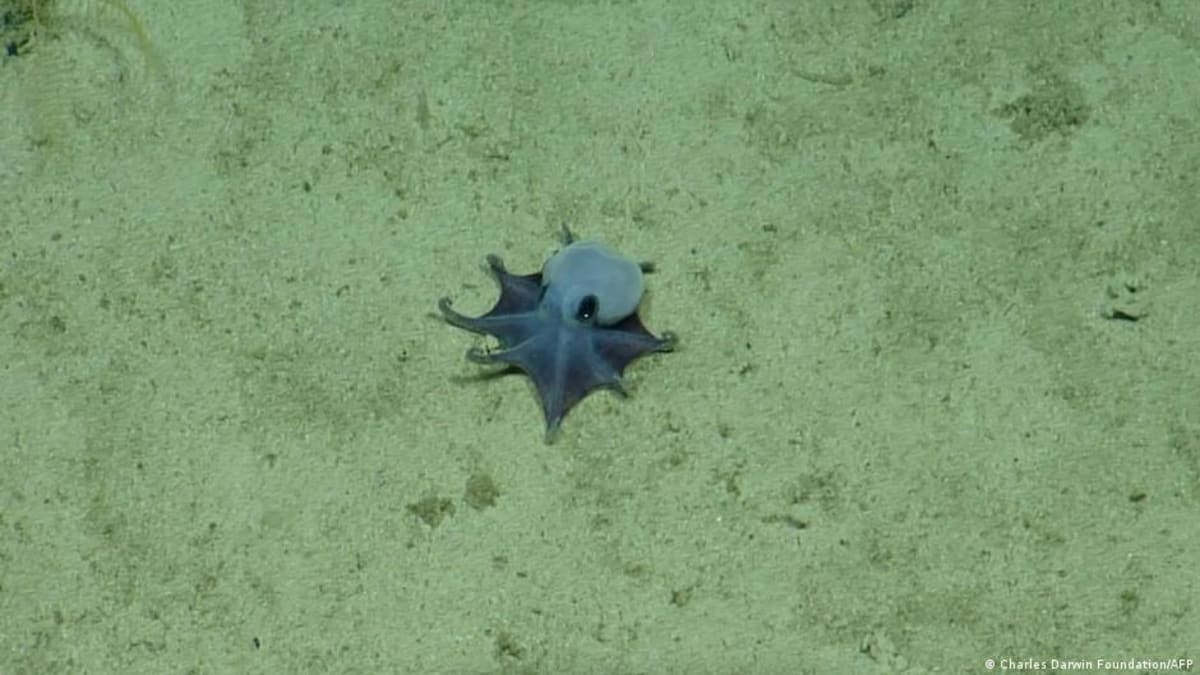
A tiny blue octopus no bigger than a golf ball has scientists celebrating a rare discovery in the deep waters surrounding Ecuador's Galapagos Islands.
The newly named Microeledone galapagensis was first spotted in 2015 by researchers operating a remotely controlled camera nearly 6,000 feet below the ocean's surface. Their excited reactions said it all: "He's tiny!" and "It's blue!" echoed through the submersible as they observed the little creature.
Janet Voight, the lead scientist who studied the octopus, knew immediately she was looking at something special. "Right away, I knew it was something really special. I'd never seen anything like it," said Voight, who has spent four decades studying octopus evolution.
The discovery matters because scientists know very little about octopuses living in the deep tropical Pacific Ocean. The crew collected the specimen and spotted two others that looked similar during their mission, suggesting these little blue octopuses may have their own thriving community down there.
Getting the octopus properly studied required some creative thinking. Because researchers only had one specimen, Voight couldn't use traditional methods that would have required cutting it apart to examine its beak, mouth, and teeth.
Instead, her team created detailed micro CT scans and built a complete 3D model of the octopus, inside and out. This was the first time in Voight's entire career that she led a study describing a brand new octopus species.
The Ripple Effect: The Galapagos Islands became famous when Charles Darwin visited in the mid-1800s and used his observations there to develop his theory of evolution. Today, the surrounding waters continue revealing creatures found nowhere else on Earth, with vast areas still waiting to be explored. Each new discovery like this tiny blue octopus helps scientists understand how life adapts to extreme environments and what other wonders might be hiding in the deep ocean. The more we learn about these unique ecosystems, the better equipped we become to protect them for future generations.
Voight's reaction to the discovery captures the joy of scientific exploration perfectly: "These are little octopuses that live in the deep sea, and hardly anybody on Earth has ever gotten to see them. I just feel lucky that I got to work with them."
The find reminds us that our planet still holds countless surprises waiting to be discovered in places we've barely begun to explore.
Based on reporting by Google News - Scientists Discover
This story was written by BrightWire based on verified news reports.
Spread the positivity!
Share this good news with someone who needs it