Harvard Chip Twists Light in Real Time for New Tech
Scientists at Harvard built a tiny chip that can control the "handedness" of light on demand, opening doors to smarter sensors and faster communications. The breakthrough could revolutionize how we detect molecules and transmit data.
Harvard engineers just created something that sounds like science fiction: a chip small enough to fit on your fingertip that can twist light like a dial.
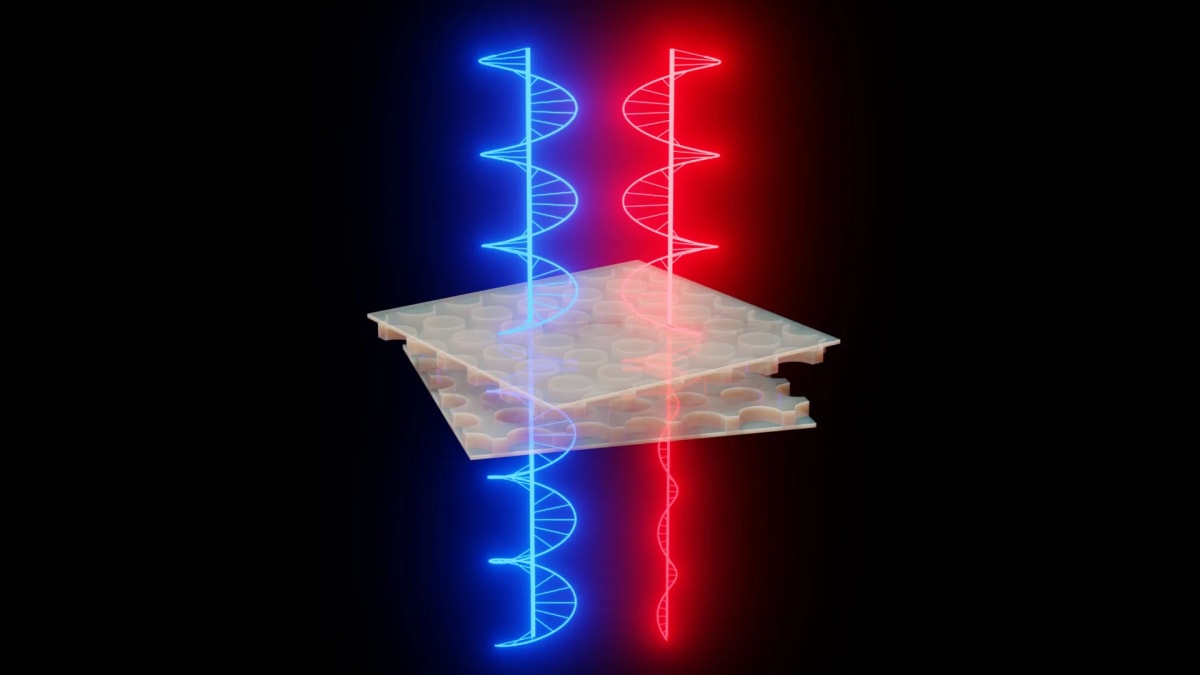
The device, built by graduate student Fan Du and his team at Harvard's School of Engineering, controls what scientists call the "handedness" of light. Just like your left and right hands are mirror images, light can spiral clockwise or counterclockwise as it travels.
The chip uses two stacked layers of nanoscale photonic crystals that rotate and adjust their spacing through a tiny mechanical system. By changing the angle and distance between these layers, the team can make the chip respond differently to left-spinning versus right-spinning light with remarkable precision.
This might sound abstract, but the real-world implications are huge. In medicine and chemistry, molecules that are mirror images of each other can have completely opposite effects in the human body. The drug thalidomide proved this tragically in the 1950s when one version helped pregnant women with morning sickness while its mirror twin caused birth defects.
Scientists currently use bulky, fixed equipment to study these molecular twins with chiral light. Harvard's device changes that game entirely by being fully tunable without swapping out any parts.
Professor Eric Mazur, who led the research, borrowed concepts from twistronics, a field that gained attention through studies of twisted graphene layers. His team applied similar thinking to light control, creating optical properties that don't exist in single layers.
The Ripple Effect spreads far beyond the lab bench. Future versions of this chip could detect specific molecules at different wavelengths, making medical diagnostics faster and more precise. In communications, the technology could modulate light signals directly on computer chips, speeding up data transmission for everything from your phone to data centers.
The device also holds promise for quantum technologies, where controlling light's properties with precision matters enormously. Because it uses standard manufacturing techniques already common in photonics, companies could adopt the technology without reinventing their production lines.
The team published their proof-of-concept study in the journal Optica, laying out a design strategy that other researchers can build upon. While the current version demonstrates what's possible, the researchers envision creating tunable sensors that adapt to whatever scientists need to study.
What makes this breakthrough especially exciting is how it combines fundamental physics with practical engineering. The chip doesn't just advance our understanding of light, it puts that knowledge into a form that fits the devices we already use every day.
Technology that can distinguish between left and right at the level of light and molecules is bringing us closer to sensors that catch diseases earlier and computers that communicate faster than ever.
Based on reporting by Science Daily
This story was written by BrightWire based on verified news reports.
Spread the positivity!
Share this good news with someone who needs it