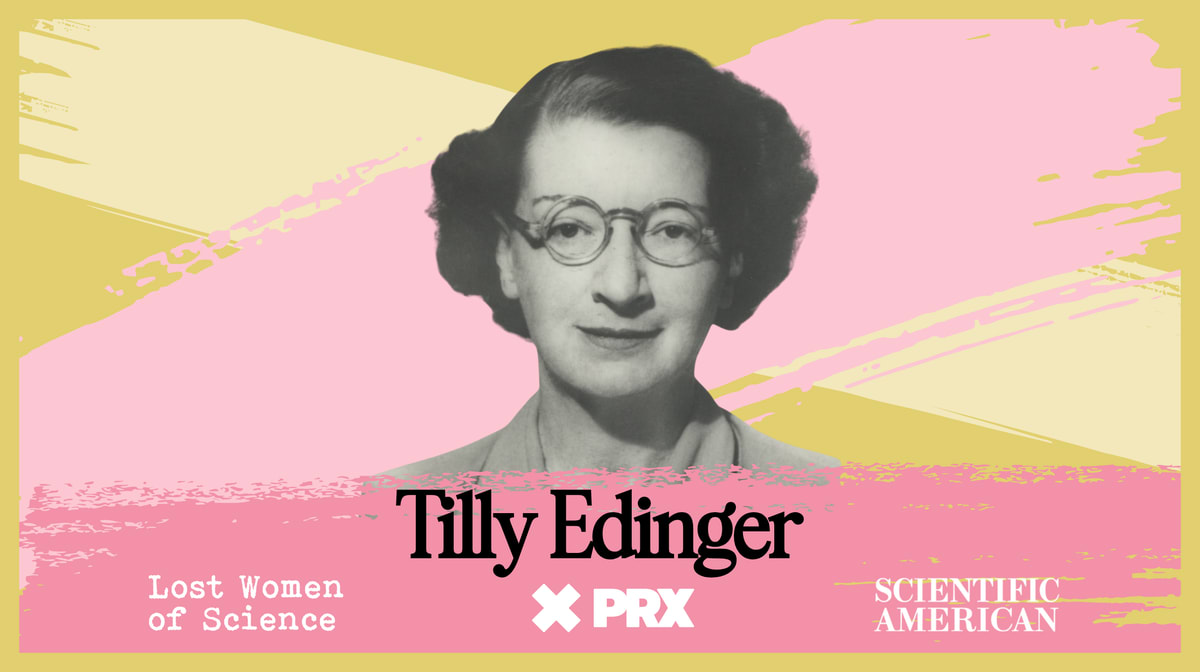
How Ancient Brains Helped One Woman Escape Nazi Germany
When Jewish paleontologist Tilly Edinger was banned from her museum job in 1938, she believed her groundbreaking research on fossilized brains would save her life. Her scientific accomplishments in a field she created became her passport to freedom.
In November 1938, as broken glass from destroyed Jewish businesses crunched beneath her feet in Frankfurt, Tilly Edinger made a bold prediction: fossils would save her.
The Jewish paleontologist had just been permanently banned from the Senckenberg Museum, where she'd volunteered for 15 years studying something extraordinary. Tilly had pioneered paleoneurology, the study of how brains evolved over millions of years by examining fossilized skulls.
Her confidence wasn't misplaced. Born into a wealthy Frankfurt banking family in the late 1800s, Tilly had advantages that helped her break into science despite being a woman with progressive hearing loss. Her mother Anna was a prominent women's rights activist, and her father Ludwig was such a respected neurologist that part of the human brain still bears his name today.
But Tilly made her own mark in the 1920s by asking a question that seemed impossible to answer: How do you study brains when those brains disappeared millions of years ago? She developed techniques to analyze the interior spaces of fossilized skulls, revealing how different species' brains had changed over evolutionary time.
As Nazi restrictions tightened through the 1930s, the museum tried protecting her. She slipped in through side doors and kept a low profile, but after Kristallnacht in November 1938, normal life ended. She couldn't referee scientific articles, couldn't translate for money, couldn't even enter her workplace.
The Ripple Effect
Tilly's scientific achievements did exactly what she hoped. Her pioneering work in paleoneurology earned her credibility that transcended borders and politics. In 1939, she secured a work visa and escaped to America, eventually joining Harvard's Museum of Comparative Zoology.
There, she continued building the field she'd created, training new generations of scientists to see what others had missed in ancient bones. Her techniques for studying brain evolution remain foundational to paleoneurology today, helping scientists understand everything from dinosaur intelligence to human cognitive development.
The woman who walked through broken glass in Frankfurt became a professor whose scientific legacy outlived the regime that tried to silence her. Her story proves that knowledge and innovation can open doors even when hatred tries to slam them shut.
More Images


Based on reporting by Scientific American
This story was written by BrightWire based on verified news reports.
Spread the positivity!
Share this good news with someone who needs it