Hubble Spots Fastest Star Jet Ever: 2.2 Million MPH
The Hubble Space Telescope just captured a baby star blasting out the fastest and longest jet ever observed, traveling at 2.2 million miles per hour and stretching 32 light-years through space. The discovery shows that even after 36 years, Hubble keeps revealing cosmic wonders that help us understand how stars are born.
A baby star 20 times larger than our sun is putting on the most spectacular light show astronomers have ever seen, and Hubble caught it all on camera.
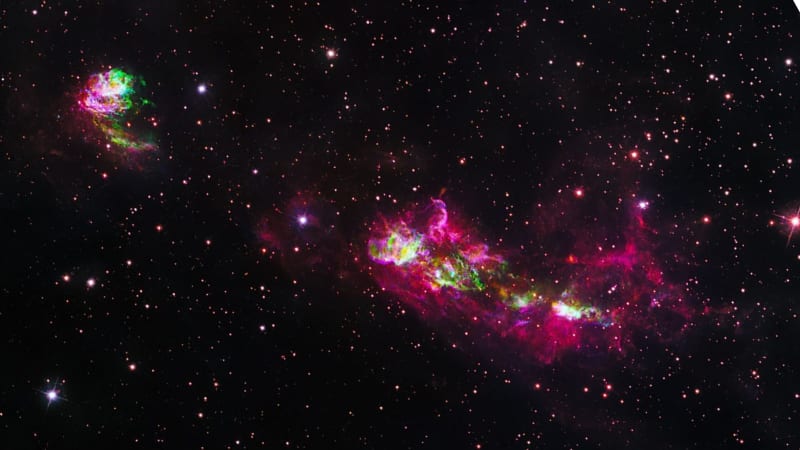
The star, called IRAS 18162-2048, sits about 5,500 light-years from Earth. It's shooting out a jet of superheated gas at a mind-bending 2.2 million miles per hour, making it the fastest stellar outflow ever recorded.
The jet stretches an incredible 32 light-years from end to end. That's roughly eight to 10 times wider than our entire solar system, making it the longest outflow from a forming star astronomers have observed.
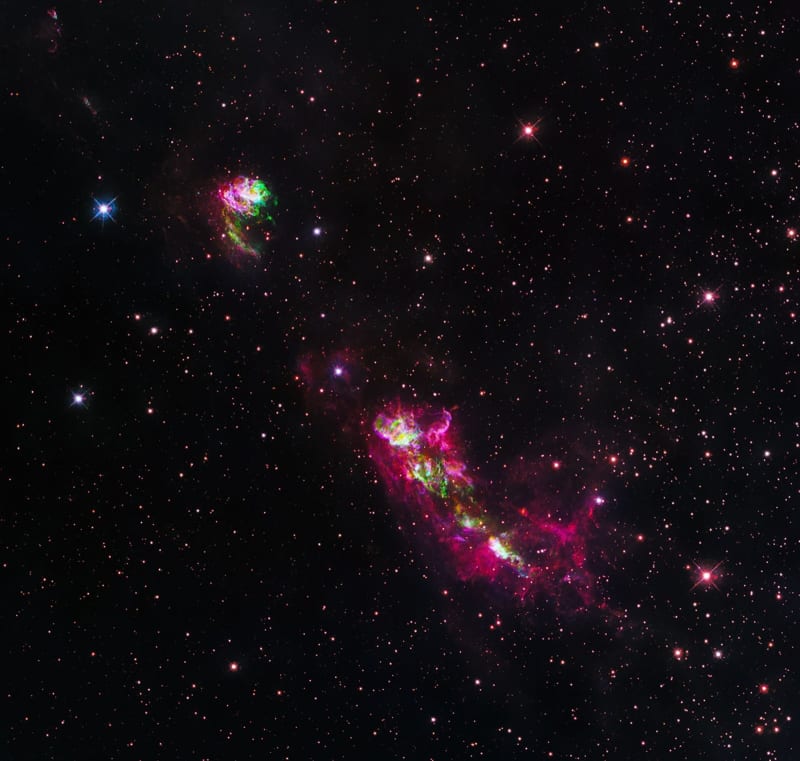
The stunning Hubble image shows two glowing clouds called Herbig-Haro objects, labeled HH 80 and HH 81, shining in brilliant neon green and pink. These colorful clouds light up when the star's powerful jet slams into gas that was blasted out earlier, creating shockwaves that heat everything up.
Baby stars are messier than you might think. As gas and dust swirl around the infant star in a disk feeding it like a cosmic baby bottle, powerful magnetic fields channel some of that material to the star's poles and launch it into space at incredible speeds.
What makes this discovery extra special is that astronomers have only seen jets like this from small forming stars before. IRAS 18162-2048 is the first massive young star ever caught driving such a powerful jet.
Why This Inspires
Hubble first spotted these glowing clouds back in 1995, but technology keeps getting better. The telescope's Wide Field Camera 3 can now detect tiny changes in these cosmic structures, helping scientists understand the violent but beautiful process of star birth.
This breakthrough proves that Hubble, now 36 years into its mission, remains essential for unlocking the universe's secrets. The aging telescope continues teaching us about how stars form, grow, and shape the cosmos around them.
Somewhere in deep space, a stellar infant is making the biggest, fastest mess imaginable, and we're lucky enough to have a front-row seat.
More Images

Based on reporting by Space.com
This story was written by BrightWire based on verified news reports.
Spread the positivity!
Share this good news with someone who needs it