India Builds First Export Container, Challenges China Grip
India just manufactured its first international-grade shipping container, cracking open a market where China controls 95% of the world's supply. With $1.2 billion in government support, the country is betting it can finally offer global shipping lines an alternative to a decades-old monopoly.
Every product you've ever ordered online that arrived by ship traveled in a steel box that almost certainly came from China.
For decades, Chinese manufacturers have built more than 95% of the world's shipping containers. The monopoly grew so powerful that in 2026, the US Justice Department indicted four Chinese container makers for allegedly doubling prices through a price-fixing cartel between 2019 and 2021.
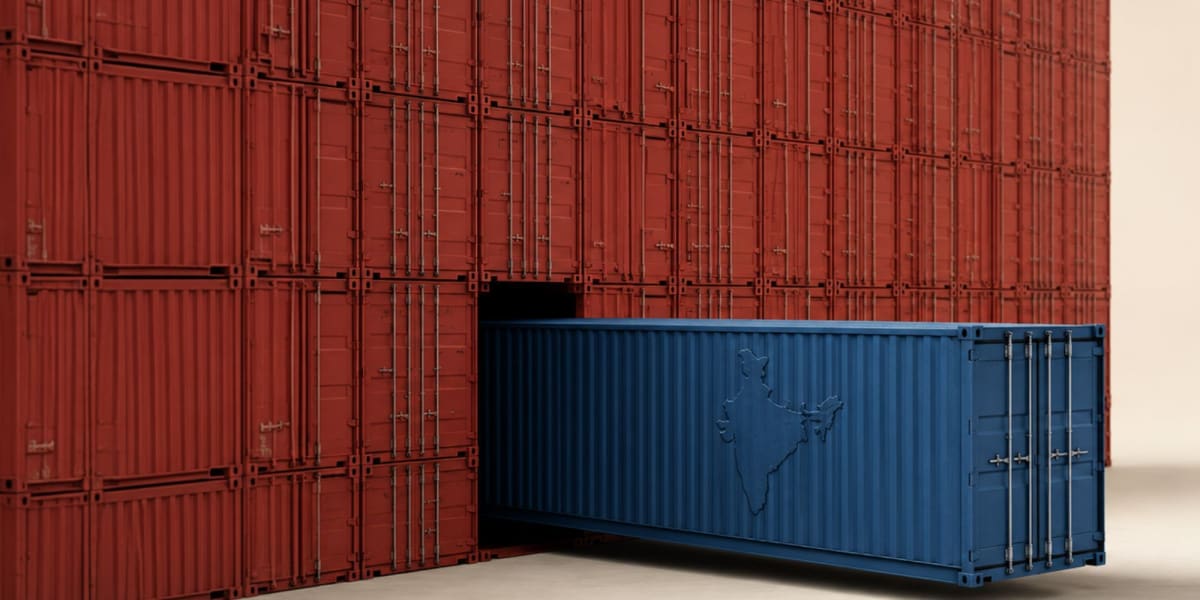
On July 3, 2026, India took its first real shot at changing that. Union Minister Sarbananda Sonowal unveiled the country's first export-grade shipping container at a Maersk depot in Dadri, Uttar Pradesh.
The box was built by DCM Shriram Group, a company better known for making fertilizers and sugar than steel containers. What makes this different from past attempts is that Maersk, the world's second-largest shipping line, actually certified it for their global fleet and immediately ordered 1,000 more.
That's a small number compared to the tens of thousands carriers usually buy each year. But it represents something bigger: proof that India can build containers that meet the strict standards global shipping demands.
The challenge isn't building a box. It's building one that can compete with China's scale and cost. A 40-foot container costs roughly $1,800 to build in China but nearly $4,200 in India, mostly due to steel prices and the efficiency of Chinese plants churning out millions of units annually.
That's where India's $1.2 billion, five-year Container Manufacturing Assistance Scheme comes in. The program will fund new plants, help bridge the cost gap, and support research to eventually build containers that can stand on their own without subsidies.
The goal is ambitious: boost India's annual capacity tenfold to 750,000 containers within five years. Vietnam has already proven the monopoly can be challenged, with Hoa Phat delivering containers to major carriers since 2025.
The Ripple Effect
This matters far beyond one steel box. Shipping containers are the invisible foundation of global trade, the standardized unit that makes modern commerce possible.
When one country controls virtually all production, they control pricing, availability, and ultimately, a crucial piece of every other nation's economy. The 2019-2021 price spike allegedly caused by Chinese manufacturers hit every company and consumer who buys imported goods.
India joining Vietnam as a credible alternative creates the possibility of real competition for the first time in decades. More manufacturers means more stable prices, better supply during shortages, and less vulnerability to a single country's decisions.
For India specifically, building containers at home instead of importing them keeps billions of dollars in the domestic economy. It creates manufacturing jobs in steel fabrication and supports the country's push to become a larger player in global supply chains.
The Maersk partnership traces back to a February 2025 meeting between Prime Minister Modi and Maersk's leadership. That kind of government-industry collaboration, combined with substantial financial support, signals India sees this as strategic infrastructure, not just another product.
One thousand containers won't dent China's dominance, but every alternative starts with a first order and a second one that follows.
More Images


Based on reporting by YourStory India
This story was written by BrightWire based on verified news reports.
Spread the positivity!
Share this good news with someone who needs it