Indian Scientist's Breast Cancer Test Cuts Costs by 78%
An Indian scientist developed a breast cancer test that predicts recurrence risk for just $780, compared to $3,500 for global alternatives. The AI-powered test helps 70% of patients safely avoid unnecessary chemotherapy.
When Manjiri Bakre lost her PhD colleague to aggressive breast cancer, she asked herself a question that would change thousands of lives: could we predict how dangerous a tumor might become while it's still small?
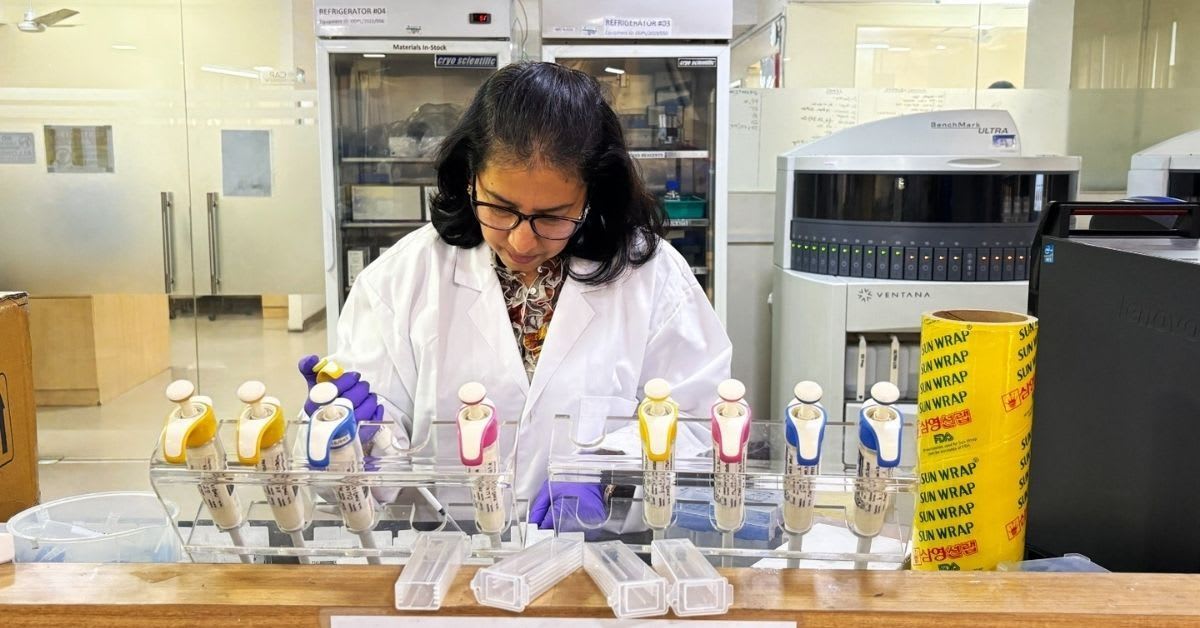
That question led the Indian Institute of Science graduate to create CanAssist Breast (CAB), a test that costs around Rs 65,000 (about $780) compared to several lakhs for international options like Oncotype DX. After 13 years of development through her company OncoStem, the test is now helping doctors make one of cancer treatment's toughest decisions.
Here's why that matters. Many early-stage breast cancer patients face chemotherapy after tumor removal, but doctors often struggle to know who truly needs it. The treatment brings devastating side effects, emotional trauma, and financial burden. Without accurate prediction tools, patients either endure unnecessary treatment or risk cancer returning.
Bakre's test uses artificial intelligence to analyze protein interactions in tumor samples removed during surgery. It generates a recurrence risk score from 1 to 100, categorizing patients as either low-risk or high-risk for cancer returning within five years. No gray area, no guesswork.
The results speak for themselves. About 70% of tested patients fall into the low-risk category, meaning they can safely skip chemotherapy without compromising their recovery. High-risk patients receive clear, evidence-backed guidance to proceed with aggressive treatment.
Dr. Garima Daga, a breast cancer surgeon who has used the test in over 300 cases, says the affordability opens doors that were previously closed. "Fewer people could afford these tests" when she relied solely on expensive foreign alternatives, she explains. Now more patients can access the clarity they need.
The science behind it took patience. From 2014 to 2016, Bakre's team built an AI algorithm that captures how proteins interact with each other in complex, non-linear ways. This was years before AI became a buzzword, when the technology was still viewed skeptically in medical circles.
The test works for early-stage breast cancer patients whose tumors are smaller than five centimeters and show specific biomarker patterns. It analyzes the same tissue already removed during surgery, requiring no additional procedures.
The Ripple Effect
Beyond individual patients, this innovation challenges a troubling reality in cancer care. Studies suggest 10 to 40% of cancer patients receive unnecessary chemotherapy, particularly in their final weeks of life. Accurate prediction tools like CAB could reshape treatment protocols worldwide, sparing patients from overtreatment while ensuring those at genuine risk receive aggressive care.
The financial impact extends beyond the test price itself. Avoiding unnecessary chemotherapy saves patients lakhs in treatment costs, prevents lost wages during recovery, and eliminates the long-term health complications that often require additional expensive care.
For a country where medical costs push millions into poverty each year, a homegrown solution that's both more affordable and equally effective represents more than scientific achievement. It's a statement that life-saving innovation doesn't have to come with an impossible price tag.
Bakre's journey from personal loss to scientific breakthrough proves that the best solutions often come from those who've witnessed the problem firsthand.
More Images
%2B(1).png)
%2Fenglish-betterindia%2Fmedia%2Fmedia_files%2F2026%2F04%2F20%2Fbreast-cancer-2026-04-20-14-31-05.jpg)
.png)

Based on reporting by The Better India
This story was written by BrightWire based on verified news reports.
Spread the positivity!
Share this good news with someone who needs it