Inside-Out Planet System Rewrites Formation Rulebook
Astronomers discovered a rare planetary system that formed backward, with rocky planets at the edge instead of the center. The find shows the universe creates worlds in more diverse ways than we ever imagined.
Scientists just found a planetary system that broke all the rules and revealed a whole new way worlds can be born.
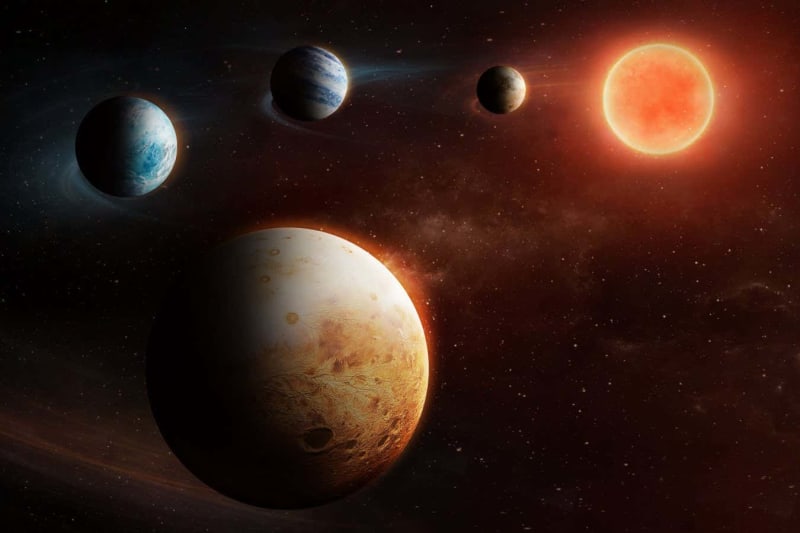
The LHS 1903 system sits about 50 light years away with four planets orbiting their star. What makes it special is that it flipped the usual recipe: instead of rocky planets hugging the star with gas giants farther out like our solar system, this one has a rocky world at its outer edge.
Ryan Cloutier at McMaster University in Canada led the team that spotted the oddball fourth planet using data from nine different observatories. The rocky world is slightly bigger than Earth but sits beyond two gaseous planets, defying everything we thought we knew about how planetary systems grow.
Most planets form together from the same swirling disc of dust and gas around a young star. That process should have given the outermost planet a thick atmosphere like its gaseous neighbors. Even if collisions or radiation stripped that atmosphere away, the inner planets would have lost their gas too.
The team ran simulations and found that traditional formation models just couldn't explain what they were seeing. The orbital patterns showed all four planets definitely came from the same disc, so something else had to be happening.
The answer surprised them. The system likely formed "inside out" with planets being born one at a time instead of all together. The first planet formed, migrated inward toward the star, then made room for the next one to develop.
This process takes longer, giving each planet time to form in a different environment as the disc around the star changes. By the time the fourth planet started forming, the gas had disappeared from the outer disc, leaving only rocky material to work with.
Why This Inspires
This discovery reminds us that the universe is far more creative than our theories predict. For decades, scientists based planet formation models mostly on our own solar system, assuming it represented the typical way worlds develop.
Finding systems like LHS 1903 opens our eyes to incredible cosmic diversity. Planets can form in stages, migrate across vast distances, and end up in configurations we never anticipated. Each unusual system we discover teaches us something new about the forces that shaped our own cosmic neighborhood billions of years ago.
The research shows that rare doesn't mean impossible. While inside-out planetary systems are uncommon, they exist and follow their own logical rules. Understanding these different pathways helps astronomers know where to look for planets that might harbor life.
Every time we point our telescopes at the stars, we find new surprises waiting in the cosmic dark, each one expanding our understanding of what's possible in this vast and wonderful universe.
More Images

Based on reporting by New Scientist
This story was written by BrightWire based on verified news reports.
Spread the positivity!
Share this good news with someone who needs it