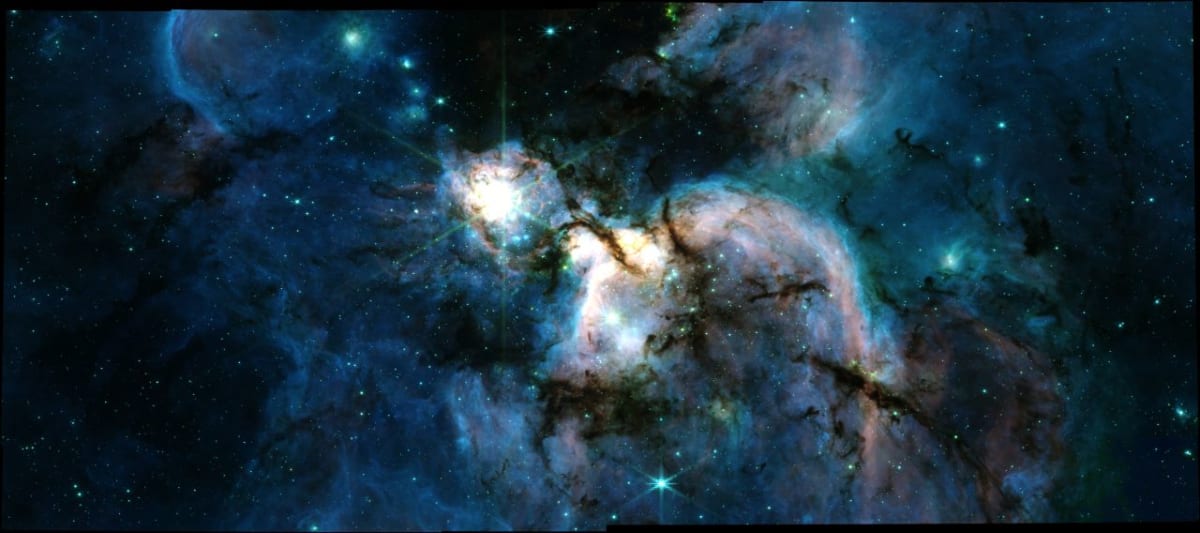
James Webb Captures Stunning "Star Factory" 17,000 Light-Years Away
The James Webb Space Telescope just revealed breathtaking new images of one of our galaxy's most active star-forming regions, showing never-before-seen details of massive stars being born. What scientists discovered in this cosmic nursery could change how we understand the universe's largest stars.
Scientists just got their clearest view ever of where the universe's most massive stars are born, and the images are absolutely stunning.
The James Webb Space Telescope focused its powerful cameras on Westerhaut 51, a massive star-forming region 17,000 light-years from Earth. Spanning 350 light-years across, this cosmic "factory" is churning out some of the rarest and most extreme stars in existence.
These O-type stars are absolute giants. With surface temperatures exceeding 30,000 kelvin, they burn blue-hot and shine with incredible brilliance. They're so rare that astronomers have struggled to understand exactly how they form and interact with the massive clouds of gas surrounding them.
Before Webb, previous telescopes could barely make out the region's details. The newborn stars remained hidden behind thick veils of cosmic dust, like trying to see through fog with a flashlight. But Webb's infrared vision cuts through that dust like nothing before it.
The new images reveal a universe of detail scientists never expected. Giant bubbles of gas expand outward from young stars. Dark filaments of dust converge like highways, feeding material into growing stellar nurseries. Massive shockwaves ripple through space where powerful jets from baby stars slam into surrounding gas.
Researchers from the University of Florida discovered something particularly surprising. North of one region called W51-IRS2, they found an unusually bright knot of material glowing in Webb's cameras. This appears to be the most energetic example ever detected of a massive newborn star's jet colliding with dense interstellar material.
The study revealed contrasting stories in different parts of the region. Around W51-IRS2, evidence suggests that energy from existing stars is actually preventing more gas from falling inward, potentially shutting down future star formation. Meanwhile, nearby W51-E is still actively pulling in material, with dust filaments geometrically converging toward it like spokes on a wheel.
Why This Inspires
This discovery reminds us that our universe is constantly creating, not static but dynamically alive with new stars being born every day. The fact that technology now allows us to witness stellar birth in unprecedented detail shows how human curiosity and innovation keep opening new windows into understanding our cosmic home.
These aren't just pretty pictures. Each new detail helps scientists understand the fundamental processes that created our own sun billions of years ago, and ultimately made life on Earth possible.
The images unveil mysteries that researchers are just beginning to explore in one of our galaxy's most productive stellar nurseries.
More Images



Based on reporting by Google: James Webb telescope
This story was written by BrightWire based on verified news reports.
Spread the positivity!
Share this good news with someone who needs it
%2Fhttps%3A%2F%2Ftf-cmsv2-smithsonianmag-media.s3.amazonaws.com%2Ffiler_public%2F29%2F49%2F29493038-7959-49c5-9352-ef74ea574dc7%2Foriginal_1.webp)