James Webb Solves Mystery of "Little Red Dots" in Space
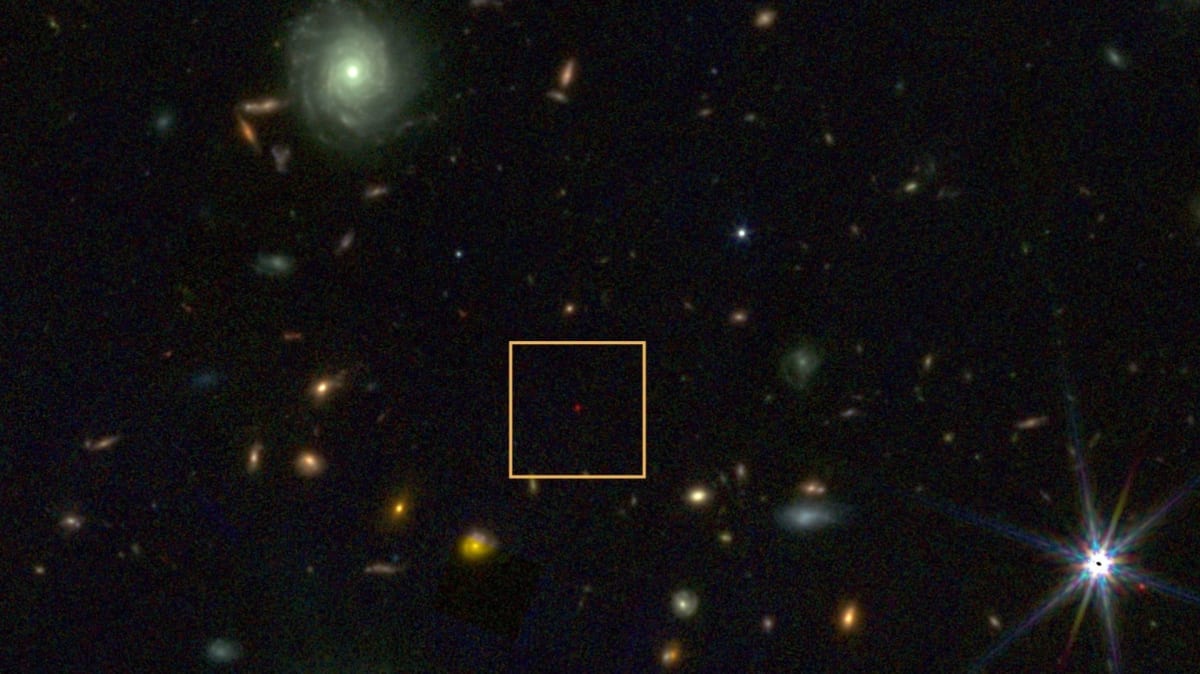
Astronomers have finally figured out what the strange red dots appearing in James Webb Space Telescope images are: black holes wrapped in glowing cocoons of gas the size of our solar system. The discovery explains one of the biggest puzzles from Webb's first years of operation.
When the James Webb Space Telescope started sending back its first images in 2022, astronomers noticed something strange: tiny red dots showing up in almost every deep space photo. They couldn't explain what they were seeing, so they just called them "little red dots" and got to work solving the mystery.
Every theory failed. If they were young galaxies, they were far too massive for a universe barely a few hundred million years old. If they were black holes eating gas, they were oddly quiet, missing the usual X-ray signals. Plus they appeared everywhere in the first billion years of the universe, then mostly disappeared by two billion years, which didn't match any known pattern.
Now a team led by astronomer Rohan Naidu has figured out at least one of them. The object, named MoM-BH*-1, is a black hole about 100,000 times the mass of our sun, completely wrapped in a shell of hydrogen gas. The gas is so dense and spread out that the entire structure glows like one giant star roughly the width of our solar system.
The breakthrough came from studying the object's spectrum, or how it emits different colors of light. Instead of the reddish color coming from dust, as everyone first assumed, the spectrum showed a dramatic cutoff at certain wavelengths. This "Balmer break" appears in middle-aged stars, but Naidu called it the deepest break ever observed in any object, far too extreme for a normal star.
The black hole itself powers the glow, doing the job nuclear fusion normally does inside stars. But nuclear fusion could never produce this kind of brightness. The object outshines the brightest known star by about 100 billion times.
Why This Inspires
This discovery represents astronomy working exactly as it should. When confronted with something completely unexpected, researchers didn't force the data to fit old theories. They stayed curious, kept measuring, and built new models until they found an answer.
Three separate research teams have now published papers pointing in the same direction. In June, a team led by Vasily Kokorev studied another dot called GLIMPSE-17775 and found more than 40 spectral lines pointing to a black hole inside a hot, dense cocoon. As the European Space Agency reported, Kokorev said part of the astronomy community is converging on a unified picture.
The discovery opens up a new chapter in understanding how the early universe worked. These "black hole stars" existed when the cosmos was only 660 million years old, helping scientists piece together how supermassive black holes formed and evolved. Questions remain about how the gas envelope forms and survives around something constantly consuming matter, but that's what makes the science exciting.
The ten billion dollar telescope is doing exactly what it was built to do: showing us things we've never seen before and challenging us to understand them. Sometimes the biggest breakthroughs start with admitting you don't know and calling something exactly what it looks like, even if that's just a little red dot.
More Images



Based on reporting by Google: James Webb telescope
This story was written by BrightWire based on verified news reports.
Spread the positivity!
Share this good news with someone who needs it