Webb Telescope May Have Found New 'Black Hole Star' Object
Scientists analyzing mysterious "Little Red Dots" from the James Webb Space Telescope believe they've discovered an entirely new type of cosmic object. The finding could explain dozens of similar puzzles scattered across the early universe.
Imagine a black hole wrapped in a glowing gas cloud the size of our entire solar system, shining with the power of 100 billion stars.
That's exactly what an international team of scientists, including researchers from DTU Space in Denmark, believe they've found hiding in images from the James Webb Space Telescope. The discovery of what they're calling a "black hole star" was just published in the journal Nature.
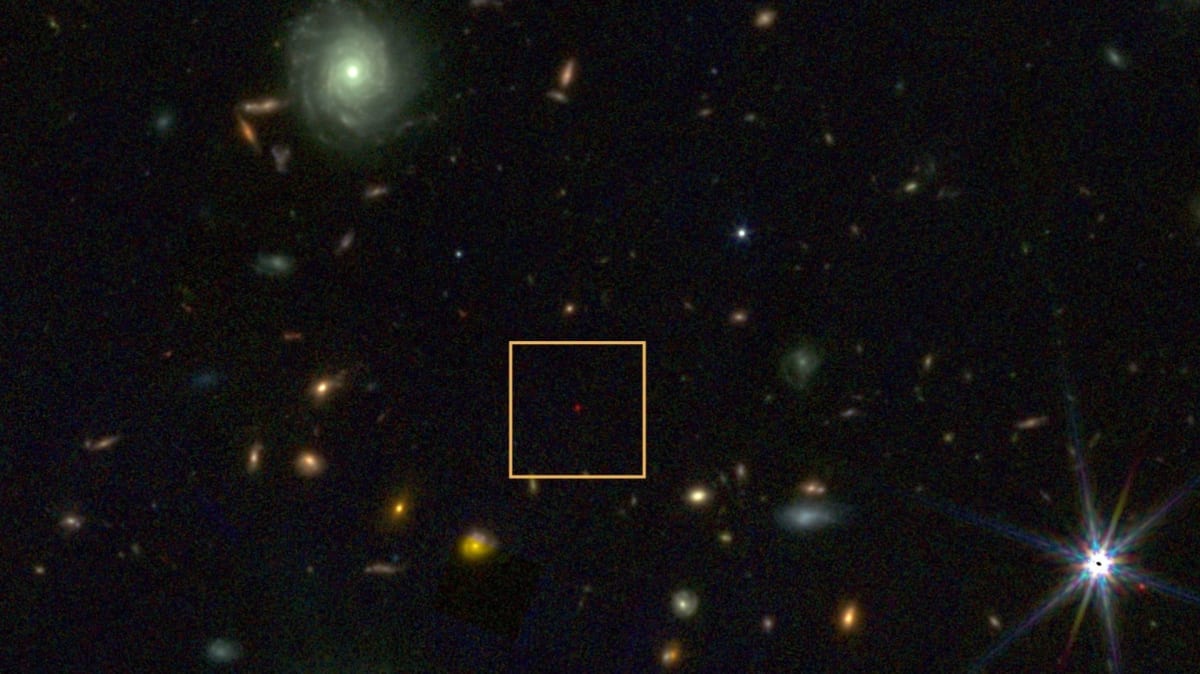
The team stumbled upon the find while searching for the universe's earliest galaxies. One tiny red dot stood out among the rest, glowing far too brightly to be an ordinary star. When they ran complex computer models to figure out what could create that distinctive red light, the answer surprised everyone.
"If our analyses hold, as we believe they do, this could be a very significant discovery," says Kasper Elm Heintz, an astrophysicist at DTU Space. "The combination we have uncovered, of a black hole and something resembling an enormous star, has never been seen before."
The object contains a supermassive black hole about 100,000 times more massive than our Sun. It's surrounded by an incredibly dense envelope of gas that makes the whole thing look like a giant star. The energy output is the real giveaway: it radiates 100 billion times more power than any known star could physically produce.
These mysterious red dots appear frequently in Webb's images of the early universe, just a few hundred million years after the Big Bang. Today, they seem to have vanished completely from our cosmic neighborhood.
Why This Inspires
This discovery shows how quickly our understanding of the universe can transform when we give scientists the right tools. The James Webb Space Telescope has only been operating for a few years, and it's already rewriting what we thought we knew about how supermassive black holes formed in the early universe.
Lead author Rohan Naidu, a NASA fellow at MIT, notes that "our picture of this type of object is evolving very rapidly." The team named their find MoM-BH-1, with the "1" deliberately chosen because they expect to find many more.
If the researchers are right, dozens or even hundreds of these black hole stars could be hiding in Webb's images, waiting to reveal secrets about the universe's first billion years. Each discovery brings us closer to understanding how the cosmos grew from its fiery birth into the vast expanse we see today.
Based on reporting by Google: James Webb telescope
This story was written by BrightWire based on verified news reports.
Spread the positivity!
Share this good news with someone who needs it