James Webb Solves Mystery of Universe's "Little Red Dots
Scientists using the James Webb Space Telescope finally cracked the case of mysterious "little red dots" spotted in the early universe. The answer involves supermassive black holes wrapped in dense clouds of glowing gas.
Astronomers just solved a cosmic puzzle that's been stumping scientists since 2022, and the answer takes us back to when our universe was barely a toddler.
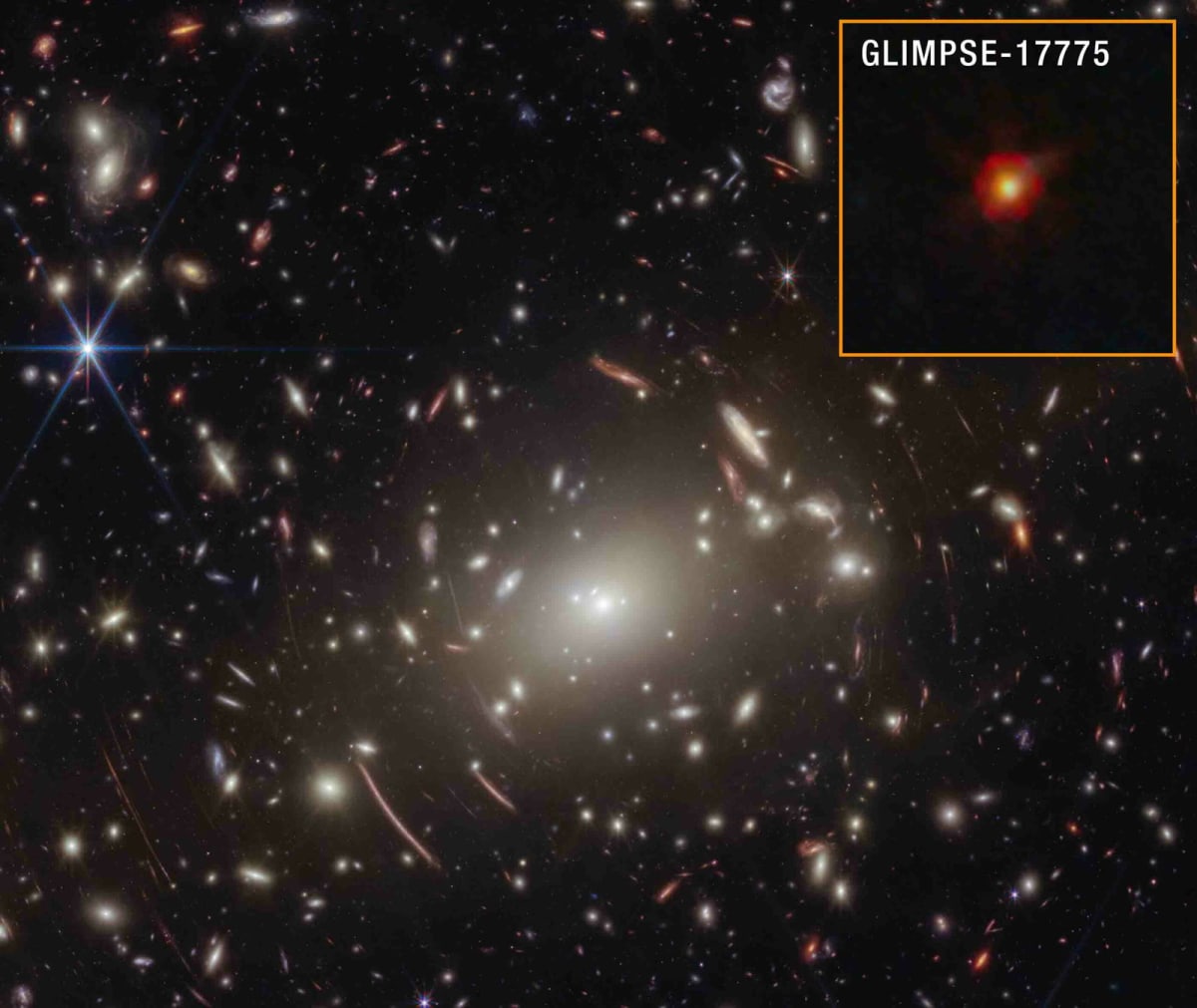
The James Webb Space Telescope captured the deepest view ever of a mysterious object called GLIMPSE-17775, one of several "little red dots" that appeared when the universe was just 1.8 billion years old. These tiny crimson specks have puzzled researchers since they first showed up in telescope images, sparking wild theories about what they could be.
Now we know the answer. They're supermassive black holes wrapped in thick cocoons of partially ionized gas, like cosmic lighthouses shrouded in fog.
The breakthrough came from a stroke of luck. Scientists were observing a distant galaxy cluster when they spotted GLIMPSE-17775 behind it, magnified by gravitational lensing like a natural cosmic magnifying glass. This happy accident gave researchers their clearest look yet at one of these enigmatic objects.
Vasily Kokorev from the University of Texas at Austin led the team that analyzed 40 spectral lines from the object, the most detailed spectrum ever captured of a little red dot. "When we saw the spectrum for the first time, it was like having all the pieces of a puzzle scattered on the floor," he said. "We picked up each piece, measured the lines, and started combining them into a mosaic."
The data revealed telltale signs that matched the black hole theory perfectly. Sixteen iron lines suggested an incredibly powerful energy source at the center. Helium absorption patterns showed something bright was wrapped in dense material. The way light scattered indicated layers of gas surrounding the core.
Even better, when scientists cross-checked with Hubble Space Telescope data, every piece of the puzzle clicked into place. A quirk that initially confused them turned out to be light interference from the host galaxy, not a problem with their theory.
Why This Inspires
This discovery shows science at its most exciting. Patient observation, fortunate timing, and careful analysis came together to answer a fundamental question about how our universe grew up. These black holes formed when the cosmos was in its infancy, teaching us how the building blocks of galaxies came together.
The findings also highlight how new technology opens doors we didn't know existed. The James Webb Space Telescope keeps revealing wonders that rewrite our understanding of space, proving that humanity's curiosity and ingenuity can unlock the deepest cosmic secrets.
Kokorev expects final confirmation within a year or two as more data comes in. For now, scientists are celebrating a major win in understanding the universe's earliest chapters and what powered the engines that helped shape everything we see today.
Based on reporting by Google: James Webb telescope
This story was written by BrightWire based on verified news reports.
Spread the positivity!
Share this good news with someone who needs it