James Webb Spots Oldest Galaxy Ever, 280M Years After Big Bang
NASA's James Webb Space Telescope discovered the most ancient galaxy ever recorded, dating back 280 million years after the Big Bang and revealing an early universe that looks nothing like scientists predicted. The find is rewriting our understanding of how quickly galaxies formed after the universe began.
Astronomers just spotted the earliest galaxy ever recorded, and it's challenging everything we thought we knew about the infant universe.
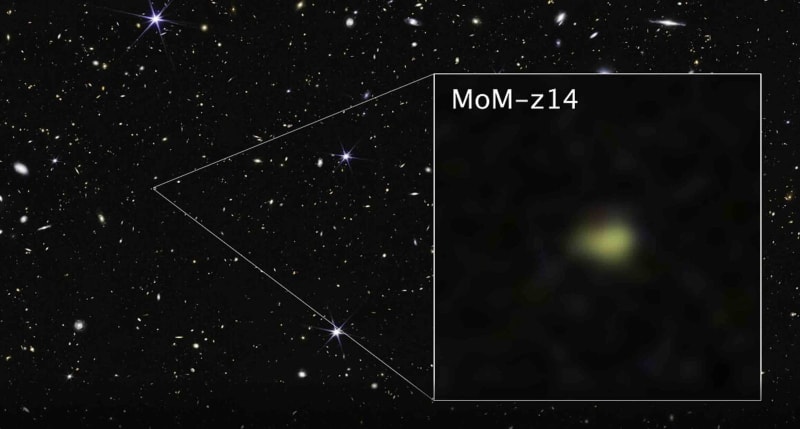
NASA's James Webb Space Telescope has detected galaxy MoM-z14, which formed just 280 million years after the Big Bang. That means the light from this distant galaxy traveled 13.5 billion years to reach us, offering a window into a time when the universe was barely 2% of its current age.
"With Webb, we are able to see galaxies farther than ever before," said lead author Rohan Naidu of MIT's Kavli Institute for Astrophysics and Space Research. "We find that the early Universe looks nothing like what we predicted, which is both challenging and exciting."
The discovery gets even more surprising. Webb is finding 100 times more bright, early galaxies than scientists expected before the telescope launched. These ancient galaxies appear larger and brighter than our current theories can explain, suggesting something fundamental about early galaxy formation needs rethinking.
The team used Webb's Near-Infrared Spectrograph to confirm the galaxy's extreme age. Co-author Pascal Oesch of the University of Geneva explained that detailed spectroscopy was crucial to know exactly what they were seeing and when it formed.
MoM-z14 is also revealing clues about one of astronomy's biggest mysteries: the Epoch of Reionization. This galaxy appears to be clearing away the heavy hydrogen fog that filled the early universe, helping scientists understand how the first stars and galaxies brought light to the cosmos.
Why This Inspires
Perhaps the most intriguing discovery involves nitrogen. Some of the oldest stars in our Milky Way show unusual nitrogen concentrations, and Webb is spotting the same pattern in these ancient galaxies. The connection suggests we can study ancient stars in our own galactic backyard like fossils while also viewing their cosmic cousins directly from that era.
"We can take a page from archeology and look at these ancient stars in our own galaxy like fossils from the early Universe," Naidu said. The dense environment of the early universe may have enabled nitrogen production in ways that don't happen today, potentially solving the puzzle.
Graduate student Yijia Li from Penn State summed up the excitement: "With Webb revealing the early Universe like never before and showing us how much there still is to discover."
The telescope continues pushing the boundaries of what we can see, taking us closer than ever to witnessing cosmic dawn itself.
Based on reporting by Google: James Webb telescope
This story was written by BrightWire based on verified news reports.
Spread the positivity!
Share this good news with someone who needs it