James Webb Spots Planet With Two Massive Gas Tails
For the first time, astronomers watched a distant planet lose its atmosphere for an entire orbit, revealing a stunning double tail of escaping helium stretching across space. The discovery shows these extreme worlds are even more dynamic than scientists imagined.
Astronomers just caught a planet bleeding into space, and it's more spectacular than anyone expected.
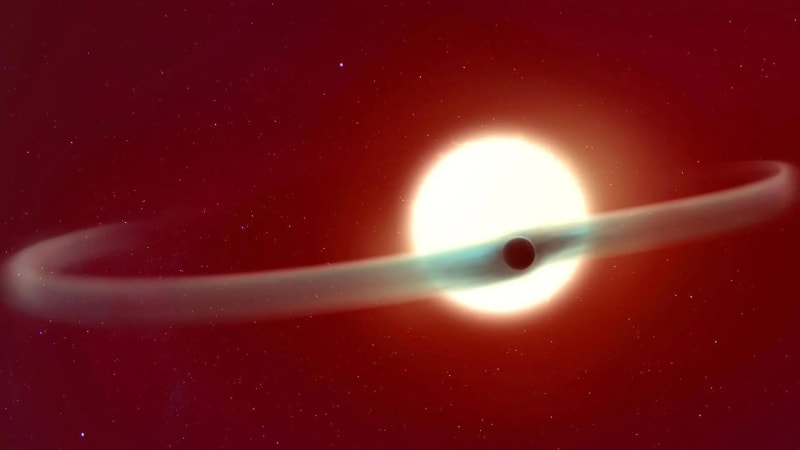
Using the James Webb Space Telescope, researchers tracked the gas giant WASP-121b for 37 hours straight as it completed a full orbit around its star. What they saw was breathtaking: two enormous helium tails, each stretching more than 100 times the planet's width, wrapping around the planet like cosmic ribbons.
WASP-121b is what scientists call an ultra hot Jupiter. It races around its star every 30 hours, so close that temperatures soar to several thousand degrees. At that heat, lightweight gases like helium simply drift away into space.
Before this observation, astronomers could only glimpse this process during brief planetary transits lasting a few hours. The University of Geneva and University of Montreal team wanted the full picture, so they used Webb's infrared camera to watch continuously for more than a complete orbit.
The double tail came as a complete surprise. One tail streams behind the planet, pushed away by radiation from the star. The other curves ahead of it, pulled forward by the star's gravity.
"We were incredibly surprised to see how long the helium escape lasted," says Romain Allart, the study's lead author. The helium signal stayed visible for more than half the planet's orbit, the longest continuous observation of atmospheric escape ever recorded.
Why This Inspires
This discovery shows how new technology keeps revealing wonders we couldn't imagine. The James Webb Space Telescope, launched just a few years ago, is already transforming our understanding of distant worlds. What looked like simple processes from afar turn out to be intricate cosmic dances of gravity, heat, and motion.
The finding also pushes scientists to think bigger. Computer models that successfully predicted simpler gas tails can't recreate this twin structure yet. Researchers now need to develop more sophisticated 3D simulations to understand how stellar winds, radiation, and gravity all work together.
Future observations will reveal whether WASP-121b is unique or if many hot planets sport these dramatic double tails. Each answer leads to new questions about how planets evolve over millions of years and what forces shape worlds beyond our solar system.
We're learning that even planets losing their atmospheres can surprise us with their beauty and complexity.
Based on reporting by Google: James Webb telescope
This story was written by BrightWire based on verified news reports.
Spread the positivity!
Share this good news with someone who needs it