James Webb Telescope Finds Galaxy 8.5 Billion Years Old
The James Webb Space Telescope has spotted the oldest "jellyfish galaxy" ever seen, revealing how the universe shaped distant worlds long before Earth existed. This cosmic discovery is rewriting what scientists thought they knew about how galaxies formed in the early universe.
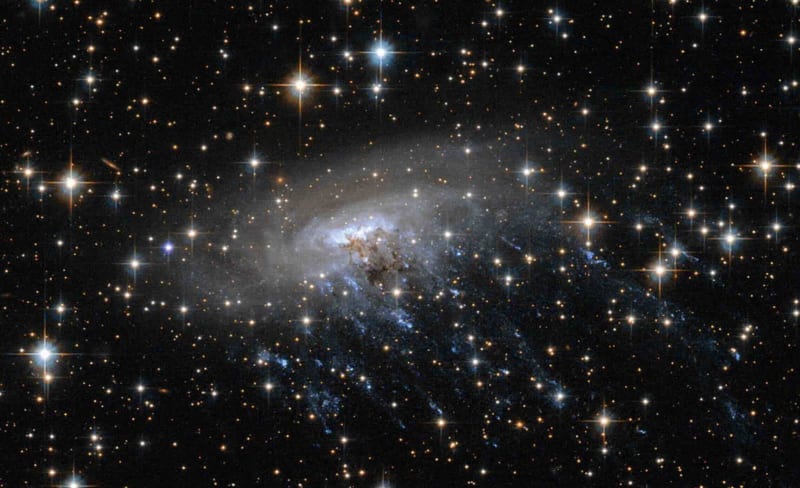
Scientists just discovered a galaxy so old it formed 8.5 billion years ago, and it looks like a jellyfish floating through space.
Researchers at the University of Waterloo made the find while combing through images from the James Webb Space Telescope. They were searching a well-studied patch of sky called the COSMOS field when something unusual caught their eye.
The galaxy has long, tentacle-like streams of gas and baby stars trailing behind it. These cosmic "tentacles" form when a galaxy travels through dense regions of space, where powerful forces strip away its gas like wind pulling at streamers.
"Early on in our search of the JWST data, we spotted a distant, undocumented jellyfish galaxy that sparked immediate interest," said Dr. Ian Roberts, a researcher at the Waterloo Centre for Astrophysics. His team was hoping to find new jellyfish galaxies, but they never expected to find one this ancient.
This galaxy existed when our universe was much younger. Earth wouldn't form for another 4 billion years after this cosmic snapshot was taken.
The Ripple Effect
This discovery is changing how scientists understand the early universe. Until now, researchers believed that 8.5 billion years ago, galaxy clusters were still coming together and conditions weren't harsh enough to dramatically reshape galaxies.
The new findings prove that the ancient universe was already a turbulent place. Dense regions of space were already sculpting galaxies into new forms much earlier than anyone expected.
The discovery also helps explain a modern mystery. Today's galaxy clusters contain many "dead" galaxies that stopped forming new stars long ago. These harsh early conditions might be the reason why.
The James Webb Space Telescope launched less than three years ago, yet it keeps revealing secrets hidden in the depths of space. Each discovery pushes back the boundaries of what we thought was possible in the early universe.
The telescope's powerful infrared vision lets it see galaxies so distant their light has been traveling toward Earth for billions of years. This makes it a time machine of sorts, showing us what the universe looked like in its youth.
As Webb continues scanning the cosmos, scientists expect many more surprises that will reshape our understanding of how galaxies grew and evolved across cosmic time.
Based on reporting by Google: James Webb telescope
This story was written by BrightWire based on verified news reports.
Spread the positivity!
Share this good news with someone who needs it