James Webb Telescope Rewrites Galaxy History
Four years of James Webb Space Telescope discoveries reveal the early universe was far busier than scientists predicted. Galaxies formed faster, shone brighter, and appeared in greater numbers just hundreds of millions of years after the Big Bang.
The James Webb Space Telescope has spent four years transforming our understanding of how the universe began, and the picture is far more vibrant than anyone expected.
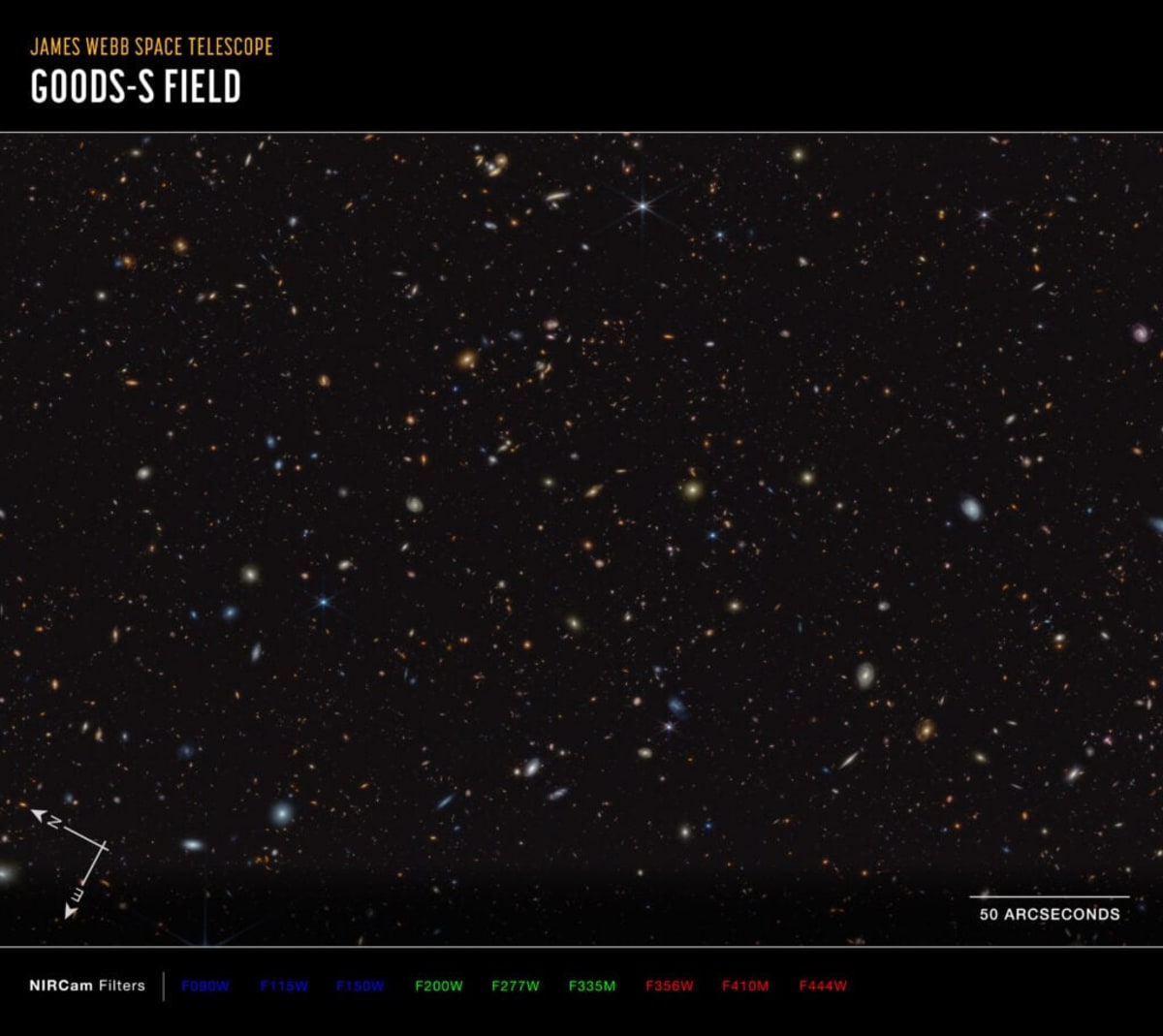
Since beginning science operations in 2022, Webb has revealed that the early universe was bustling with activity. Within just a few hundred million years after the Big Bang, galaxies were already forming stars at impressive rates, shining brighter than forecasts suggested, and appearing in far greater numbers than most models predicted.
Before Webb launched, astronomers could glimpse only a handful of extraordinarily bright galaxies near the limits of what the Hubble telescope could detect. Beyond that, scientists had to guess what the cosmic dawn looked like by extending trends measured from later periods.
Webb's infrared camera changed everything. As the universe expands, light from distant young stars stretches from ultraviolet into infrared wavelengths that Webb can capture perfectly.
The telescope didn't just find a few record-breaking galaxies. It found many bright systems across multiple survey fields, forcing scientists to reconsider how quickly the universe sprang to life.
In 2024, Webb confirmed two remarkable galaxies existing just 300 million years after the Big Bang. Their light came primarily from stars, not black holes, confirming that star formation was happening earlier and more vigorously than expected.
The findings don't overturn our fundamental understanding of cosmology. The theory of how dark matter shaped the universe still holds. Instead, Webb is revealing that ordinary matter behaved differently than scientists thought, converting gas into stars more efficiently in those early cosmic moments.
Some initial "impossible galaxies" turned out to be closer than first measured when scientists analyzed their light more carefully. But even after these corrections, the census of early bright galaxies remains higher than pre-Webb predictions suggested.
The Bright Side
These discoveries represent science working exactly as it should. Webb hasn't broken our understanding of the universe; it's refined it with real observations instead of educated guesses.
Astronomers now have actual data from the cosmic dawn instead of extrapolations. Each spectrum Webb captures replaces uncertainty with knowledge, turning the first few hundred million years of cosmic history from theory into observable reality.
The early universe wasn't the quiet, sparsely populated dawn scientists imagined—it was already alive with stellar nurseries lighting up the cosmic darkness.
More Images

Based on reporting by Google: James Webb telescope
This story was written by BrightWire based on verified news reports.
Spread the positivity!
Share this good news with someone who needs it