James Webb Telescope Uses Einstein's Gravity Trick to See Time
The James Webb Space Telescope is peering billions of years into the past using Einstein's century-old prediction about gravity as a cosmic magnifying glass. New images reveal ancient galaxies that would otherwise be invisible, appearing as warped orange arcs of light stretched around massive galaxy clusters.
A wild prediction Albert Einstein made 100 years ago is now helping scientists see some of the oldest galaxies in the universe.
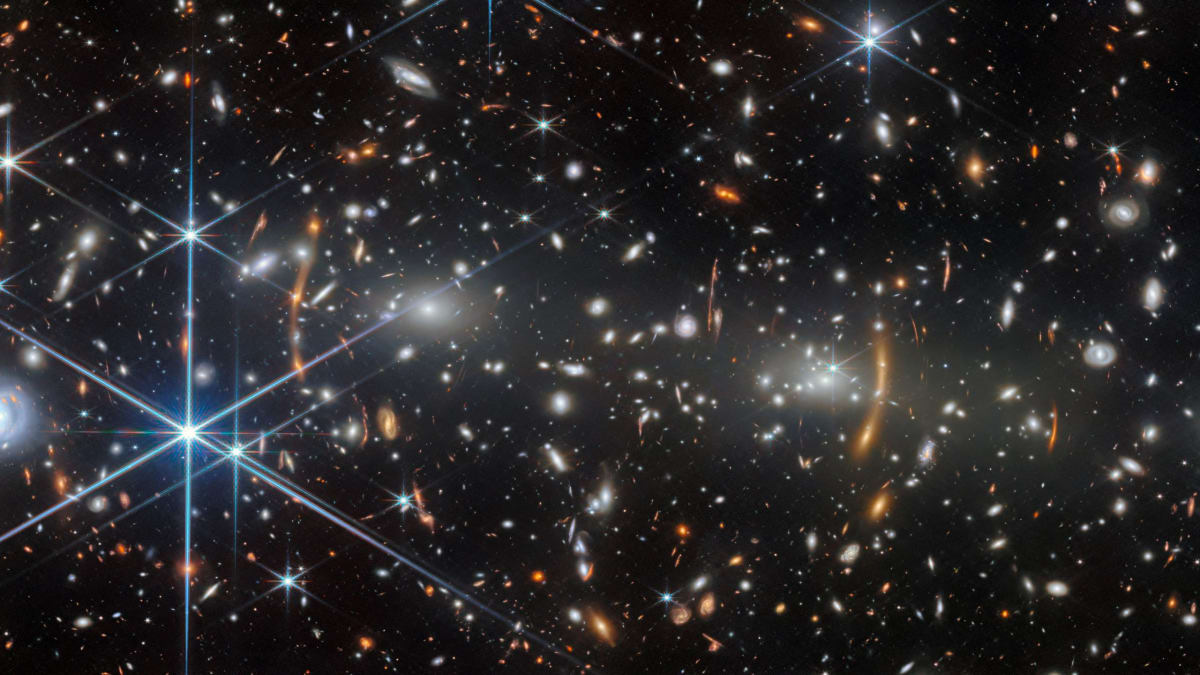
The James Webb Space Telescope just released stunning images showing gravitational lensing in action, a phenomenon Einstein theorized where massive objects bend space itself like a magnifying glass. The result is a cosmic funhouse mirror that lets astronomers peek at galaxies from less than a billion years after the Big Bang.
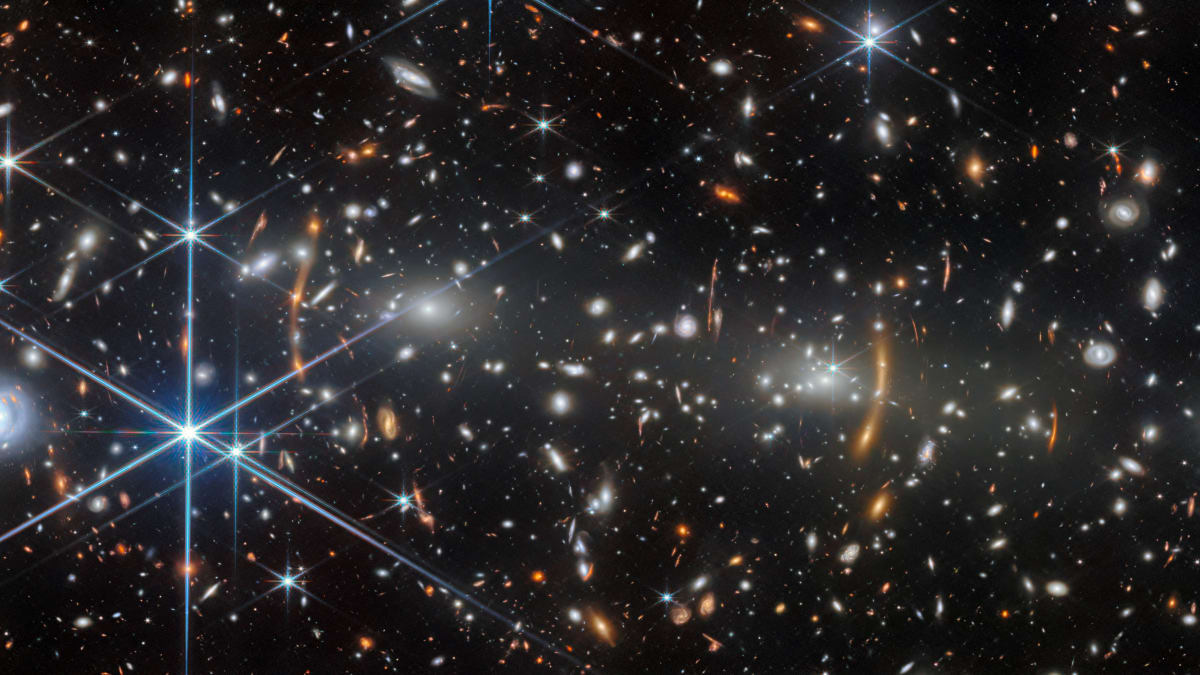
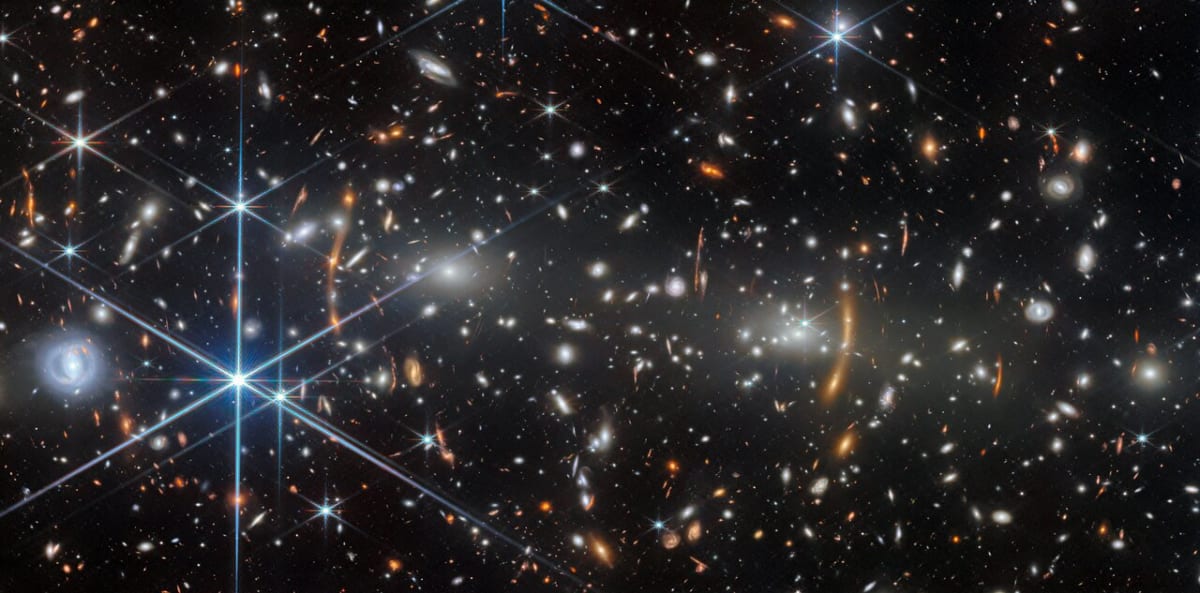
The new image captures MACS J0553.4-3342, a chaotic cluster of galaxies in the constellation Columba. Two enormous elliptical galaxies anchor the scene, each surrounded by smaller galaxies, and they're in the middle of a dramatic collision that started 4.4 billion years ago.
The galaxies have already crashed through each other once and now sit about a million light-years apart. Eventually they'll swing back together and merge into one massive galaxy.
But the real treasures hide in the stretched orange arcs framing the cluster on both sides. These aren't random smears of light. They're ancient galaxies from the dawn of time, their light bent and magnified as it travels through the warped space around the massive cluster.
Three bright dots in the left arc are actually the same galaxy appearing three times, thanks to the trippy effects of gravitational lensing. Similar duplications appear throughout the image, each one opening a window to corners of the early universe that would otherwise remain hidden.
Why This Inspires
Einstein's prediction seemed audacious in the 1920s, but it's become one of astronomy's most powerful tools. Without gravitational lensing, these faint early galaxies would be completely invisible, even to our most advanced telescopes.
The technique has already led to surprising discoveries. Scientists using James Webb have found that the oldest stars and galaxies grew larger and faster than our current theories predict they should have. These findings are forcing astronomers to rethink how the universe evolved in its earliest days.
What started as a theoretical physicist's thought experiment is now revealing secrets about cosmic history that could keep scientists busy for decades. Each warped arc of light is a time machine, carrying photons that have traveled for over 13 billion years to reach us.
The universe keeps proving that its strangest predictions often turn out to be real.
More Images

Based on reporting by Google: James Webb telescope
This story was written by BrightWire based on verified news reports.
Spread the positivity!
Share this good news with someone who needs it