Japan to Collect First-Ever Samples From Martian Moon
Japan's space agency is launching a groundbreaking mission to bring back rocks from Phobos, one of Mars' moons, which could solve decades-old mysteries about how these celestial bodies formed. The samples, expected to arrive on Earth in 2031, will be the first moon rocks ever collected from beyond our own planet.
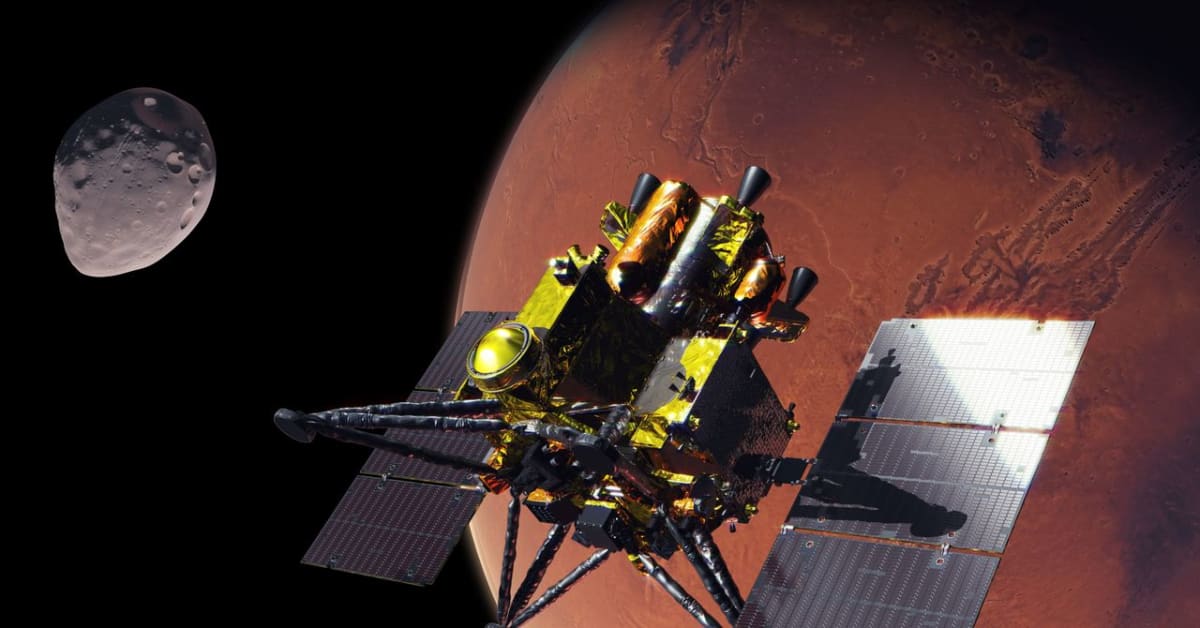
In 2026, Japan will launch a spacecraft on a seven-year round trip to Mars with an ambitious goal: bring back the first samples ever collected from another planet's moon.
The mission, called MMX (Martian Moons eXploration), will travel to Phobos, the larger of Mars' two moons, and collect at least 10 grams of rock and dust. If successful, these samples could finally answer a question that's puzzled scientists for decades: where did Mars' moons come from?
The Japan Aerospace Exploration Agency (JAXA) has two main theories to test. Either Phobos and its companion moon Deimos formed from debris after a massive asteroid slammed into Mars, or they're captured asteroids that wandered too close and got trapped by Mars' gravity. The moons look dark like water-rich asteroids, but their nearly circular orbits suggest they formed from a planetary collision.
Getting these samples home won't be easy. The spacecraft will spend a year traveling to Mars, three years exploring and collecting samples, then another year returning to Earth. The whole mission carries some serious technical challenges.
Landing on Phobos is particularly tricky. The moon's gravity is 300 times weaker than our own Moon's but 50 times stronger than asteroids JAXA has visited before. That sweet spot means the spacecraft can't use familiar landing techniques from either place.
The probe solves this problem with smart autonomous navigation. Because radio signals take up to 20 minutes to travel between Earth and Mars, the spacecraft has to make split-second decisions on its own. It will scan the surface, compare terrain to maps, detect hazards, and adjust its landing site if needed, all without human help.
Before the main spacecraft touches down, a small rover built by French and German space agencies will scout the surface for about 100 days. Once safely landed, a robotic arm will drill into Phobos while another device shoots nitrogen gas to capture the finest dust particles.
Scientists expect about 0.1 percent of the collected samples will actually be debris from Mars itself, blasted onto the moon's surface by ancient meteorite impacts. That Martian material could provide bonus insights into the Red Planet's history.
The Ripple Effect
This $345 million mission represents much more than scientific discovery. It's Japan's first Mars probe in 28 years and a testing ground for technologies that could enable future round-trip missions to Mars itself. The autonomous navigation, precision landing, and sample collection systems being developed for MMX could pave the way for humans to eventually visit the Red Planet.
The rover partnership with European space agencies also shows how international collaboration is advancing space exploration faster than any single nation could alone.
By 2031, when those precious samples arrive on Earth, they'll carry answers to fundamental questions about planetary formation and the early solar system. They might even contain traces of ancient Mars, offering clues about whether the planet once harbored conditions for life.
The MMX spacecraft lifts off from Tanegashima Space Center in October 2026, beginning humanity's next chapter in understanding our cosmic neighborhood.
More Images




Based on reporting by Wired
This story was written by BrightWire based on verified news reports.
Spread the positivity!
Share this good news with someone who needs it